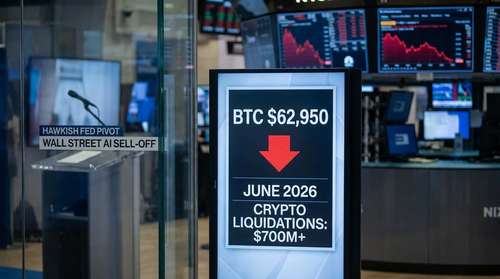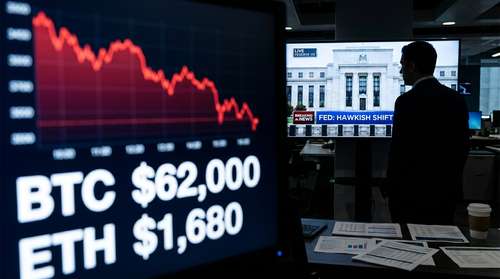

Traders are glued to the 2025 charts, convinced that the current slump is just another pre-tax season buying opportunity. But a deeper look reveals that the engine of the last bull run has been replaced by a toxic mix of energy warfare, a bursting AI bubble, and a Fed Chair who refuses to play by the old rules.
In financial markets, muscle memory is a powerful, often dangerous thing.
As Bitcoin struggles to hold the $70,000 line this Sunday—down significantly from its 2025 highs—the crypto community is collectively soothing its anxiety with a single narrative: "We’ve seen this movie before."
The script goes like this: Q1 is always choppy. It’s tax season. It’s profit-taking. Just wait for April 15th to pass, and the liquidity will return, sending us back to the moon, just like it did after the dip in early 2025.
On the surface, the charts rhyme. But underneath, the fundamental melody of the global economy has changed into a funeral march. The "April Recovery" thesis is a honey trap because it ignores three massive structural shifts that have turned 2026 into a completely different beast than 2025. We are not dealing with a technical correction; we are dealing with a triple-threat of macro "Black Swans."
From "Clean War" to "Dirty War": The Energy Trap
To understand why $70k feels so heavy right now, we must revisit the euphoria of June 2025. Operation "Am Kalavi" (The 12-Day War) was a defining moment for markets. When Israel and the US dismantled Iran’s nuclear capabilities at Fordow and Natanz, the markets reacted with a paradoxical sigh of relief.
Why? Because it was a "sterile" war in economic terms. Bunkers were destroyed, centrifuges were erased, but the oil barrels were left untouched. The world got the removal of an existential nuclear threat without paying for it at the gas pump.
2026 is the hangover. Iran, stripped of its nuclear leverage, has shifted tactics to "The Samson Option"—economic warfare. The recent disruptions at the port of Bandar Abbas and the constant, looming threat to the Strait of Hormuz have fundamentally altered the risk profile.
The market knows how to price in missiles (and usually ignores them after 48 hours). It does not know how to price in a stranglehold on global energy supply chains. The fear of oil spiking—and the resulting "sticky" inflation—is acting as a glass ceiling on Bitcoin. In 2025, inflation was falling. In 2026, energy insecurity threatens to bring it back. Bitcoin, an asset that craves liquidity, cannot breathe when inflation fears are suffocating the central banks.
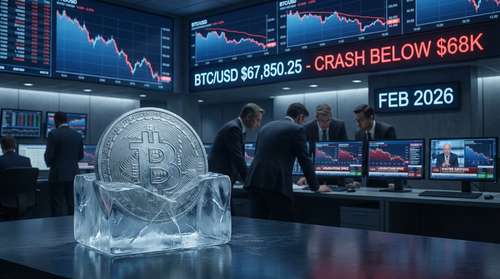
The Warsh Paradox: When the White House Wants a Dove but Gets a Hawk
The second, and perhaps most sophisticated trap for investors, sits in the Federal Reserve. Last year, the market operated under the predictable, if cautious, guidance of Jerome Powell.
This year, we are navigating the early tenure of Kevin Warsh, President Trump’s appointee. The optical illusion here is deadly: The market assumes that because Trump wants low rates and a cheaper dollar, his appointee will deliver them.
But Warsh is not a puppet; he is an ideologue. Known as a "Sound Money" advocate and a fierce critic of the Fed's ballooning balance sheet, Warsh views the asset bubbles of the last few years as a malady to be cured, not a metric of success.
While investors at $70k are praying for a rate cut to stimulate a rally, Warsh is likely looking at the sticky energy prices and thinking about tightening. The "Fed Put"—the belief that the central bank will bail out the market if it drops—is effectively dead under this new regime. Warsh is willing to tolerate short-term market pain to restore long-term monetary discipline, a stance that is terrifying for risk assets like crypto.
The Tech Wreck: The DeepSeek Aftershock
Finally, we must address the engine that actually pulled Bitcoin to its all-time highs in 2024 and 2025: The Artificial Intelligence boom. For 18 months, Bitcoin traded like a leveraged proxy for Nvidia and the Nasdaq. "Tech goes up, Bitcoin goes up."
That correlation has now become a liability. The release of the Chinese model DeepSeek was the pin that pricked the bubble. By proving that elite-level AI can be built at a fraction of the cost and compute power, DeepSeek shattered the "infinite CapEx" narrative that justified the trillion-dollar valuations of hardware manufacturers.
As tech giants slash their hardware orders in Q1 2026, the Nasdaq is undergoing a painful repricing. Because Bitcoin is still statistically tethered to Big Tech, it is being dragged down by the gravity of the bursting AI bubble. The "Tech Savior" narrative is over; Bitcoin now has to stand on its own merits, and at $70k, it is struggling to find a new thesis.
The Verdict: Don't Buy the Date, Buy the Pivot
So, where does this leave the investor holding the bag at $70,000?
The uncomfortable truth is that April is just a month on the calendar. The liquidity crunch we are facing is not seasonal; it is structural.
For Bitcoin to break out of this consolidation and reclaim its glory, we don't need tax season to end. We need a fundamental macro pivot. We need one of two things to happen:
* A Geopolitical De-escalation: A guarantee that energy supply chains are safe, crushing the inflation fear.
* A Warsh Capitulation: A moment where the market drops hard enough to force the new Fed Chair to abandon his "Sound Money" principles and turn the money printer back on.
Until one of those triggers is pulled, $70,000 is not a launchpad—it is a precarious ledge. Proceed with caution.