
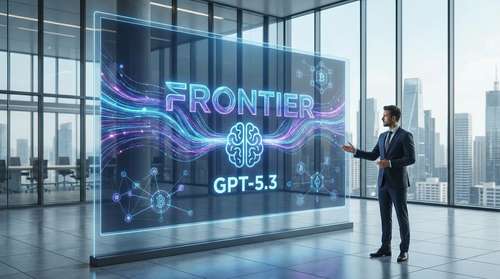
SAN FRANCISCO — February 8, 2026 — The era of the passive chatbot is officially over. In a watershed moment for the artificial intelligence industry, OpenAI has officially released the OpenAI Frontier platform and its newest flagship model, GPT-5.3-Codex. Launched just 72 hours ago, this dual release represents a fundamental pivot from AI as a tool to AI as an autonomous workforce, capable of executing complex, multi-step technical workflows without human intervention. As businesses race to integrate these GPT-5.3-Codex agents, the tech world is witnessing the rapid emergence of a decentralized AI infrastructure designed to support an economy where software builds software.
The Frontier Platform: A New Operating System for Work
While the model itself is impressive, the real game-changer is the OpenAI Frontier platform. Unlike the chat interfaces of 2024 and 2025, Frontier is designed as a management environment for autonomous AI technology. It allows enterprises to deploy "agent swarms"—teams of specialized AI workers that can collaborate on long-horizon tasks.
Early benchmarks released during the February 5th launch event are staggering. GPT-5.3-Codex reportedly scores 64.7% on the OSWorld benchmark, a test measuring an AI's ability to control a desktop computer to perform open-ended tasks. This is nearly double the score of its predecessor, GPT-5.2. "This isn't about generating code snippets anymore," said an OpenAI spokesperson during the demo. "This is about an agent that can set up its own development environment, debug its own errors, and deploy the application to the cloud while you sleep."
Self-Improving Agents
Perhaps the most startling revelation was OpenAI's admission that GPT-5.3-Codex was "instrumental in its own creation." The engineering team utilized early versions of the model to debug training runs and optimize the deployment architecture, marking a significant step toward recursive self-improvement. This capability has reignited the race with competitors, specifically Anthropic, whose recent Opus 4.6 release also touts "agent team" capabilities.
The Rise of the ‘Agentic Web’ and Decentralized Finance
The launch of Frontier has accelerated the conversation around the "Agentic Web"—an internet where the primary users are not humans, but AI agents interacting with one another. This shift is driving urgent demand for agentic AI crypto integration. As these autonomous agents begin to negotiate services, procure computing power, and trade data, they require financial rails that are as fast and automated as they are.
Traditional banking APIs are proving too slow and permissioned for this new machine-to-machine economy. Consequently, we are seeing a massive surge in decentralized AI infrastructure projects. Protocols that enable AI agent payments without bank accounts are becoming the backbone of the Frontier ecosystem.
- On-Chain Execution: Agents on the Frontier platform are already being integrated with blockchain protocols like the Agent Payments Protocol (AP2) and various Layer-2 solutions to handle micro-transactions for API usage and data access.
- Verified Autonomy: New crypto-verification standards are emerging to prove that an agent is running genuine OpenAI software, preventing "identity spoofing" in high-stakes automated transactions.
Google, Visa, and the Payment Protocol Wars
The battle to become the "central bank" for AI agents is heating up. Just days before the OpenAI announcement, reports surfaced regarding Google's Agent Payments Protocol (AP2) gaining traction among major e-commerce platforms. Simultaneously, Visa has been piloting its own Agent Authentication Standards to allow authorized bots to use credit rails.
However, the crypto-native community argues that OpenAI 2026 release highlights the need for truly trustless settlement. "If a GPT-5.3 agent needs to buy storage space from a Claude agent, they aren't going to use a credit card," notes a lead developer at a major DeFi protocol. "They will use a smart contract settlement layer that resolves in seconds." This friction between traditional finance and decentralized protocols will likely define the economic landscape of 2026.
What This Means for the Global Workforce
The release of GPT-5.3-Codex and the Frontier platform signals that the "co-pilot" era was merely a transition. We are now entering the "auto-pilot" phase. For developers, this means shifting from writing code to architecting agent workflows. For the broader economy, it signals the arrival of a new class of digital labor that operates 24/7, requires no salary, and pays for its own resources using AI agent payments.
As we move further into 2026, the question is no longer whether AI can do the job—it's how we build the economic infrastructure to support a world where the work is done by the machines, for the machines, to serve us all.