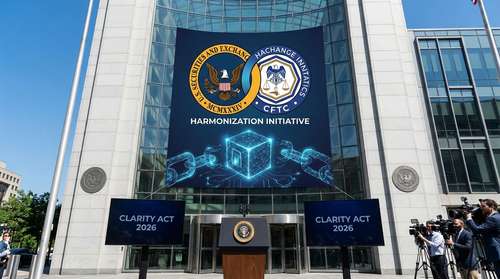
In a watershed moment for the United States digital asset industry, the Securities and Exchange Commission (SEC) and the Commodity Futures Trading Commission (CFTC) have officially launched the SEC CFTC Harmonization Initiative. This joint task force, operational as of this weekend, marks the end of years of jurisdictional turf wars and the beginning of a unified regulatory era under the pending CLARITY Act 2026. For investors and builders alike, this unprecedented collaboration promises to replace chaos with the regulatory certainty needed to cement America's status as the global crypto capital.
The Dawn of Unified US Crypto Policy 2026
The Harmonization Initiative is the direct operational outcome of the "Project Crypto" strategic alignment announced by SEC Chair Paul Atkins and CFTC Chair Michael Selig late last month. By formally combining enforcement and rulemaking resources, the agencies aim to eliminate the duplicative requirements that have long stifled innovation. This move comes just days after key provisions of the CLARITY Act 2026—formally the Digital Asset Market Clarity Act—advanced in the Senate, mandating a cooperative framework rather than the adversarial "regulation by enforcement" approach of previous administrations.
"We are drawing a bright line in the sand," said CFTC Chair Selig in a press briefing Sunday. "The days of guessing which regulator is knocking on your door are over. This initiative ensures that if you are building a digital commodity, you answer to the CFTC. If you are issuing a tokenized security, you answer to the SEC. There is no longer a gray area."
Defining the Digital Asset Taxonomy
At the heart of this initiative is the establishment of a unified digital asset taxonomy. For years, the industry has struggled with ambiguous definitions that left tokens in legal limbo. The new framework, supported by the legislative text of the CLARITY Act, categorizes assets into three distinct buckets:
- Digital Commodities: Assets that function as decentralized stores of value or utility tokens, which will fall under the exclusive jurisdiction of the CFTC.
- Tokenized Securities: Digital representations of traditional financial instruments or investment contracts, remaining firmly under SEC crypto jurisdiction.
- Payment Stablecoins: Regulated instruments pegged to fiat currencies, overseen primarily by banking regulators under the previously passed GENIUS Act, but with clear secondary market rules now enforced jointly.
Ending the Compliance Nightmare
Previously, a platform listing a new token risked lawsuits from both agencies simultaneously. The new tokenized securities framework allows for dual-registration exemptions. A platform registered as a digital commodity exchange with the CFTC can now seamlessly list limited security tokens under a special purpose broker-dealer exemption without rebuilding their entire compliance stack. This "passporting" model is expected to reduce compliance costs for US-based exchanges by up to 40% in 2026 alone.
The CLARITY Act 2026: A Legislative Backbone
While the agencies are moving fast, their authority is cemented by the CLARITY Act 2026. Building on the momentum of the House-passed version from 2025, the Senate's refined bill creates the statutory "safe harbors" that developers have demanded for a decade. Crucially, the Act provides a 24-month "decentralization grace period." During this time, token issuers can operate with limited oversight while they work toward sufficient decentralization to qualify as a digital commodity. This provision directly addresses the catch-22 where early-stage projects were deemed securities simply because they had active development teams.
Impact on Global Competitiveness
The US crypto policy 2026 shift is already having global repercussions. Major firms that fled to Dubai or Singapore in 2024 are reportedly preparing to re-domicile in the United States. With the European Union's MiCA regulation now fully implemented, the US was at risk of falling behind. However, the Harmonization Initiative goes further than MiCA by integrating DeFi (Decentralized Finance) protocols into its safe harbor provisions, provided they remain truly non-custodial.
"This is the signal the market has been waiting for," notes regulatory analyst Sarah Jenkins. "By harmonizing their rulebooks, the SEC and CFTC are effectively unlocking trillions of dollars in institutional capital that was sidelined by regulatory risk. We are looking at the maturing of the asset class in real-time."
What Comes Next?
The joint task force will release its first comprehensive guidance on "mixed-use" assets within 45 days. Market participants can expect immediate relief from pending enforcement actions that contradict the new taxonomy. As crypto regulation USA enters this new chapter, the message from Washington is clear: The United States is open for business, and the rules of the road are finally paved.