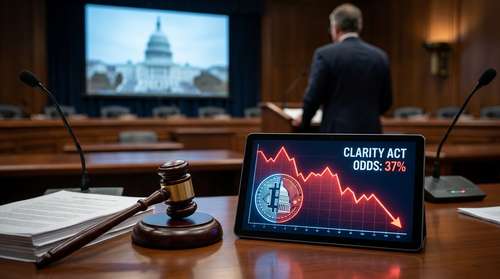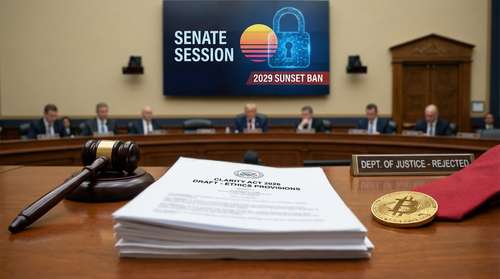
The U.S. Senate Banking Committee has officially postponed the markup of the Digital Asset Market Clarity Act (CLARITY Act), a landmark bill intended to define the future of American crypto regulation. The sudden delay, announced late Wednesday by Committee Chairman Tim Scott (R-S.C.), comes directly on the heels of a fierce public intervention by Coinbase CEO Brian Armstrong, who warned that the legislation in its current form would be "materially worse than the status quo" for the digital asset industry.
Coinbase Withdraws Support: "Better No Bill Than a Bad Bill"
The legislative process came to a screeching halt just hours before the scheduled Thursday vote when Armstrong took to X (formerly Twitter) to withdraw Coinbase's support. His critique centered on late-stage amendments that he argued would stifle innovation and hand an unfair advantage to traditional banks.
“We appreciate all the hard work by members of the Senate to reach a bipartisan outcome, but this version would be materially worse than the current status quo,” Armstrong wrote. He specifically highlighted provisions that would effectively ban stablecoin rewards—a feature that allows holders of assets like USDC to earn yield—arguing that such restrictions are designed to protect banks from competition rather than protect consumers.
Armstrong’s declaration that “we’d rather have no bill than a bad bill” signaled a fracture in the fragile coalition of industry players and lawmakers that had been working on the framework for months. With Coinbase being a dominant force in the U.S. market, their withdrawal effectively drained the bill's political momentum.
The Sticking Point: Stablecoin Rewards and DeFi Privacy
At the heart of the dispute is the treatment of stablecoin reward legislation. The draft bill proposed a prohibition on "pass-through" yields for stablecoins, a move fiercely lobbied for by the banking sector. Banks argue that allowing crypto platforms to offer interest on stablecoins without banking charters creates an uneven playing field and risks destabilizing the financial system.
However, industry advocates see this as a "moat-building" exercise. By banning rewards, the legislation would eliminate one of the primary utility incentives for holding digital dollars, potentially driving users back to traditional low-yield savings accounts or offshore platforms.
Beyond stablecoins, the CLARITY Act 2026 faced criticism for its approach to decentralized finance (DeFi). Privacy advocates warned that the bill's requirements for DeFi protocols to collect user data were technically impossible for true decentralized systems to comply with, acting as a de facto ban on the technology in the United States.
Senate Banking Committee Scrambles for Consensus
The postponement is a significant setback for Senator Tim Scott and the Senate Banking Committee, who had hoped to fast-track the bill following the passage of the GENIUS Act in 2025. The goal was to establish a comprehensive "rules of the road" framework that clarified the jurisdictional tug-of-war between the SEC vs CFTC.
Despite the delay, Chairman Scott remains optimistic. In a statement following the postponement, he emphasized that the pause provides time to "get the details right" and bring stakeholders back to the table. "Our goal remains unchanged: to ensure American leadership in the future of finance while protecting consumers," Scott stated.
What's Next for the Digital Asset Market Clarity Act?
The bill is not dead, but its path forward is now murky. Negotiations are expected to continue through January, with a potential rescheduled vote in February 2026. However, for the bill to proceed, lawmakers will likely need to make significant concessions regarding stablecoin yields and DeFi compliance—changes that risks alienating the banking lobby.
For now, the industry remains in a state of high alert. As the U.S. crypto regulation news cycle spins rapidly, the message from the crypto sector is clear: they demand a regulatory framework that validates their technology, not one that regulates it out of existence.