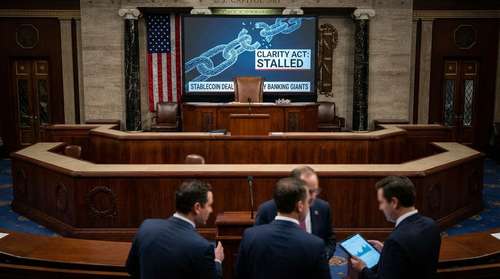
A critical legislative effort to overhaul the U.S. cryptocurrency market has hit a wall in the Senate this week. The Digital Asset Market Clarity Act (CLARITY Act), widely viewed as the final piece of the regulatory puzzle for the trillion-dollar industry, is now in legislative limbo after the American Bankers Association (ABA) formally rejected a White House-brokered compromise on stablecoin yield provisions. The impasse, confirmed by multiple sources on Capitol Hill on Thursday, effectively halts momentum for a bill that was expected to reach the President's desk by Memorial Day 2026.
Banking Lobby Torpedoes 'Rewards' Compromise
The breakdown in negotiations centers on a contentious dispute over "stablecoin rewards"—interest-like payments offered by crypto exchanges to customers who hold digital dollar tokens. While the GENIUS Act, signed into law in 2025, explicitly banned stablecoin issuers from paying interest, it left a regulatory gray area allowing third-party platforms like Coinbase and Kraken to offer "rewards" to attract users.
According to insiders close to the talks, the White House had proposed a nuanced compromise earlier this week. The administration's framework would have permitted platforms to offer modest rewards for active peer-to-peer payment balances while maintaining a strict ban on yield for passive, deposit-like holdings. However, the American Bankers Association (ABA) flatly rejected the proposal on Wednesday, arguing that any form of yield outside the banking system creates an uneven playing field.
"The banking industry has drawn a line in the sand," said a senior aide to Senate Banking Committee Chairman Tim Scott (R-SC). "They view these rewards programs as a direct threat to the $6.6 trillion in customer deposits currently sitting in traditional savings accounts. Without the ABA's sign-off, there are simply not enough votes to move the CLARITY Act out of committee."
The $6.6 Trillion Deposit War
At the heart of the standoff is a battle for the future of savings in America. Traditional financial institutions argue that stablecoins offering 4-5% APY rewards—without carrying the same regulatory burdens as FDIC-insured banks—could trigger a massive capital flight. In a letter sent to Senate leadership, the ABA warned that "regulatory arbitrage" could destabilize community banks by siphoning off low-cost deposits that fund local lending.
Crypto proponents, however, slam the banking lobby's position as anti-competitive protectionism. Patrick McHenry, the former House Financial Services Chair who now serves as Vice Chairman at Ondo Finance, criticized the banks' refusal to negotiate.
"The White House offered a reasonable path forward that protects consumers while fostering innovation," McHenry stated in an interview on Friday. "For the banking lobby to reject it outright suggests they are more interested in protecting their monopoly on interest rates than in creating a safe, regulated market structure for digital assets."
White House Frustration Mounts
The collapse of the deal is a significant blow to the administration's tech policy agenda. White House digital assets advisor Patrick Witt, who has spent months shepherding the negotiations, reportedly expressed frustration with the banks' intransigence. Sources indicate the administration viewed the CLARITY Act as essential for cementing the U.S. dollar's dominance in the digital economy against rising competition from the Euro and digital Yuan.
What the CLARITY Act Standoff Means for Crypto
The CLARITY Act was designed to finally settle the jurisdictional turf war between the SEC and CFTC, classifying most cryptocurrencies as digital commodities under CFTC oversight while leaving truly decentralized assets outside the SEC's dragnet. Its stagnation leaves the industry in a familiar state of uncertainty.
For now, the legislative freeze means:
- No Jurisdictional Certainty: The SEC and CFTC will continue their regulation-by-enforcement approach, battling over who controls the crypto spot markets.
- Rewards Programs Remain: ironically, by killing the bill, banks have ensured that the current "loophole" remains open, allowing exchanges to continue offering high-yield rewards indefinitely without the new guardrails the bill would have imposed.
- Market Volatility: Bitcoin and major stablecoin tokens reacted negatively to the news, dipping slightly as traders priced in a longer timeline for institutional clarity.
Next Steps: Is the Bill Dead?
While the current text is stalled, Senate Agriculture Committee Chairman John Boozman (R-AR) has indicated he may try to split the bill, advancing the market structure provisions separately from the toxic stablecoin elements. However, Senate leadership has signaled that a piecemeal approach is unlikely to get floor time before the midterms.
"We are in a freeze," admitted a lobbyist for a major crypto exchange. "Unless the banks come back to the table or the White House exerts significant pressure, the CLARITY Act is effectively dead until after the 2026 election cycle."