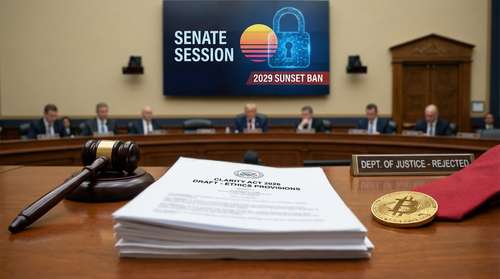
The U.S. path to comprehensive crypto regulation hit a massive roadblock this Monday morning as the Senate Banking Committee confirmed the indefinite delay of the landmark Digital Asset Market CLARITY Act. The collapse of the scheduled markup, originally set for late last week, comes after Coinbase—the nation's largest cryptocurrency exchange—publicly withdrew its support, citing "unworkable" last-minute amendments that would have stifled US crypto market reform 2026. As industry leaders scramble to salvage the legislation, the delay marks a significant setback for those hoping for regulatory certainty before the midterm elections.
Coinbase Withdraws Support Over 'Existential' Threats
The unraveling of the bill began Wednesday evening when Coinbase CEO Brian Armstrong announced the exchange could no longer back the legislation. In a move that effectively acted as a structural veto, Armstrong warned that the Senate's revised text had become "materially worse than the current status quo." His primary contention? The inclusion of what he termed "hostile" amendments that would place a de facto ban on tokenized equities and impose crushing restrictions on decentralized finance (DeFi).
"We can't support a bill that hands the industry to the banks while killing the very innovation we're trying to protect," Armstrong stated, referencing new provisions that would bar consumer platforms from offering yield on stablecoins. This specific Coinbase CLARITY Act opposition highlights a growing fracture between crypto-native firms and the traditional banking lobby, which has aggressively pushed for tighter strictures on non-bank stablecoin issuers.
The 'Hostile' Amendments: What Changed?
The Senate Banking Committee crypto bill was initially drafted to provide a clear division of authority between the SEC and the CFTC. However, sources close to the negotiations reveal that the text morphed significantly in the 48 hours leading up to the scheduled markup. The contested revisions reportedly included:
- Expanded SEC Oversight: New language that would have widened the SEC's jurisdiction over "ancillary assets," effectively weakening the CFTC's role in the proposed SEC vs CFTC authority bill.
- Stablecoin Reward Bans: A provision heavily lobbied for by the American Bankers Association that would criminalize yield payments on stablecoins by non-bank entities, a core revenue stream for many exchanges.
- DeFi Surveillance: An expansion of the Bank Secrecy Act that would require decentralized protocols to collect user data, a technical impossibility for most autonomous smart contracts.
Industry Reaction: A Fractured Coalition
The fallout has been swift. While some legacy financial institutions like Goldman Sachs—whose CEO David Solomon addressed the bill during an earnings call this weekend—have urged for continued patience, the crypto-native sector is reeling. Bitcoin, which had been rallying toward $100,000, stalled in the $95,000 range following the news, reflecting market anxiety over the sudden legislative vacuum.
What's Next for US Crypto Regulation?
Senator Tim Scott, Chairman of the Banking Committee, attempted to downplay the collapse, stating on Sunday that stakeholders "remain at the table working in good faith." However, with the CLARITY Act Senate delay now indefinite, the window for passing comprehensive crypto regulation US 2026 is closing fast. Political analysts warn that if a consensus isn't reached before the summer recess, the bill likely won't see a floor vote until after the 2026 midterm elections.
For now, the industry remains in a precarious limbo. The delay preserves the status quo—which Armstrong argued was preferable to a "bad bill"—but leaves American crypto firms vulnerable to the very regulation-by-enforcement tactics the legislation was designed to end. As negotiations restart behind closed doors, the question remains: can the Senate craft a bill that satisfies both Wall Street banks and the crypto innovators they seek to displace?