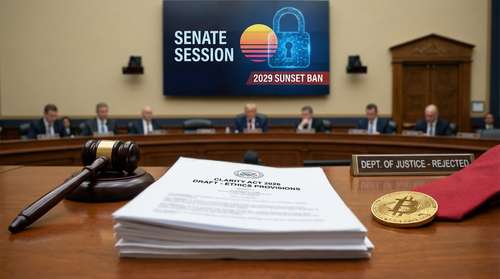
The path to comprehensive US Crypto Regulation 2026 hit a critical roadblock this weekend as the Senate Judiciary Committee formally opposed key provisions in the Digital Asset Market Clarity Act. This legislative friction marks the second major blow to the bill in under 72 hours, following the Senate Banking Committee hearing delay triggered when Coinbase CEO Brian Armstrong publicly withdrew industry support. At the heart of the new conflict is a fierce debate over crypto developer liability, with Judiciary leaders arguing the current draft unconstitutionally threatens software engineers with money-transmitter obligations.
Judiciary Committee vs. The Clarity Act
In a sharp rebuke delivered late Friday, ranking members of the Senate Judiciary Committee issued a statement criticizing the Digital Asset Market Clarity Act for its broad definition of "financial intermediaries." The committee warned that the bill’s current language fails to distinguish between custodial exchanges and non-custodial software developers, effectively placing open-source code writers in the crosshairs of federal money-laundering statutes.
This opposition aligns with the principles of the Blockchain Regulatory Certainty Act, a standalone measure reintroduced earlier this week by Senators Cynthia Lummis and Ron Wyden. The Judiciary Committee’s intervention suggests they will not allow the Clarity Act to move forward unless it incorporates specific safe harbors for developers who do not control user funds. Legal experts argue that without these protections, the US risks driving the entire DeFi sector offshore, a concern that has resonated with privacy advocates and constitutional lawyers alike.
Coinbase Pulls Support: The Stability Issue
The legislative chaos began earlier this week when Coinbase Brian Armstrong crypto bill discussions turned contentious. On Wednesday evening, Armstrong announced on X (formerly Twitter) that Coinbase could no longer support the legislation, stating, "We’d rather have no bill than a bad bill." His primary objection centers on a controversial provision inserted at the behest of banking lobbyists: a complete ban on stablecoin issuers and exchanges offering yield or rewards on payment stablecoins.
Armstrong argued that this "yield ban" is designed solely to protect traditional banks from competition, rather than to protect consumers. By preventing crypto users from earning interest on assets like USDC, the bill would strip digital assets of a key utility. Following this public withdrawal of support, Senate Banking Committee Chair Tim Scott indefinitely postponed the critical markup hearing originally scheduled for Thursday, leaving the bill’s future in limbo.
DeFi Regulation USA: The Liability Trap
Beyond the stablecoin dispute, the industry is alarmed by the bill's approach to DeFi regulation USA. The draft legislation proposes giving the Treasury Department sweeping powers to require Know-Your-Customer (KYC) compliance from decentralized protocols. Industry groups, including the DeFi Education Fund, have labeled this a "technology ban in disguise," noting that decentralized software cannot inherently collect user data.
The Judiciary Committee’s recent pushback specifically targets this overreach. Their stance is that holding software developers liable for the illicit use of their code—when they have no ability to freeze funds or reverse transactions—violates fundamental principles of due process. This creates a rare alignment between crypto industry leaders and constitutional conservatives in the Senate.
What’s Next for Crypto Legislation?
The convergence of the Banking Committee’s delay and the Judiciary Committee’s opposition has effectively stalled the bill. For the Digital Asset Market Clarity Act to survive 2026, lawmakers must now navigate a complex "trilemma": appeasing the banking lobby on stablecoins, satisfying the crypto industry on DeFi innovation, and addressing the Judiciary Committee’s constitutional concerns.
Insiders suggest the most likely path forward involves stripping the controversial stablecoin yield ban and merging the protections of the Blockchain Regulatory Certainty Act directly into the main bill. However, with the 2026 midterms looming, the window for passing such complex legislation is rapidly closing. For now, the US remains without a unified regulatory framework, and the industry continues to operate in a state of uncertainty.