
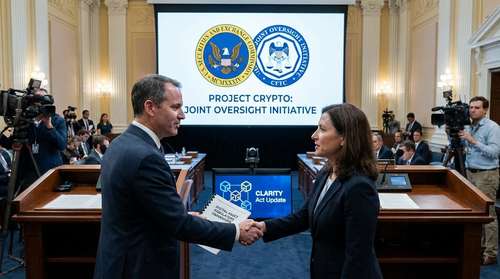
In a historic move that signals the end of a decade-long regulatory turf war, the Securities and Exchange Commission (SEC) and the Commodity Futures Trading Commission (CFTC) have officially debuted Project Crypto. This groundbreaking joint initiative, announced late last week and cemented by high-level meetings yesterday, aims to eliminate jurisdictional confusion and establish a harmonized regulatory framework for digital assets in the United States. Spearheaded by Paul Atkins, SEC Chairman, and his CFTC counterpart Michael Selig, the project represents the most significant step forward for US crypto regulation 2026 has seen to date.
The Dawn of Project Crypto: SEC and CFTC United
For years, market participants have navigated a labyrinth of conflicting rules, unsure if their assets were securities under the SEC's purview or commodities regulated by the CFTC. Project Crypto SEC CFTC changes that paradigm. Speaking from the CFTC headquarters in Washington, D.C., Chairman Atkins declared that modern markets "do not divide neatly along regulatory lines," acknowledging that the fragmented approach of the past has failed both investors and innovators.
Under this new collaborative framework, the agencies have signed a Memorandum of Understanding (MOU) to formalize their cooperation. The initiative focuses on three core pillars:
- Unified Taxonomy: Establishing clear, shared definitions for digital assets to determine automatically whether an asset is a security, a commodity, or a hybrid.
- Joint Supervision: Creating cross-agency teams to oversee dual-registered entities, reducing the compliance burden for exchanges and custodians.
- Data Sharing: Implementing real-time information sharing to detect fraud and systemic risks across spot and derivatives markets simultaneously.
CFTC Chairman Selig emphasized that this partnership supports the administration's vision to make America the "crypto capital of the world," a core tenet of Trump crypto policy 2026. "We are choosing coordination over competition," Selig stated, promising a regime rooted in data rather than enforcement-first tactics.
New Guidance on Tokenized Securities
Accompanying the launch of Project Crypto is the release of comprehensive federal guidance on tokenized securities SEC guidance. Issued on January 28 and elaborated upon this week, the guidance addresses the booming sector of real-world asset (RWA) tokenization. The SEC's Division of Corporation Finance has now formally distinguished between "issuer-sponsored" and "third-party sponsored" tokenized securities.
This clarity is vital for institutional adoption. The guidance clarifies that traditional securities laws apply regardless of the technological format, but it offers a streamlined registration pathway for assets recorded on distributed ledgers. By validating the use of blockchain technology for maintaining ownership records, the SEC has effectively greenlit 24/7 equity trading and instantaneous settlement, provided issuers meet specific custody and disclosure standards. This move is expected to unlock billions in liquidity for private equity and real estate markets moving on-chain.
White House Summit and the CLARITY Act Update
While regulators align on enforcement, the legislative battle continues. On Monday, February 2, the White House convened a high-stakes closed-door summit involving banking lobbyists, crypto executives, and administration officials. The primary agenda: resolving the stalemate over stablecoin yields that has stalled the CLARITY Act crypto update.
The Digital Asset Market CLARITY Act, which passed the House last year, faces a final hurdle in the Senate. The core conflict, as highlighted during the summit led by crypto adviser Patrick Witt, pits traditional banks against stablecoin issuers. Banks argue that yield-bearing stablecoins mimic unregulated deposits, threatening financial stability. Conversely, crypto firms contend that banning yield stifles innovation and pushes capital offshore.
The digital asset market structure bill advanced by the Senate Agriculture Committee last week attempts to bridge this gap by offering a "provisional registration" status for digital commodity intermediaries. However, the White House has set a strict deadline for industry stakeholders to reach a compromise on the yield issue, viewing the passage of the CLARITY Act as essential to cementing the success of Project Crypto.
Looking Ahead: A Defined Path for 2026
With Project Crypto now operational, the U.S. regulatory environment is shifting from hostility to harmonization. The synchronized efforts of the SEC and CFTC, backed by imminent legislative action, suggest that 2026 will be the year the U.S. finally establishes a mature, competitive market structure for digital assets. For investors and builders alike, the message is clear: the rules of the road are finally being paved.