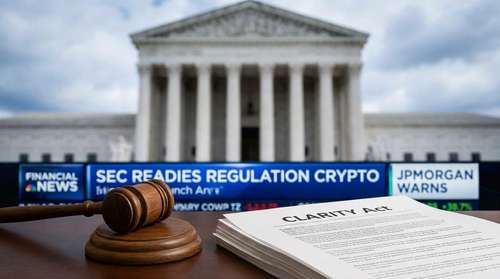
WASHINGTON, D.C. — February 1, 2026 — The U.S. crypto market was thrown into chaos this Sunday as a partial federal government shutdown officially froze the operations of key financial regulators, halting the historic joint regulatory framework that was set to launch this week. The lapse in funding, triggered after the House failed to vote on a Senate-passed spending bill before the Saturday midnight deadline, has effectively paralyzed the US government shutdown crypto contingency plans, leaving the industry in a state of suspended animation.
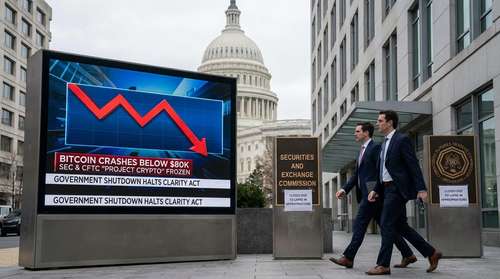
The shutdown could not have come at a worse time. Just 48 hours prior, on January 30, SEC Chair Paul Atkins and CFTC Chair Michael Selig had unveiled "Project Crypto," a groundbreaking SEC CFTC joint framework designed to finally harmonize digital asset oversight. Now, that initiative is on indefinite hold. Markets reacted violently to the uncertainty, with the Bitcoin price crash today sending the asset tumbling below the critical $80,000 support level, wiping out over $2.5 billion in leveraged positions overnight.
'Project Crypto' Frozen: Regulation in Limbo
For the first time in history, the two most powerful U.S. financial regulators were poised to speak with one voice. "Project Crypto" was intended to end the turf war between the agencies, establishing clear guidelines on which assets constitute securities and which are commodities. However, the shutdown has forced the SEC and CFTC to trigger their continuity plans, which legally prohibit them from engaging in non-essential activities—including policy-making and the rollout of new frameworks.
"We are seeing a total cessation of the regulatory dialogue we fought for," said a senior policy analyst at the Blockchain Association. "The SEC digital asset enforcement division may operate on a skeleton crew for emergencies, but the constructive work—the rule-making, the guidance, the approvals—is dead in the water until Congress acts."
This regulatory paralysis is particularly damaging for firms waiting on the SEC CFTC joint framework to clarify compliance requirements for 2026. With agency staff furloughed, applications for digital asset licenses and feedback on the new "digital commodity" taxonomy proposed by Chair Selig are now gathering dust, pushing the timeline for crypto regulation 2026 further into uncertainty.
CLARITY Act Delay: Legislation on Ice
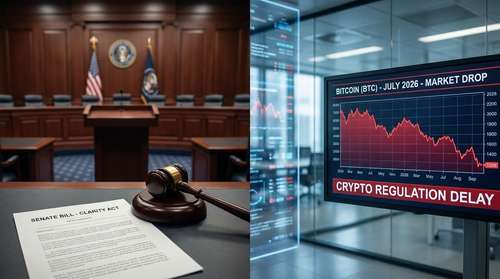
The shutdown has also thrown a wrench into the legislative machinery needed to pass the Digital Asset Market Clarity Act (CLARITY Act). Although the Senate successfully passed a funding package on Friday, the House of Representatives was in recess and is not expected to vote until Monday at the earliest. This delay has a domino effect on pending crypto legislation.
The CLARITY Act delay is a major blow to the industry. The bill, which passed the House last year and was undergoing reconciliation in the Senate, aims to codify the jurisdictional lines between the SEC and CFTC. Proponents hoped the act would be signed into law by Q1 2026. Now, with legislative days being burned on budget battles, the window for passing the CLARITY Act before the midterms is narrowing.
The Section 404 Controversy
Complicating matters is the fierce debate over "Section 404" of the act, which seeks to ban third-party yield on stablecoins. Industry lobbyists were in the middle of crucial negotiations to amend this provision when the funding lapsed. With Capitol Hill staffers furloughed or focused entirely on the budget crisis, these vital conversations have ceased, leaving the controversial provision unchallenged.
Bitcoin Price Crash: Markets React with 'Extreme Fear'
The political dysfunction in Washington triggered an immediate sell-off in global markets, with crypto taking the hardest hit. The Bitcoin price crash today saw the asset plunge 8% to trade around $78,200, its lowest point in nine months. Ethereum fared even worse, dropping nearly 10% as fears of a prolonged regulatory vacuum spooked institutional investors.
Data from Coinglass reveals that the crash liquidated $2.5 billion in long positions, marking one of the most severe deleveraging events of 2026. The Crypto Fear & Greed Index has plummeted to 14, indicating "Extreme Fear." Analysts point to the shutdown as the primary catalyst, noting that the stalling of the SEC CFTC joint framework removed the bullish narrative of "regulatory clarity" that had supported prices earlier in the year.
"The market hates uncertainty," explained a lead analyst at Coinbase Institutional. "Investors were pricing in a smooth rollout of Project Crypto. Instead, they got a government shutdown and a regulatory blackout. Until the House reconvenes and passes a budget, we expect volatility to remain high."
What's Next for Crypto Regulation in 2026?
All eyes are now on the House of Representatives, which is scheduled to return on Monday to vote on the Senate's funding deal. If the measure passes, agencies could reopen by Tuesday, potentially allowing the SEC digital asset enforcement and policy teams to resume work on Project Crypto. However, if the agreement falls apart, the U.S. could face a prolonged shutdown similar to the record-breaking closures of the past.
For now, the crypto industry is left waiting. The promise of 2026 being the "year of clarity" is currently being held hostage by budgetary brinkmanship. As the shutdown drags into its second day, the message to investors is clear: Washington's dysfunction is still the biggest risk to your portfolio.
Stay tuned to Cryptovot news for real-time updates on the government shutdown and its impact on your digital assets.