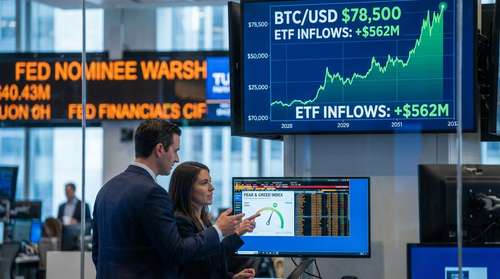
Bitcoin (BTC) has staged a decisive recovery, reclaiming the $78,500 level on Tuesday, February 3, 2026, after a turbulent weekend that saw prices plunge to a new 2026 low. The Bitcoin price rebound comes on the heels of a massive wave of institutional crypto buying, with Spot Bitcoin ETFs recording a staggering $562 million in daily inflows—effectively snapping a multi-day streak of capital exits. This resurgence suggests that while retail sentiment remains shaken, institutional players are aggressively stepping in to defend key Bitcoin support levels 2026.
Institutional Giants Trigger $562 Million Inflow Reversal
The primary catalyst for today’s recovery is a sharp reversal in institutional sentiment. After days of bleeding capital, U.S. Spot Bitcoin ETF inflows surged to $562 million on February 2, marking the largest single-day buying spree since mid-January. Data from SoSoValue reveals that Fidelity’s FBTC led the charge with $153 million in net inflows, signaling that major asset managers viewed the weekend dip as a prime accumulation opportunity.
"The ETF bid that supported prices in 2025 appeared to evaporate last week, but yesterday's flows confirm that institutions are still eager to buy the dip," noted a market analyst from BitBull Capital. This influx of capital was crucial in stabilizing the market, which had been teetering on the edge of a deeper correction. The sudden pivot from outflows to massive inflows indicates that the $74,500 level is being fiercely defended by smart money, even as the broader market remains cautious.
The Kevin Warsh Effect: Fed Nomination Rattles Markets
The weekend's volatility was exacerbated by macroeconomic shockwaves, specifically surrounding the Kevin Warsh Fed nomination. On January 31, President Trump officially nominated former Fed Governor Kevin Warsh to succeed Jerome Powell as Federal Reserve Chair when his term expires in May 2026. The announcement initially triggered a "risk-off" sentiment, as Warsh has historically been viewed as a hawk who might prioritize fighting inflation over stimulating growth.
However, the narrative quickly shifted as investors digested the news. While Warsh has criticized the Fed's "easy money" policies in the past, his deep ties to Wall Street and advisory role at Anchorage Digital suggest a nuanced understanding of digital assets. The market's initial knee-jerk reaction—dumping risk assets—has given way to a more calculated assessment, with Bitcoin market analysis today suggesting that certainty in leadership is ultimately preferable to speculation.
Fear and Greed Index Hits "Extreme Fear"
Despite the price recovery, sentiment remains fragile. The crypto fear and greed index plunged to a reading of 14 ("Extreme Fear") over the weekend, levels not seen since the 2018 bear market depths. This extreme bearishness often acts as a contrarian signal; when the crowd is fearful, seasoned investors tend to accumulate. The divergence between retail panic and institutional accumulation is currently at its widest point in months.
Technical Outlook: Defending the $74,500 Floor
From a technical perspective, the bounce from the $74,500 low is significant. Analysts at Compass Point have identified this zone as a critical line in the sand. A failure to hold this level could have opened the door to an "air pocket" drop toward $60,000, a range where long-term holders have historically accumulated.
Currently trading near $78,662, Bitcoin faces immediate resistance at $80,000 and $81,000. Reclaiming these levels is essential to confirm that the local bottom is in. Conversely, if the Bitcoin price rebound loses momentum, the $74,500 support will likely be tested again. With over $2.2 billion in leveraged positions liquidated during the drop, the market has been flushed of excess leverage, potentially paving the way for a more organic move upward.
What’s Next for Bitcoin in Q1 2026?
As the market stabilizes, all eyes are on the interplay between macroeconomic policy and crypto-specific flows. The successful defense of $74,500 combined with the resumption of ETF inflows paints a bullish picture for the short term. However, with the transition at the Federal Reserve looming and global liquidity conditions tightening, volatility is expected to remain a constant companion.
For now, the institutional "Green Light" has been flashed. The question remains whether this momentum can push Bitcoin back above the psychological $80,000 barrier, or if this is merely a relief rally in a broader downtrend.