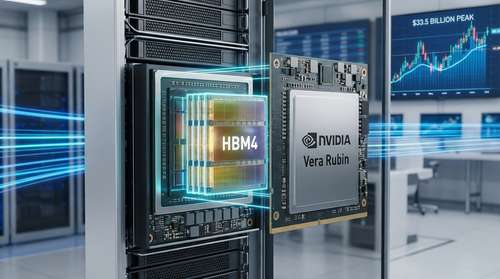
The AI supercycle is entering uncharted territory this spring. Following a breathtaking first quarter, Micron Technology has officially crossed the rubicon into the next era of computing. The Boise-based semiconductor giant has launched volume shipments of its 36GB High Bandwidth Memory 4 (HBM4), effectively laying the foundation for the highly anticipated NVIDIA Vera Rubin GPU platform.
This milestone triggers a massive shockwave across the broader AI hardware infrastructure ecosystem. Just weeks ago, Micron set Wall Street ablaze by posting a staggering $33.5 billion revenue guidance for its fiscal third quarter. That single quarterly projection eclipses the company's full-year earnings from any year prior to 2024. Memory is no longer just a commodity; it has become the ultimate strategic asset dictating the pace of global AI development.
The Power Behind the NVIDIA Vera Rubin GPU
Scaling compute power for trillion-parameter models requires exponentially faster data delivery. Without a highly optimized memory architecture, even the most advanced next-gen AI chips sit idle waiting for data.
Micron's new 36GB 12-High HBM4 stack answers this bottleneck directly. Operating at pin speeds exceeding 11 Gb/s, the module delivers an unprecedented 2.8 terabytes per second of bandwidth—a 2.3x jump over previous HBM3E iterations. Perhaps more critically for power-hungry data centers, it achieves this massive throughput with a 20% improvement in energy efficiency.
When integrated into the rack-scale NVIDIA Vera Rubin GPU architecture, specifically the NVL72 systems, this memory density becomes transformative. The Rubin platform represents extreme hardware-software co-design. A single rack connects 72 Rubin GPUs and 36 Vera CPUs using the sixth-generation NVLink switch. The entire system targets an aggregate bandwidth of up to 22 TB/s. That raw throughput is exactly what developers need to push complex mixture-of-experts (MoE) models and agentic reasoning pipelines toward real-time execution speeds.
Smashing Records: Micron's $33.5 Billion Supercycle
You cannot accurately evaluate AI stock trends 2026 without looking at the memory sector's explosive balance sheets. Driven by aggressive hyperscaler spending, Micron reported an astonishing 196% year-over-year revenue surge in its fiscal second quarter, bringing in $23.86 billion.
But the $33.5 billion forecast for Q3 is what fundamentally shifts market expectations. Alongside this revenue spike, gross margins have expanded past 74%, upended by persistent supply shortages and fierce competition to lock in hardware contracts. SK Hynix, Samsung, and Micron are all operating at maximum capacity, aggressively funding cleanroom expansions in New York, Idaho, and across Asia.
Investors tracking the sector see a distinct decoupling of AI hardware from traditional cyclical tech trends. The structural deficit in AI-capable memory hardware is expected to last through at least the end of the decade. Consequently, securing a steady flow of high-margin silicon has become the deciding factor for market leadership. Wall Street views the successful high-volume shipment of Micron HBM4 as proof that the company can execute on ultra-premium components while maintaining dominant manufacturing yield rates.
Hyperscale Constraints and the Rise of DePIN Compute Hardware
While centralized giants like Amazon, Meta, and Microsoft pour billions into localized facilities, physical constraints are forcing a parallel infrastructure evolution. A single hyperscale data center now regularly demands upwards of a gigawatt of continuous power. Finding the real estate and the electrical grid capacity to support these AI factories is creating severe delays.
This hard physical limit has accelerated the adoption of DePIN compute hardware (Decentralized Physical Infrastructure Networks). By early April 2026, the DePIN market valuation surged past $11 billion, shifting completely from a niche crypto experiment into a highly practical enterprise utility.
The decentralized model operates with striking efficiency. Hardware operators plug their resources into the network and earn tokens for maintaining uptime, effectively crowdsourcing the massive capital expenditures normally required for data center construction. For AI developers, the raw GPU pricing on these decentralized networks can run 45% to 60% cheaper than traditional cloud equivalents. As centralized server racks consume the bulk of new memory upgrades, DePIN ecosystems capture the massive overflow demand. They provide a critical, cost-effective release valve for researchers and enterprise startups priced out of dedicated Rubin cluster time.
A Strategic Shift in Global Computing
We are witnessing the physical reconstruction of enterprise computing. The transition from general-purpose servers to accelerated, AI-specific infrastructure requires entirely new ecosystems. Micron's ability to synchronize its memory production roadmap with NVIDIA's aggressive release cycle ensures that processing pipelines stay saturated.
Every newly manufactured component points toward a highly orchestrated environment. Alongside HBM4, Micron is also rolling out the industry's first PCIe Gen6 data center SSDs and 192GB SOCAMM2 memory modules designed specifically to support Vera CPU nodes. This hardware synergy isn't just an incremental upgrade. It is the core foundation required to unlock the next massive leap in machine intelligence.