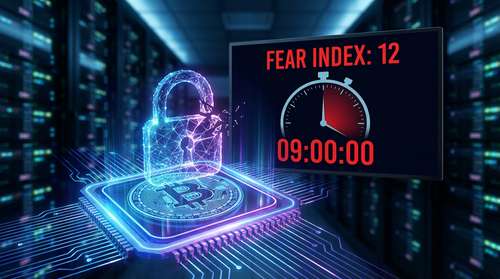
The cryptocurrency world is facing an unprecedented existential crisis this week. Following the release of highly anticipated theoretical models by Google Quantum AI researchers on March 31, 2026, the crypto market fear index—widely known as the Fear & Greed Index—has plummeted to a devastating 12. This signals Extreme Fear across the entire sector. The catalyst for this panic is a groundbreaking report demonstrating that advanced quantum computers could shatter the network's cryptographic safeguards in under nine minutes. As the reality of the Bitcoin quantum threat sets in, the industry is scrambling to evaluate the urgency of upgrading infrastructure before the foundation of decentralized finance is irrevocably compromised.
The 9-Minute Window: How Shor's Algorithm Threatens Cryptography
The core security model relies heavily on the Elliptic Curve Digital Signature Algorithm (ECDSA) and the secp256k1 curve. For years, the consensus was that cracking this complex mathematics would require millions of physical qubits, placing the danger decades away. The new Google whitepaper shatters that timeline, revealing that a superconducting quantum computer using roughly 500,000 physical qubits—translating to less than 1,500 logical qubits—could derive a private key from a public key in approximately nine minutes.
This specific timeframe is catastrophic for the current protocol architecture. The network's average block time is ten minutes. In what researchers classify as an on-spend attack, a bad actor with a cryptographically relevant quantum computer (CRQC) could intercept a transaction while it sits in the public mempool waiting for confirmation. By deriving the sender's private key within that nine-minute window, the attacker broadcasts a fraudulent, replacement transaction with a much higher miner fee. This effectively steals the funds before the legitimate transfer ever finalizes on-chain. By successfully executing Shor's algorithm Bitcoin networks become instantly vulnerable to real-time theft.
Billions at Risk: The Vulnerable Coin Supply
While the nine-minute mempool interception dominates recent Bitcoin security news, the immediate and perhaps larger danger lies in at-rest attacks. Approximately 6.5 to 6.9 million coins are currently resting in vulnerable, older address formats like P2PK (Pay-to-Public-Key). Because these early formats permanently expose the public keys on the blockchain, attackers do not even need to beat the ten-minute block clock to execute a theft.
A staggering portion of these exposed assets—roughly 1.7 million coins—belong to the Satoshi Nakamoto era. If a state-sponsored actor or rogue organization achieves quantum supremacy, they could quietly drain these dormant wallets. Furthermore, security experts warn of the Harvest Now, Decrypt Later strategy currently in play. Bad actors are actively scraping exposed public keys and stockpiling intercepted network data. Once adequate quantum hardware comes online, they will retroactively decrypt these files, proving the threat model is active today.
Market Fallout: Quantum Computing Crypto 2026 Panic
The reaction to the quantum computing crypto 2026 breakthroughs has been swift and brutal. Institutional investors are rapidly re-evaluating their risk exposure. Venture capitalist Chamath Palihapitiya recently warned that the timeline for a viable quantum threat has violently compressed from a comfortable 25 years down to perhaps five to seven years. He noted that malicious entities would likely target these decentralized assets first to trigger widespread market collapse.
It is crucial to distinguish between the two pillars of cryptography involved here. The SHA-256 hash function used for Proof-of-Work mining remains secure; Grover's algorithm provides only a minor speedup against it, meaning viable quantum mining is still centuries away. The acute vulnerability lies entirely within the digital signature schemes. Despite this nuance, the panic is fueled by the notoriously sluggish nature of decentralized governance. Upgrading the core protocol requires overwhelming consensus among developers, miners, and node operators.
The Race for a Quantum-Resistant Blockchain
Migrating to a quantum-resistant blockchain is no longer an optional roadmap item; it is a strict necessity. With technology giants reducing quantum resource requirements by a factor of 20 and urging a sector-wide shift by 2029, developers are accelerating debates around critical network upgrades.
Potential Defense Strategies
Cryptographers are actively reviewing several technical defenses to mitigate the impending crisis:
- BIP 360 and Commit/Reveal Schemes: Proposals to shield public keys until the exact moment of final confirmation, neutralizing the mempool interception vulnerability entirely.
- SPHINCS+ and SLH-DSA: Integrating NIST-approved, post-quantum hash-based signatures. While highly secure, these dramatically increase transaction data sizes, which could congest the network.
- Forced Migration Protocols: Highly controversial governance proposals to quarantine or destroy quantum-insecure coins (like the Satoshi stash) if owners fail to migrate them to safe addresses before the quantum threshold is breached.
The post-quantum cryptography transition will undoubtedly define the next era of decentralized finance. As computational power continues its exponential ascent, the industry must adapt rapidly. The newly discovered nine-minute vulnerability serves as a stark reminder that in the relentless arms race between cryptographic defense and quantum mechanics, mathematics grants no extensions.