
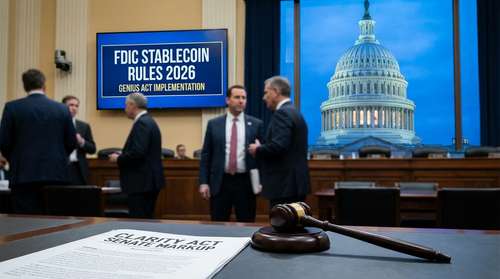
The long-awaited transformation of the American cryptocurrency sector has officially arrived. Today, April 7, 2026, brought dual milestones that fundamentally redraw the lines of financial regulation. Following months of tense negotiations, the Senate Banking Committee crypto panel has officially scheduled a hearing to amend and advance the landmark market structure bill. Simultaneously, federal regulators are formalizing the exact pathways that will allow traditional banks to mint digital currencies, rolling out the highly anticipated FDIC stablecoin rules 2026.
A Historic Milestone: The CLARITY Act Senate Markup
For the digital asset industry, the upcoming CLARITY Act Senate markup represents a crucial breakthrough. The legislation, which narrowly avoided collapse earlier this year, aims to replace the SEC's controversial regulation-by-enforcement approach with bright-line statutory boundaries dividing jurisdiction between the SEC and the CFTC.
According to Senator Bill Hagerty (R-Tenn.), the bill is expected to advance out of committee and reach the full Senate floor by the end of April. The path wasn't easy. Lawmakers spent weeks deadlocked over yield provisions. Traditional banks argued that allowing trading platforms to pay interest-like rewards on stablecoins would trigger massive deposit flight, effectively hollowing out local lending reserves. A recent compromise brokered with the White House finally cleared the logjam, striking a delicate balance between consumer incentives and banking sector stability.
Protecting Code Over Intermediaries
Beyond resolving the yield dispute, the draft legislation creates a safe harbor for decentralized finance (DeFi). The bill protects peer-to-peer activity and software developers by focusing regulatory efforts on corporate control rather than open-source code. Centralized intermediaries that interact with DeFi protocols will face targeted risk-management and anti-money laundering standards, preventing illicit finance while keeping legitimate blockchain activity onshore.
Banks Enter the Fray: GENIUS Act Implementation
While lawmakers debate market structure on Capitol Hill, the Federal Deposit Insurance Corporation is firmly establishing its grip on the digital dollar. The agency's actions today mark a critical phase of GENIUS Act implementation, finalizing the procedures for insured depository institutions to issue payment stablecoins through approved subsidiaries.
Enacted in July 2025, the Guiding and Establishing National Innovation for U.S. Stablecoins (GENIUS) Act mandates that only "permitted payment stablecoin issuers" (PPSIs) can operate within the United States. The newly finalized rules dictate how bank subsidiaries must apply for this coveted PPSI status. Crucially, the FDIC drew a hard line on consumer protections: payment stablecoins will not be eligible for pass-through deposit insurance, and issuers are strictly prohibited from marketing their digital assets as being backed by the full faith and credit of the federal government.
Strict Standards: New Stablecoin Reserve Requirements
The regulatory guardrails accompanying this rollout are intentionally uncompromising. To prevent another devastating algorithmic collapse, federal banking agencies have synchronized their rules to ensure immediate, absolute liquidity.
The new stablecoin reserve requirements mandate transparent, dollar-for-dollar backing. Issuers must hold these reserves completely separate from their corporate funds. Regulators demand highly liquid assets, such as U.S. cash, short-term treasury notes, and government money market funds. A minimum of 10% of these assets must be convertible to cash daily, while 30% must be convertible weekly.
Beyond the reserves, PPSIs face hefty operational hurdles. New issuers must maintain at least $5 million in high-quality tier 1 equity. Furthermore, they are required to lock away an operational backstop equivalent to 12 months of operating expenses. Missing these capital minimums for two consecutive quarters triggers a mandatory, fee-free wind-down of the asset, forcing the issuer to redeem all outstanding stablecoins. State-chartered issuers circulating more than $10 billion must either notify regulators to transition to federal oversight within 360 days or stop issuing entirely.
The Missing Piece in the US Digital Asset Framework
This week's developments offer the most consequential crypto regulation news since the creation of Bitcoin. For years, digital asset firms have threatened to move offshore due to fragmented oversight and overt regulatory hostility. Now, Washington is rapidly assembling a cohesive US digital asset framework that marries institutional safety with technological innovation.
If the CLARITY Act clears the Senate next month, the American crypto ecosystem will finally have a predictable statutory rulebook. Paired with the GENIUS Act's banking pathways, traditional finance and decentralized technology are no longer operating on completely parallel tracks—they are actively converging. Wall Street banks can now safely spin up digital asset subsidiaries, while native crypto startups have a clear, realistic roadmap for federal compliance.
The clock is ticking ahead of the November 2026 midterm elections. Failing to pass the current legislation by May could severely imperil its chances of becoming law this year. However, with bipartisan momentum building and federal regulators releasing actionable guidelines, the U.S. is closer than ever to securing its position as the global capital for responsible digital innovation.