
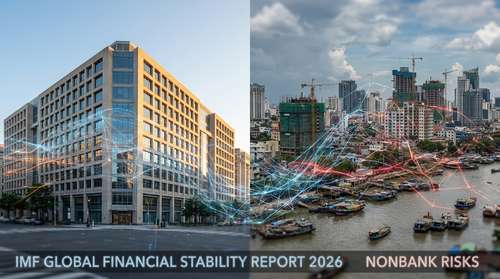
The International Monetary Fund (IMF) officially launched Chapter 2 of its highly anticipated IMF Global Financial Stability Report 2026 on Tuesday, April 7, 2026. Setting the tone for global finance ahead of the upcoming Spring Meetings in Washington, the release spotlights a seismic shift in how capital moves across borders. Traditional banking dominance is giving way to alternative lenders, fundamentally altering the trajectory of emerging market capital flows. While this evolution brings unprecedented opportunities for developing economies, it also unearths new systemic fragilities that have regulators on high alert.
The April 2026 GFSR: Tracking Capital to Emerging Markets
The newly released analytical chapter, titled "The Growing Role of Nonbank Investors in Emerging Market Finance," reveals that cross-border portfolio flows to developing nations have skyrocketed since the global financial crisis. Investment funds, private credit firms, and hedge funds now drive a massive share of external capital flowing into these regions.
By expanding financing options beyond traditional commercial banks, nonbank entities provide a crucial lifeline for emerging and developing economies (EMDEs). This influx of capital supports infrastructure development, bolsters market liquidity, and funds corporate expansion in regions historically starved of credit. However, the IMF warns that relying heavily on these agile investors introduces distinct vectors of volatility.
The Double-Edged Sword of Liquidity
Unlike conventional banks, which operate under strict reserve requirements and enjoy direct access to central bank backstops, alternative lenders are highly sensitive to sudden macroeconomic shifts. When global interest rates fluctuate, these funds can orchestrate rapid capital withdrawals. This "hot money" dynamic threatens to destabilize local currencies and disrupt sustained market access for emerging market borrowers exactly when they need stability the most.
Shadow Banking Vulnerabilities and Systemic Risk
The rise of alternative lending frameworks has amplified nonbank financial institutions risk to unprecedented levels. As outlined in the latest global financial stability news, the IMF categorizes the current environment as a balancing act between robust external financing and looming shadow banking vulnerabilities.
These entities often operate with elevated leverage and significant liquidity mismatches. When market stress occurs, highly leveraged nonbank entities may be forced into fire sales of emerging market debt to meet margin calls or investor redemptions. Because these institutions are deeply interconnected with both traditional banking systems and sovereign bond markets, localized distress can easily cascade into a broader macro-financial crisis.
Tobias Adrian, Financial Counsellor and Director of the IMF's Monetary and Capital Markets Department, alongside other key policymakers, emphasize that the financial ecosystem must implement robust guardrails. Establishing comprehensive stress-testing for nonbanks and improving data transparency are non-negotiable steps to prevent a localized credit crunch from metastasizing globally.
The Macroeconomic Crypto Impact
Beyond traditional private credit, the broader context of the report underscores the increasingly systemic nature of digital assets. The macroeconomic crypto impact on developing nations is transforming how citizens and corporations navigate currency volatility. In economies facing high inflation or strict capital controls, digital assets offer an alternate exit ramp, effectively bypassing domestic monetary policy.
While this provides individual financial autonomy, it severely complicates central bank operations. The growing integration of tokenized assets and stablecoins into the shadow banking infrastructure blurs the lines between decentralized networks and institutional finance. If a major crypto-asset platform experiences a liquidity crisis, the contagion could easily spill over into the traditional nonbank sector, exacerbating capital flight from emerging markets.
Regulatory Push: Securing the Financial Future
The stark warnings contained within the April 2026 GFSR culminate in an urgent call for enhanced cross-border regulatory cooperation. Individual nations cannot police global capital flows in isolation. The IMF recommends a synchronized approach to oversight, demanding that policymakers adapt their frameworks to capture the realities of the modern financial ecosystem.
- Enhanced Monitoring: Regulators must develop tools to track leverage and liquidity mismatches across the nonbank sector in real-time.
- Policy Coordination: Harmonizing cross-border digital asset regulations to mitigate the macroeconomic crypto impact on vulnerable currencies.
- Crisis Management: Designing specialized liquidity backstops that can address nonbank distress without encouraging moral hazard.
As the global economy anticipates a projected 3.3% growth rate for 2026, the message from the IMF Spring Meetings is clear. The architectural foundations of international finance have evolved. Ensuring sustained growth in emerging markets now requires a regulatory apparatus just as agile and sophisticated as the nonbank investors it seeks to govern.