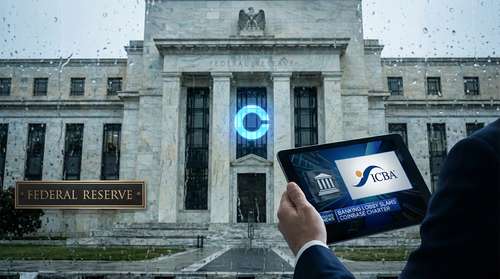
Just days after the Office of the Comptroller of the Currency (OCC) granted conditional authorization for the Coinbase National Trust Charter, traditional banking advocates are mounting a fierce counteroffensive. On Monday, the Independent Community Bankers of America (ICBA) officially launched a campaign aimed at halting the newly approved OCC crypto bank license. The federal authorization, which allows Coinbase to operate under a unified national framework, significantly reduces the regulatory burden of state-by-state licensing while enabling nationwide custody and market infrastructure. However, traditional financial institutions view the move as a dangerous precedent that could destabilize the American financial system.
The Landmark OCC Decision
On April 2, 2026, the OCC formally granted conditional approval to establish the Coinbase National Trust Company. This non-insured national trust bank, headquartered in New York, operates as a wholly owned subsidiary of Coinbase Global Inc. The primary goal of the new entity is to provide a single, streamlined regulatory umbrella for institutional custody, trading integration, and fiduciary digital asset services. Instead of navigating a fractured patchwork of fifty different state licenses, the exchange can now theoretically serve institutional clients across the country under one comprehensive federal roof.
The Mechanics of the New Entity
The operational scope of the new trust company is strictly defined. The filing outlines a nationwide, digital-only operating model tailored exclusively for institutional clients, eliminating the need for a physical branch network. By bringing its operations under federal purview, the firm aims to capture a larger share of the traditional finance market that requires federally supervised custodians to hold digital assets securely.
Why the ICBA Opposes the OCC Crypto Bank License
The ICBA crypto opposition was swift and uncompromising. ICBA President and CEO Rebeca Romero Rainey publicly condemned the agency's decision, stating that the approval is a "grave mistake that will only serve to put U.S. consumers at risk". The prominent trade group argues that nonbank fintech entities are exploiting regulatory mechanisms to gain the immense benefits of a banking charter without absorbing the heavy compliance, capital, and oversight requirements that traditional community banks must endure.
Systemic Risk and Statutory Authority Concerns
The escalating battle of Coinbase vs banks fundamentally revolves around statutory authority and risk management. The ICBA asserts that the OCC lacks the statutory authority to expand non-fiduciary trust powers to crypto entities. Furthermore, community lenders claim that the crypto exchange's application demonstrates flawed risk controls and profitability challenges. If a highly complex digital asset custodian were to face insolvency, the banking lobby warns that the OCC's receivership framework remains entirely untested for an institution of this scale and technological complexity.
Coinbase Defends Its Federal Trust Bank Charter
Executives at the digital asset exchange have forcefully pushed back against the narrative that they are skirting financial regulations. Greg Tusar, Co-CEO of Coinbase Institutional, emphasized that the conditional approval is the culmination of years of intensive investment in compliance and direct engagement with regulators. He sought to clarify the strict boundaries of the new federal trust bank charter.
"Coinbase is not becoming a commercial bank," Tusar stated unequivocally following the approval. "We will not be taking retail deposits. We will not be engaging in fractional reserve banking".
For the exchange, securing this charter is about standardizing market infrastructure. As the primary custodian for over 80% of the world's digital asset ETFs, the company handles massive volumes of institutional capital. A unified federal framework provides the regulatory confidence that hedge funds, asset managers, and institutional partners require to safely allocate funds to the digital asset sector. Tusar noted that the OCC charter was designed precisely to provide clear oversight over assets in safekeeping.
The Shifting Landscape of US Crypto Regulation 2026
The conditional approval represents a watershed moment for US crypto regulation 2026. Following the initial filing on October 3, 2025, the digital asset industry watched closely to see how federal authorities would balance technological innovation against systemic risk. The firm joins a growing list of digital asset companies, including Circle, Ripple, and Paxos, that have aggressively pursued federal approvals to legitimize their operations at the highest levels of American finance.
This ongoing development is rapidly reshaping digital asset custody laws. Historically, crypto companies operated alongside the traditional financial system rather than within it. Now, by moving toward the center of federal banking oversight, digital asset firms are forcing a convergence between decentralized technology and legacy finance. The OCC's preliminary nod signals a willingness to integrate crypto custodians into the national framework, provided they meet stringent pre-opening conditions.
While the conditional approval is a massive victory for digital asset advocates, it is not a final operating license. The company must successfully navigate a rigorous pre-opening examination, finalize key personnel hires, and satisfy all regulatory conditions before officially opening the doors of its national trust bank. As the debate over systemic risk and consumer protection continues to intensify, the outcome of this institutional clash will likely dictate the operating terms for every major digital asset custodian in the United States over the coming decade.