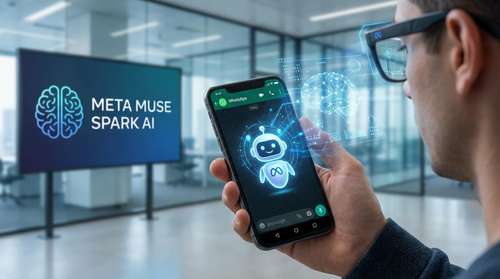
In one of the most consequential tech developments of the year, Meta has officially taken the wraps off Meta Muse Spark AI. Announced on April 8, 2026, this massive technological leap marks a sharp departure from the company's previous open-source Llama series. Built entirely from scratch over the last nine months, the highly anticipated multimodal system positions Meta to directly challenge industry heavyweights like OpenAI and Google. By delivering real-time visual reasoning and parallel multi-agent capabilities directly to billions of users, the company is attempting to redefine the global standard for digital assistants.
The Engine Behind the Pivot: Superintelligence Labs
The driving force behind this transformation is the newly formed Superintelligence Labs Meta. Led by Chief AI Officer Alexandr Wang, the elite division has orchestrated a top-to-bottom overhaul of the tech giant's neural architecture. Following the lackluster reception of Llama 4 last year, leadership poured staggering resources into this pivot, scaling the company's 2026 capital expenditures toward an estimated $135 billion. To train the Muse lineup, engineers utilized a colossal computing cluster powered by over 500,000 NVIDIA Blackwell B200 GPUs.
What makes this debut particularly disruptive is the strategic shift in distribution. Unlike its predecessors, the foundational framework of this new system remains closed-source. Executives assert this proprietary approach allows for tighter ecosystem integration and enhanced safety protocols. Early testing reflects a massive leap in capability; the system scored an impressive 89.5% on the graduate-level GPQA Diamond reasoning benchmark, placing it firmly in the same top-tier performance bracket as GPT-5.4 and Claude Opus 4.6.
Transforming the Social Ecosystem
The most immediate consumer impact is surfacing through the highly anticipated WhatsApp AI update rolling out this week. Rather than operating as an isolated chatbot, the assistant now functions as an embedded, context-aware utility. Users can snap a photo of a crowded shelf in a grocery store, and the system can instantly identify products, calculate nutritional values, and log the data—all natively within the chat interface. The system naturally processes text, image, and voice inputs without relying on clunky third-party plugins.
Upgraded Creative Workflows
Simultaneously, the new Instagram Muse Spark features are designed to seamlessly blend content consumption with advanced creation. The platform now empowers creators with sophisticated tools, radically lowering the technical barrier for high-quality production. Furthermore, a deeply integrated shopping mode pulls styling insights directly from real-time social trends. If a user spots a jacket in a Reel, the assistant can immediately identify the brand, verify local inventory, and execute the purchase without the user ever leaving the app. The AI is designed to actively credit and pull from actual content creators, establishing a more transparent attribution loop.
Pioneering Multi-Agent Reasoning
One of the most notable generative AI breakthroughs found in this release is its varied operational states. By default, the platform utilizes an "Instant" mode tailored for rapid, everyday queries. For more complex logic, the system relies on a "Thinking" mode that unpacks and analyzes visual and text data sequentially.
Even more ambitious is the incoming "Contemplating Mode," which introduces parallel sub-agents to consumer devices. If you are planning a complex corporate retreat, the architecture allows one agent to aggressively source flights, a second to map out team-building itineraries, and a third to compare hotel rates simultaneously. The system then synthesizes these separate tasks into one unified response. This multi-agent structure represents a massive step forward, directly rivaling the extended reasoning tools currently locked behind enterprise subscriptions like Gemini Deep Think and GPT-5.4 Pro.
To support these intense computing tasks safely, Meta integrated a rigorous risk framework. Researchers subjected the model to extensive adversarial testing, ensuring the parallel agents refuse high-risk requests while remaining highly capable across rigorous scientific, mathematical, and coding assessments.
A Vision for Personal Superintelligence
The underlying thesis of the Mark Zuckerberg AI announcement is clear: Meta is building the foundational layer of "personal superintelligence". This initiative goes far beyond parsing text prompts. It is about creating a system that natively understands a user's environment, an advantage that compounds exponentially when paired with hardware like the Ray-Ban Meta smart glasses. This spatial perception allows the assistant to literally "see" alongside the user, answering immediate health, diet, or navigation questions based on real-world context.
While rivals continue to gatekeep their most advanced tools, deploying a sophisticated multimodal AI model 2026 directly into the world's largest social platforms is a calculated gamble. The implications for global e-commerce, automated content creation, and daily communication are immense. As this rollout expands beyond its initial US launch, the technology sector is watching closely. If successful, this ecosystem-wide integration could permanently crown Meta as the undisputed leader in consumer-facing artificial intelligence.