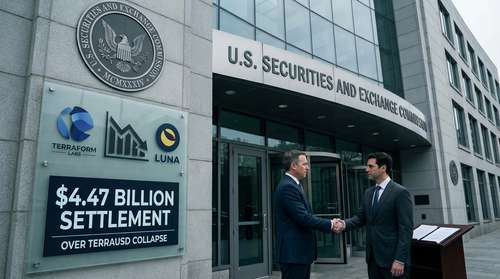
A U.S. federal judge has officially approved a staggering $4.47 billion Terraform Labs settlement, bringing a decisive end to the high-profile enforcement action brought by the Securities and Exchange Commission (SEC). This landmark ruling closes one of the darkest chapters in cryptocurrency history, holding the company and its embattled founder, Do Kwon, accountable for the devastating implosion of the UST stablecoin. By imposing record-breaking financial judgments and strict professional bans, regulatory authorities are signaling an aggressive new era of accountability for the digital asset sector.
Breakdown of the Digital Asset Fraud Penalties
The financial scope of this resolution is practically unprecedented in the cryptocurrency space. To resolve the SEC crypto lawsuit, the court mandated a combination of massive disgorgements, prejudgment interest, and civil fines that total approximately $4.47 billion. Terraform Labs bears the brunt of the financial impact, agreeing to pay nearly $3.6 billion in disgorgement to return ill-gotten gains, plus hundreds of millions in additional civil penalties. This astronomical figure reflects the sheer scale of investor losses triggered by the network's failure. Furthermore, these digital asset fraud penalties are designed not just for restitution, but as a punitive warning to other algorithmic stablecoin developers operating outside established financial frameworks. The sheer magnitude of the fine underscores the regulatory stance that stablecoins tied to volatile algorithms pose systemic risks. Regulators have repeatedly pointed to this specific case as the primary catalyst for the devastating crypto winter that wiped trillions of dollars from global markets.
Do Kwon Legal News: Permanent Industry Exile
While the corporate entity faces severe financial stripping, the individual consequences for the company's architect are equally uncompromising. The latest Do Kwon legal news confirms that the founder is permanently barred from serving as an officer or director of any public company in the financial industry. Alongside the professional ban, Kwon is personally liable for an $80 million civil penalty and must transfer millions of dollars into a specialized trust aimed at victim compensation. These individual sanctions underscore the SEC's commitment to pursuing executive accountability, ensuring that leaders who engineer fraudulent ecosystems cannot simply pivot to new ventures after a collapse. Kwon's broader legal troubles remain highly complex. Beyond the SEC's civil victory, the founder still faces severe criminal fraud charges from both U.S. and South Korean prosecutors. The jurisdictional tug-of-war over his extradition from Montenegro has created a convoluted legal saga that continues to unfold.
Tracing the TerraUSD Collapse 2024 Resolution
To understand the magnitude of this judgment, one must look back at the catalyst. The TerraUSD collapse 2024 resolution legally ties up the loose ends of a catastrophic event that vaporized roughly $40 billion in market value practically overnight. Unlike traditional fiat-backed stablecoins, TerraUSD (UST) relied on a complex algorithmic relationship with its sister token, LUNA, to maintain its dollar peg. When that mechanism unraveled, it created a hyper-inflationary death spiral. The SEC successfully argued that Terraform Labs and Kwon repeatedly misled investors about the stability of UST and the real-world utility of the ecosystem, artificially inflating the perceived safety of their financial products. The court's approval validates the government's position that these digital assets were offered as unregistered securities, bypassing fundamental consumer protection laws.
Analyzing LUNA Recovery News and Victim Compensation
For the thousands of retail and institutional investors financially devastated by the crash, the pressing question revolves around actual monetary restitution. While the headline settlement number is massive, the reality of LUNA recovery news is significantly more complicated. Because Terraform Labs filed for Chapter 11 bankruptcy protection earlier this year, the actual distribution of funds will be managed through liquidation protocols. The SEC has agreed to classify its massive financial claims as unsecured in the bankruptcy proceedings. This critical concession means that returning capital to defrauded investors takes priority over paying the government's fines. Legal experts closely monitoring the bankruptcy dockets note that administrative claims and secured creditors will take precedence. However, the SEC's willingness to subordinate its multi-billion-dollar claim provides a glimmer of hope that retail investors might eventually see a fraction of their lost capital returned.
Crypto Regulation Updates: A Warning Shot to the Industry
This historic enforcement action reaches far beyond a single failed stablecoin. As part of broader crypto regulation updates, the court's approval of this settlement establishes a formidable legal precedent. The SEC has effectively codified its authority to pursue astronomical damages against decentralized finance (DeFi) protocols and offshore entities that solicit U.S. capital. Market observers view this outcome as a clear blueprint for future regulatory actions. Companies launching algorithmic stablecoins or unregistered securities now face the very real threat of multi-billion-dollar judgments and permanent executive bans. As regulatory frameworks continue to tighten globally, the Terraform Labs judgment stands as an enduring monument to the severe consequences of digital asset fraud, permanently altering how blockchain projects will approach legal compliance.