
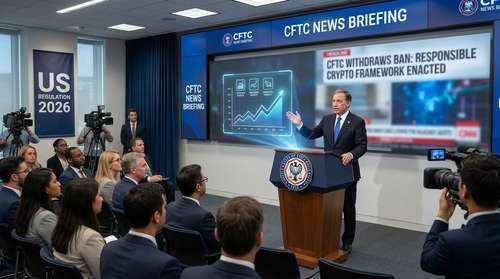
In a watershed moment for the digital asset industry, the Commodity Futures Trading Commission (CFTC) has officially withdrawn its controversial 2024 proposal to ban political and sports-related event contracts. The decision, confirmed this week by Chairman Michael S. Selig, marks a decisive end to the regulatory uncertainty that has plagued decentralized prediction markets for years. By pivoting from prohibition to a new framework of "responsible development," the agency has signaled that US crypto regulation 2026 will be defined by innovation rather than suppression.
A Historic Pivot: The CFTC Prediction Market Ruling
The withdrawal of the "Event Contracts" rule is more than just a procedural update; it is a fundamental ideological shift in Washington. The original proposal, drafted under the previous administration, sought to classify election betting and sports derivatives as contrary to the public interest. However, Chairman Selig CFTC, who was confirmed in late 2025, has wasted no time dismantling what he termed a "frolic into merit regulation."
Speaking from the agency's headquarters, Selig emphasized that the CFTC's mandate is to police fraud and manipulation, not to act as a moral arbiter of what Americans can trade. "Markets thrive on information," Selig noted in a statement following the withdrawal. "By bringing these contracts into the light of federal oversight, we are ensuring market integrity rather than driving activity into the shadows." This CFTC prediction market ruling effectively greenlights platforms to list contracts on political outcomes, provided they adhere to strict anti-money laundering (AML) and surveillance standards.
The "Project Crypto" Effect: SEC-CFTC Harmonization
This regulatory U-turn didn't happen in a vacuum. It follows the landmark SEC-CFTC Harmonization Event held on January 29, where Chairman Selig and SEC Chairman Paul Atkins unveiled "Project Crypto." This joint initiative aims to end the jurisdictional turf wars that previously left crypto operators in legal limbo. Under this new collaborative approach, the agencies are establishing clear lanes: the SEC retains authority over capital-raising securities, while the CFTC asserts exclusive jurisdiction over digital commodities and derivatives, including crypto event contracts.
The harmonization effort is critical for the sector's growth. For years, platforms feared that complying with one regulator would invite enforcement from the other. Now, with a unified federal front, the path is clear for compliant innovation. "We are finally seeing the government move at the speed of the market," said an industry analyst regarding the joint announcement. "The era of regulation-by-enforcement is being replaced by regulation-by-coordination."
Rise of Decentralized Prediction Markets
The biggest beneficiaries of this shift are decentralized prediction markets like Polymarket and regulated exchanges like Kalshi. These platforms have seen explosive growth, with billions of dollars in volume traded during the last election cycle. The new legal clarity allows them to expand their offerings without the constant threat of a federal shutdown.
Connecting to the Real Economy
Proponents argue that these markets serve a vital economic function by allowing businesses to hedge against real-world risks, such as policy changes or climate events. By validating legal political betting US as a form of risk management rather than mere gambling, the CFTC is opening the door for institutional capital to enter the space. Major financial players, previously hesitant to touch event contracts due to compliance risks, are now reportedly exploring partnerships with leading prediction platforms.
The State vs. Federal Battleground
Despite the federal green light, the legal landscape remains complex. While the CFTC has asserted its authority, state regulators in jurisdictions like Nevada are pushing back, arguing that sports-related contracts constitute gambling under state law. This sets the stage for a potential Supreme Court showdown over federal preemption.
However, the CFTC's confident stance suggests they are ready for the fight. By formally withdrawing the 2024 ban and establishing a robust oversight regime, the agency is strengthening its legal argument that these are federally regulated financial instruments, not casino games. For now, the momentum is undeniably with the innovators, and 2026 is shaping up to be the year prediction markets finally go mainstream.