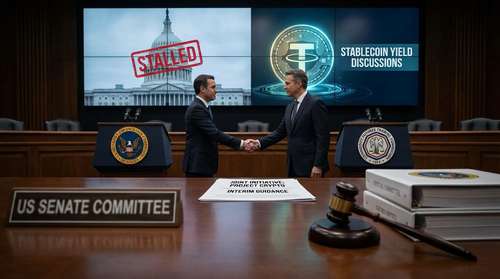
Washington, D.C. — The U.S. Senate Banking Committee remains locked in a high-stakes stalemate this weekend over the Digital Asset Market Clarity Act, leaving the crypto industry’s most anticipated legislation in limbo. As of Sunday, February 15, 2026, negotiations have hit a wall over a controversial provision to ban yield-bearing stablecoins—a move vehemently demanded by banking lobbyists but rejected by digital asset advocates. In response to the legislative paralysis, the SEC and CFTC have accelerated Project Crypto, a joint initiative designed to force regulatory clarity through agency rulemaking while Congress deliberates.
The Sticking Point: Stablecoin Yield Regulation
The primary obstacle to passing the Clarity Act 2026 is no longer the classification of tokens, but the economic mechanics of stablecoins. Senate Banking Committee Chairman Tim Scott (R-SC) has been working to broker a compromise, but talks collapsed late Friday over the issue of "pass-through yields."
Powerful banking trade groups are lobbying for a strict ban on stablecoin yield regulation that would prevent digital asset service providers from offering interest on stablecoin deposits. Their argument is rooted in the fear of deposit flight; if a stablecoin wallet can offer 4-5% APY derived from Treasury-backed reserves, community banks fear they cannot compete. "We are seeing a fundamental clash between traditional banking safeguards and the programmed efficiency of DeFi," notes a senior aide to the Banking Committee.
Opponents of the ban, including major U.S. exchanges, argue that prohibiting yield would effectively neuter the utility of American stablecoins, handing the market advantage to offshore competitors not bound by US crypto legislation 2026. This specific deadlock has paused what was otherwise a bipartisan march toward a floor vote.
Project Crypto: SEC and CFTC Build a 'Regulatory Bridge'
With the legislative path obstructed, federal regulators are taking matters into their own hands. In a rare display of unity, Securities and Exchange Commission Chair Paul Atkins and Commodity Futures Trading Commission Chair Michael Selig have formally launched SEC CFTC Project Crypto.
Unveiled in testimony earlier this week, Project Crypto is a collaborative framework aimed at establishing a definitive token taxonomy SEC and CFTC officials can use immediately. "We cannot wait for the legislative gears to grind while the market evolves," Chair Atkins told the House Financial Services Committee on Thursday. "Project Crypto will provide the interim certainty required to distinguish a digital commodity from a security, regardless of the Senate's timeline."
Defining the Token Taxonomy
The initiative promises to deliver a joint guidance document by Q2 2026 that will categorize the top 100 digital assets by market cap. This taxonomy is designed to function as a "regulatory bridge," giving compliance officers at major financial institutions the confidence to proceed with tokenization projects without fear of retro-active enforcement actions.
Institutional Crypto Adoption at Risk
The stakes of this delay were highlighted Friday by Patrick Witt, Executive Director of the President's Council of Advisors for Digital Assets. Speaking on national television, Witt warned that "trillions of dollars in institutional capital are sitting on the sidelines," waiting for the green light that the Clarity Act—or a robust Project Crypto—would provide.
Institutional crypto adoption has stalled in the first quarter of 2026 precisely because of this uncertainty. Asset managers like BlackRock and Fidelity have signaled readiness to launch tokenized money market funds on public blockchains, but the lack of clarity on stablecoin yields and token classification remains a massive liability shield. "If the Senate cannot pass the Clarity Act, the United States risks ceding the next generation of financial infrastructure to Europe and Asia," Witt cautioned.
What Comes Next?
Negotiators are expected to resume talks on Tuesday, following the Presidents' Day holiday. The potential compromise being floated involves a "tiered yield" system, where only accredited investors could earn yield on stablecoins, while retail users would be restricted to non-interest-bearing accounts. However, until ink is put to paper, the industry looks to the SEC and CFTC's Project Crypto as the only viable path forward for US crypto legislation 2026.