
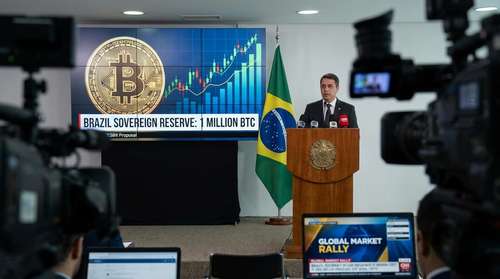
In a landmark move that has sent shockwaves through the global financial system, the Brazilian government has officially unveiled a legislative proposal to establish a Sovereign Strategic Bitcoin Reserve (RESBit), with the ambitious goal of accumulating up to 1 million Bitcoin (BTC) over the next five years. The announcement, spearheaded by Federal Deputies Eros Biondini and Luiz Gastão, has immediately provided a critical psychological floor for the cryptocurrency market, helping Bitcoin firmly defend the $68,000 support level amidst a week of broader economic volatility. If passed, this policy would position Brazil as a world leader in nation-state crypto adoption, potentially surpassing the holdings of major economic powers.
The RESBit Proposal: A 1 Million BTC Strategic Asset
The core of this breaking development is the reintroduced Bill 4501/2024, colloquially known as the "RESBit Act." Unlike previous iterations that suggested a modest allocation of foreign reserves, the revised text sets a hard target: the gradual acquisition of 1 million BTC to serve as a strategic sovereign asset. This accumulation plan is designed to be executed over a five-year period, minimizing market disruption while securing a substantial portion of the asset's finite supply.
Federal Deputy Eros Biondini, the bill's original author, emphasized that the initiative is not merely about speculation but about monetary sovereignty. "We are moving beyond experimentation. This reserve is a shield against currency devaluation and a statement that Brazil intends to lead the digital economy," Biondini stated in a press briefing earlier this week. The proposal also includes a strict prohibition on the auctioning of Bitcoin seized by law enforcement, mandating instead that these assets be folded into the national treasury.
Backing the 'Drex' and Hedging Inflation
A critical component of the plan involves integrating the Bitcoin reserve with Brazil's central bank digital currency (CBDC), the Drex. Proponents of the bill argue that holding a hard asset like Bitcoin on the national balance sheet will provide a layer of trust and collateral for the digital real, distinguishing it from purely fiat-pegged CBDCs.
Strengthening the Real
By allocating up to 5% of its international reserves into Bitcoin, Brazil aims to hedge against the depreciation of the US dollar and other fiat currencies. Deputy Luiz Gastão, the bill’s rapporteur, highlighted that this diversification is essential for modernizing the nation's economic defense mechanisms. The legislation also proposes allowing federal tax payments in Bitcoin, further embedding the asset into the country's fiscal infrastructure.
Global Market Reaction: Defending the $68,000 Level
The market's response to Brazil's announcement was immediate and bullish. Bitcoin, which had been testing liquidity around the $66,000 range earlier in the week, surged past $68,000 within hours of the news, signaling renewed institutional confidence. Analysts suggest that the sheer scale of Brazil's proposed buying pressure—removing nearly 5% of the total Bitcoin supply from circulation over five years—has forced a repricing of long-term scarcity models.
This "sovereign FOMO" (Fear Of Missing Out) is already sparking debates in other capitals. While El Salvador was the pioneer of nation-state adoption, Brazil's entry as a G20 economy brings a different level of legitimacy and capital weight to the table. If the plan proceeds, Brazil's holdings would dwarf those of corporate giants and rival the estimated seizures held by the United States and China.
Political Hurdles and Central Bank Resistance
Despite the legislative enthusiasm, the path to a 1 million BTC reserve faces significant hurdles. The Central Bank of Brazil (BCB) has historically maintained a conservative stance, viewing Bitcoin's volatility as a risk to financial stability rather than a hedge. Central Bank officials have previously expressed skepticism about using volatile assets to back international reserves, preferring traditional liquidity buffers like US Treasuries and gold.
The coming weeks will be crucial as the bill moves through the Economic Development Commission. For the proposal to become law, it must navigate the complex Brazilian legislative process and win over the economic team of the executive branch. However, with the global conversation shifting toward strategic Bitcoin stockpiles, the political cost of being left behind may ultimately outweigh the risks of adoption.