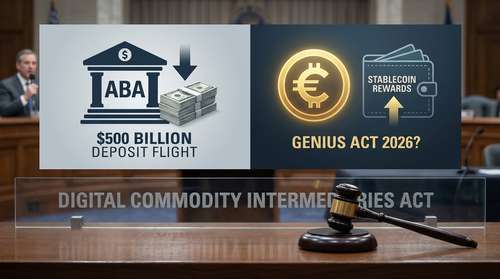
Washington is thawing out from a historic winter storm, but the heat is rising on Capitol Hill as the Senate Agriculture Committee prepares for a critical markup of the Digital Commodity Intermediaries Act tomorrow, Thursday, January 29. At the center of the storm is a fierce lobbying war between the American Bankers Association (ABA) and the cryptocurrency industry over a controversial practice: stablecoin rewards. The ABA is warning lawmakers that a regulatory "loophole" in the 2025 GENIUS Act could trigger a massive $500 billion stablecoin deposit flight from traditional community banks, threatening the foundation of local lending.
The "GENIUS" Loophole: A legislative Oversight?
When the Guiding and Establishing National Innovation for U.S. Stablecoins Act (GENIUS Act) was signed into law in the summer of 2025, it was hailed as a comprehensive framework for digital assets. A key provision explicitly banned stablecoin issuers—like Circle or Paxos—from paying interest to token holders, a measure designed to prevent these assets from functioning as unregistered securities or high-yield savings accounts.
However, six months later, a new battleground has emerged. Crypto exchanges and third-party platforms have begun offering "rewards" or "loyalty points" on stablecoin balances, effectively bypassing the issuer ban. The ABA argues this violates the spirit of the law. "The GENIUS Act was intended to ensure stablecoins remain a payment instrument, not an investment vehicle," stated Rob Nichols, President and CEO of the American Bankers Association, in a blistering letter to the Senate committee earlier this week. "By allowing third-party platforms to offer yield, we are opening a backdoor for unregulated shadow banking."
The $500 Billion Warning
The stakes, according to the banking lobby, are existential. In their "Blueprint for Growth" released on January 20, the ABA cited internal projections suggesting that if stablecoin rewards remain unchecked, up to $500 billion could migrate from low-interest bank deposits to higher-yielding crypto platforms within the first year. Some estimates from major lenders like Bank of America paint an even grimmer long-term picture, warning of a potential $6 trillion shift over the next decade.
"Every dollar that leaves a community bank for a crypto exchange is a dollar that cannot be lent to a local small business, a first-time homebuyer, or a family farm," the ABA warned. They are pressuring Senator John Boozman (R-AR), Chair of the Senate Agriculture Committee, to add an amendment to the Digital Commodity Intermediaries Act that would explicitly ban any entity from offering yield on payment stablecoins.
Crypto Industry Strikes Back: "Totally Absurd"
The crypto industry has mobilized a swift counter-offensive, arguing that the banks are simply trying to legislate away competition. Leaders in the space contend that crypto interest regulation shouldn't protect banks from having to compete for customers' deposits.
Jeremy Allaire, CEO of Circle, dismissed the "deposit flight" narrative as fear-mongering during a press briefing yesterday. "The idea that offering consumers a fair reward for their assets causes bank runs is totally absurd," Allaire said. "Stablecoins are modernizing the dollar. Banks should focus on modernizing their services rather than lobbying to ban innovation."
Supporters of the current system argue that the GENIUS Act 2026 implementation guidelines never prohibited third-party rewards, which are often funded by marketing budgets or lending activities, separate from the stablecoin reserves themselves. They warn that a blanket stablecoin rewards ban would drive innovation offshore, repeating the mistakes of the early 2020s.
Thursday's Showdown: The Digital Commodity Intermediaries Act
All eyes are now on the Senate Agriculture Committee markup, rescheduled for tomorrow, January 29, at 10:30 AM EST due to the severe weather that shut down D.C. earlier this week. The Digital Commodity Intermediaries Act is primarily designed to give the CFTC jurisdiction over digital commodities like Bitcoin and Ether, but it has become the vehicle for this last-minute US crypto legislation fight.
Sources close to the Committee suggest the markup will be contentious. While Committee Chair Boozman has expressed a desire to "close unintended gaps" in the GENIUS Act, he faces resistance from pro-innovation lawmakers who see the American Bankers Association crypto stance as anti-competitive. With the Senate Banking Committee stalled on its own housing initiatives, this Ag Committee bill represents the best chance for moving any significant financial regulation forward in early 2026.
For investors and bank customers alike, the outcome of tomorrow's markup could redefine where they can keep their cash—and how much they can earn on it. As the snow clears in Washington, the path forward for digital assets remains anything but clear.