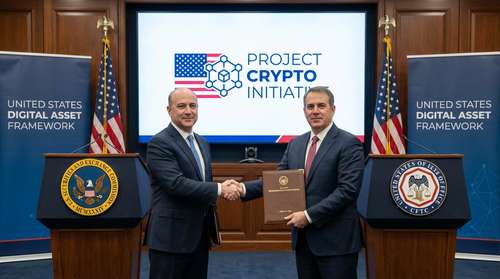
(March 13, 2026) — For years, the digital asset industry has been caught in the crossfire of overlapping federal jurisdictions. That era formally ended this week. On March 12, Securities and Exchange Commission Chairman Paul Atkins and Commodity Futures Trading Commission Chairman Michael Selig signed a landmark agreement that fundamentally reshapes the future of American financial markets. The highly anticipated SEC CFTC MOU 2026 establishes a unified approach to digital asset oversight, replacing decades of bitter agency rivalry with a seamless, coordinated strategy.
This historic agreement officially cements the inter-agency Project Crypto initiative, effectively ending what Chairman Atkins described as a stifling turf war that historically drove innovators to offshore jurisdictions. By introducing a shared rulebook, a unified taxonomy, and cooperative enforcement protocols, the agencies aim to build a coherent US digital asset framework that fosters innovation while maintaining robust consumer protections. Building a durable US digital asset framework has been the missing puzzle piece for widespread institutional adoption.
The Evolution of the Project Crypto Initiative
Initially launched as an internal SEC program to evaluate tokenized securities, the Project Crypto initiative has rapidly evolved into a comprehensive joint operation. Following preliminary harmonization announcements in late January, the newly inked memorandum of understanding operationalizes this grand vision. The Joint Harmonization Initiative is now co-led by the SEC’s Robert Teply and the CFTC’s Meghan Tente, moving beyond mere leadership rhetoric to establish day-to-day operational coordination at the staff level.
Rather than shuffling firms back and forth between isolated bureaucratic silos, the agencies will now hold combined meetings on product applications, share surveillance data in real-time, and conduct joint examinations of regulated entities. Chairman Selig emphasized that the U.S. regulatory landscape must adapt to the continuous, 24/7 nature of modern digital markets, where trading, clearing, and custody frequently transcend traditional asset boundaries.
Establishing a Comprehensive Crypto Taxonomy 2026
A central pillar of this newly established alliance is the formal rollout of a definitive crypto taxonomy 2026. Previously, market participants faced a fiercely contested gray zone where the SEC and CFTC might claim jurisdiction over the exact same asset based on conflicting legal theories. The resulting enforcement-heavy strategy often left developers and compliance officers guessing whether their native tokens were securities or commodities.
The SEC CFTC MOU 2026 resolves this classification conflict systematically. By categorizing digital assets into distinct, mutually agreed-upon buckets—securities, digital commodities, collectibles, and utility tokens—the agencies provide immediate clarity for previously disputed assets. This updated crypto taxonomy 2026 directly impacts complex tokenized collateral, stablecoins, and staking derivatives. This shared vocabulary guarantees that a product's regulatory status will not depend on which agency decides to file a lawsuit first.
Paul Atkins Crypto Regulation: The 'Super App' Model
The philosophical shift behind this collaboration is striking. Detailing the Paul Atkins crypto regulation strategy during a recent fireside chat, the SEC Chairman likened his ideal regulatory architecture to a super app. In this model, jurisdictional lines are intentionally blurred for the end-user and market participant, while internal actions remain highly coordinated behind the scenes. He candidly noted that the agencies previously operated like two fortresses with no man's land in between, a hostile dynamic that stranded countless viable financial products.
To remedy this friction, Atkins has aggressively championed the concept of substituted compliance. Under this modernized approach to Paul Atkins crypto regulation, dually registered exchanges and financial intermediaries will experience significantly reduced administrative burdens. Instead of undergoing redundant and conflicting audits from both watchdogs, firms meeting the rigorous standards of one agency may satisfy the baseline operational requirements of the other.
What SEC CFTC Joint Oversight Means for DeFi
For developers building decentralized finance (DeFi) applications, self-custody wallets, and open-source smart contracts, SEC CFTC joint oversight brings much-needed operational certainty. Under Chairman Selig’s minimum effective dose regulatory philosophy, the CFTC is actively drafting targeted guidance specifically to clarify when non-custodial software developers actually trigger federal registration requirements.
This coordinated front directly addresses the massive institutional demand for on-chain infrastructure. By clarifying the rules surrounding leveraged retail transactions, tokenized real-world assets, and perpetual futures contracts, the agencies are laying the regulatory groundwork to onshore billions of dollars in trading volume currently flowing through Dubai, Singapore, and the Cayman Islands.
Streamlining Enforcement and Market Surveillance
Redundant enforcement actions do not increase market deterrence; they only amplify legal confusion. The terms of the SEC CFTC MOU 2026 guarantee that the regulatory bodies will coordinate legal theories and remedial strategies before taking punitive action. Shared supervisory findings and cross-market surveillance protocols will become standard practice. This ensures that bad actors face a unified federal response while compliant companies can innovate without fear of unpredictable regulatory strikes.
The Road Ahead for US Financial Leadership
As lawmakers on Capitol Hill continue debating comprehensive market structure legislation like the CLARITY Act, this inter-agency agreement provides immediate and tangible relief to a strained industry. The SEC and CFTC are no longer waiting for Congress to act; they are actively utilizing their existing statutory authority to build a functional, fit-for-purpose regulatory path today.
For market participants, venture capitalists, and institutional investors tracking the latest cryptovot regulation news, the underlying message is crystal clear: the United States is serious about reclaiming its position as the undisputed global hub for digital asset innovation. By officially burying the hatchet, the SEC and CFTC have replaced regulatory friction with a powerful blueprint for the next generation of decentralized financial technology.