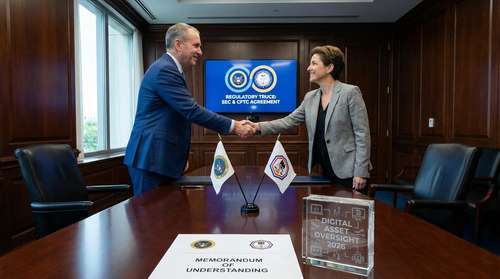
The era of overlapping rules and contradictory mandates in the American cryptocurrency sector has officially concluded. On March 11, 2026, a groundbreaking SEC CFTC crypto agreement was signed, formally halting the bitter regulatory conflicts that have plagued the financial technology industry for the last decade. By establishing a unified, cooperative approach to market supervision, this landmark treaty signals a fundamental shift in how digital assets will be governed in the United States, replacing ambiguity with actionable policy.
A Historic SEC vs CFTC Jurisdictional Truce
For years, companies building blockchain infrastructure navigated a contradictory labyrinth. The Securities and Exchange Commission frequently categorized tokens as unregistered securities, while the Commodity Futures Trading Commission designated many of those same digital assets as commodities. This ongoing friction created a contested gray zone, forcing innovative builders offshore and sidelining billions of dollars in institutional capital due to persistent compliance fears.
The new SEC vs CFTC jurisdictional truce directly resolves this foundational problem. Instead of fighting over first-mover advantage on high-profile lawsuits, both agencies have committed to a shared taxonomy. A cryptocurrency asset will now be classified once under a jointly agreed framework, eliminating the threat of double-jeopardy enforcement actions. The pact supersedes outdated 2018 coordination guidelines, replacing fragmented policies with a cohesive roadmap designed to bring trading volume and enterprise development back to American shores.
The Mechanics of the SEC CFTC MoU
At the core of the SEC CFTC MoU is the newly established Joint Harmonization Initiative. Co-led by Robert Teply from the SEC and Meghan Tente from the CFTC, this senior-level operational task force moves well beyond previous rhetorical promises. It embeds inter-agency cooperation directly into daily rulemaking, risk monitoring, and examinations.
The Joint Harmonization Initiative will specifically focus on several critical operational areas:
- Clarifying product definitions through joint interpretations and rulemakings.
- Modernizing clearing, margin, and collateral frameworks.
- Streamlining reporting data for dually registered exchanges and intermediaries.
- Coordinating cross-market surveillance, economic analyses, and enforcement actions.
One highly anticipated deliverable from this effort is a shared product approval portal. Digital asset firms will soon be able to submit new financial products for pre-launch guidance through a single platform, with both regulators reviewing the details simultaneously rather than running parallel, disconnected processes.
Paul Atkins SEC Chair and Michael Selig: A Unified Vision
Leadership alignment proved to be the vital catalyst for this regulatory breakthrough. Paul Atkins SEC chair noted during the announcement that decades of duplicative registrations and conflicting frameworks had severely stifled American innovation, actively pushing market participants into friendlier, foreign jurisdictions. Under his leadership, the agency has prioritized market integrity without suffocating enterprise growth.
CFTC Chairman Michael Selig echoed these sentiments, framing the agreement around an urgent need to reclaim U.S. financial supremacy. Selig emphasized that modernizing these frameworks will eliminate burdensome rules and usher in a "Golden Age of American finance". Crucially, both regulators have agreed to adopt a "minimum effective dose" regulatory strategy—applying the smallest regulatory footprint necessary to protect consumers. Furthermore, if both agencies pursue the same enforcement target, they will now confer on potential charges, sequence their litigation filings, and align their public communications, ensuring operators face a coherent set of expectations.
Setting the Stage for Crypto Market Structure Legislation
While this administrative breakthrough delivers immediate relief to founders and investors, it also lays the critical groundwork for sweeping congressional action. The harmonization effort serves as a strategic bridge, establishing the bureaucratic infrastructure required to implement upcoming crypto market structure legislation seamlessly.
By ironing out product definitions and modernizing collateral frameworks ahead of time, the agencies are proactively preparing to absorb comprehensive legislative mandates. The unified taxonomy guarantees that the SEC and CFTC will not trip over one another once Congress formally codifies the dividing line between digital asset securities and commodities into federal law. This collaborative alignment provides the robust foundation necessary to achieve total crypto regulatory clarity 2026.
The Future of US Digital Asset Oversight
The downstream economic effects of this historic treaty are immense. With a "fit-for-purpose" framework replacing the hostile environment of the past, the United States is rapidly positioning itself as the premier global destination for blockchain enterprise.
This shift in US digital asset oversight specifically targets offshore market dominance. For example, perpetual futures currently command over $13 trillion in global annual volume, largely trading on foreign exchanges due to a historical lack of domestic guidance. The new joint oversight model signals potential openings for these complex financial products, as well as standardized event contracts and prediction markets, to operate legally and transparently on U.S. platforms.
Institutional participants no longer have to fear arbitrary, uncoordinated enforcement sweeps. The market has loudly demanded a predictable, secure environment to deploy capital, and this coordinated agreement delivers exactly that. By sharing surveillance data and eliminating overlapping compliance hurdles, Washington has finally provided the stable, unified foundation the industry needs to mature and scale domestically.