
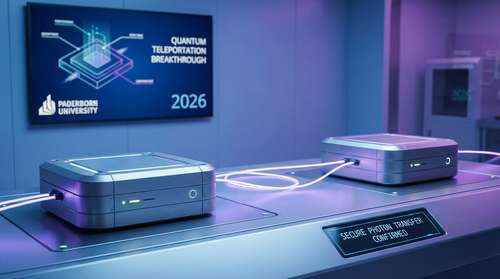
Digital security and network architecture crossed a definitive threshold this week. An international coalition of scientists has announced a historic quantum teleportation breakthrough, successfully transferring the polarization state of a single photon between two physically isolated quantum dots. By completing this transfer on demand, researchers have established the critical hardware baseline for the quantum internet 2026 development cycle. This achievement moves global communications away from vulnerable classical channels and toward an era of unhackable, instantaneous data relay. The demonstration marks the first time such an information transfer has occurred between solid-state quantum bits in entirely separate locations, offering a tangible preview of the decentralized quantum web.
Paderborn University Research Drives the Innovation
The latest findings, published this week in Nature Communications, represent nearly a decade of sustained optical measurement and data evaluation. The Paderborn University research group, led by Professor Klaus Jöns, collaborated extensively with a team under Professor Rinaldo Trotta at Sapienza University of Rome. They did not work alone; partners at Johannes Kepler University Linz developed the high-precision quantum dots, while the University of Würzburg handled the nanofabrication of essential resonators.
During the field experiment, the team utilized a 270-meter free-space optical link across the Sapienza University campus in Rome, successfully bypassing the physical limitations that traditionally hinder terrestrial fiber networks. Operating in a real-world urban communication environment, the equipment handled atmospheric turbulence using ultra-fast single-photon detectors, GPS-supported synchronization, and active stabilization systems.
Engineering the Quantum Networking Nodes
Creating reliable quantum networking nodes demands absolute precision. The core challenge the team overcame was interfacing distinct, dissimilar quantum emitters. In reality, no two quantum dots are completely identical; they naturally possess mismatched optical properties that normally disrupt quantum interference.
To solve this, the researchers engineered a complex hybrid quantum network. They embedded gallium arsenide quantum dots into nanophotonic cavities and integrated them with piezoelectric actuators to control the electron structure precisely. Using magnetic fields to tune the emission wavelengths, they effectively forced the distinct photons to become indistinguishable.
The Mechanics of the Transfer
Unlike science fiction tropes, nothing physical actually traveled between the two distant points. Instead, the system relies on quantum entanglement. One quantum dot generates an entangled photon pair, linking their properties completely. Through a Bell-state measurement, the unknown polarization state of a third photon interacts with one half of the entangled pair, instantaneously mapping its exact state onto the distant partner particle. The experiment achieved an astonishing teleportation fidelity of 82±1%, shattering the classical threshold by more than ten standard deviations.
Shaping the Future of Cryptography
This milestone completely reshapes our expectations for secure communication technology. Conventional internet infrastructure requires optical amplifiers to boost light signals roughly every 50 kilometers. Because the laws of physics dictate that quantum information cannot be simply copied, amplified, and forwarded, classical network architecture is largely incompatible with a pure quantum web.
Quantum teleportation circumvents this roadblock entirely. By transferring information across macroscopic distances without moving the actual particle, networks can maintain fragile quantum states. This provides the backbone for the future of cryptography. High-fidelity transfers will directly enable secure quantum key distribution and distributed quantum computing architectures. Any attempt by a malicious actor to intercept or measure these transmissions instantly alters the particle state, alerting both sender and receiver to the intrusion and rendering the stolen data completely useless.
As we increasingly rely on digital financial transactions, confidential healthcare data, and sensitive national security communications, the threat of sophisticated cyberattacks continues to grow. Conventional encryption methods currently face the looming threat of being cracked by early-stage quantum computers. Implementing secure communication technology anchored by quantum teleportation provides an absolute mathematical guarantee of privacy. You no longer have to rely on complex mathematical puzzles that a powerful machine might eventually solve; your security is guaranteed by the fundamental laws of physics itself.
The Road to a True Decentralized Quantum Web
Successfully linking two independent emitters confirms that semiconductor quantum dots serve as the ideal foundational technology for scalable quantum relays. With the free-space link proven viable, future network iterations could efficiently connect terrestrial ground stations directly to low-Earth orbit satellites, reducing the immediate need for physical fiber optic cables.
The scientific community is already preparing for the next major phase of development. Researchers plan to demonstrate entanglement swapping between two deterministic quantum dot sources. Accomplishing that subsequent step will yield a fully functional quantum repeater, the critical component for extending network ranges indefinitely. As the global race to commercialize this infrastructure accelerates, this European collaboration has proved that a robust quantum network for everyday information processing is rapidly moving from theoretical physics into achievable engineering reality.
This breakthrough is not just a triumph of academic research; it signals a monumental shift for enterprise tech infrastructure. Over the next few years, telecommunications giants and government defense agencies will likely accelerate their investments in quantum networking nodes based on this semiconductor foundation. We are witnessing the very first building blocks of a new internet architecture being laid down in real-time. By moving quantum teleportation out of highly controlled, isolated laboratory conditions and into turbulent urban environments, scientists have given us a clear roadmap for the decade ahead.