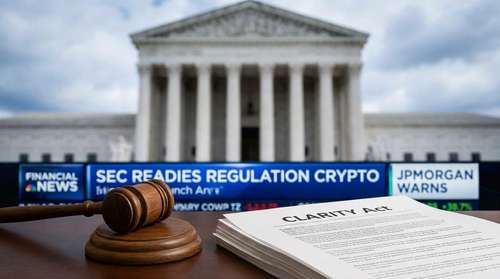

In a watershed moment for the digital asset industry, federal regulators took the Nakamoto Stage at the Bitcoin 2026 conference in Las Vegas this week to officially retire the government's hostile stance on blockchain technology. SEC Chair Paul Atkins and CFTC Chair Mike Selig delivered back-to-back addresses, charting an unprecedented course for domestic innovation. The message was unmistakable: the enforcement-first era is over, and a "new day" for digital finance has begun in the United States.
The Dawn of 'Project Crypto' and a Unified Vision
For years, crypto companies have navigated a regulatory no-man's-land, caught between overlapping jurisdictions and conflicting enforcement actions. The newly formalized SEC CFTC joint framework completely alters that dynamic. Originally conceived as an internal SEC review, the Project Crypto initiative has evolved into a fully integrated, bilateral mission to streamline federal oversight and keep talent onshore.
During his historic appearance—making him the first sitting Securities and Exchange Commission head to address a Bitcoin-focused event—Chairman Atkins acknowledged the failures of the past. He noted that modern financial markets, with instantaneous on-chain settlement and 24/7 algorithmic trading, do not fit neatly into legacy jurisdictional boxes. Fragmented regulation, he argued, only served to confuse investors and drive entrepreneurs to foreign jurisdictions.
CFTC Chairman Selig echoed these sentiments, stating that regulators are finally "turning over a new page". Selig, who previously served as chief counsel of the SEC's Crypto Task Force under Atkins, highlighted that the two agencies are functioning as a coordinated unit. Their immediate goal is establishing a clear token taxonomy, which has already resulted in classifying 16 crypto assets outright as digital commodities.
SEC Paul Atkins 2026: The 'ACT' Strategy and the Innovation Exemption
The centerpiece of the SEC's revised regulatory posture is what Atkins described as the ACT strategy: Advance, Clarify, Transform. This three-pillar approach intends to reverse the domestic brain drain by replacing punitive measures with clear, actionable rules for market participants.
To execute the "Advance" and "Transform" pillars, the agency is preparing an imminent digital asset safe harbor, officially dubbed the Innovation Exemption. Set to launch in the coming weeks, this tokenization sandbox will allow companies to issue and test on-chain tokenization and securitization tools in a supervised environment for 12 to 36 months without triggering full registration burdens.
According to SEC Paul Atkins 2026 policy outlines, the exemption fundamentally addresses long-standing frictions in capital formation. Startups will be able to leverage blockchain technology to navigate crypto capital raising laws legally, modernizing how initial distributions and network rewards are treated under federal securities laws.
Clarifying the Token Taxonomy
Addressing the "Clarify" pillar, Atkins reinforced the joint five-category token taxonomy. He made a crucial distinction that most crypto tokens trading in secondary markets—including digital commodities, tools, and collectibles—are not themselves securities. The SEC is shifting its focus away from broad-brush categorization toward the economic reality of the transaction itself, bringing much-needed logic to the application of the Howey test.
Mike Selig and 'Future-Proofing' US Markets
While the SEC focuses on capital formation and securities exemptions, the CFTC is moving aggressively to accommodate leveraged spot crypto trading and digital commodity markets. Chairman Selig detailed the CFTC's "Future-Proof" initiative, a comprehensive review aimed at rewriting agricultural-era trading rules so they function effectively for perpetual futures and blockchain-native assets.
Selig grounded his policy directives in fundamental property rights, framing token ownership as private property that deserves predictable, durable legal treatment. This alignment between agencies eliminates the single greatest source of uncertainty that has plagued the crypto sector since 2017: the dreaded guessing game of whether an asset is a commodity or a security.
A Bullish US Crypto Regulation Update for the Industry
The market response to this sweeping US crypto regulation update has been overwhelmingly positive. The unprecedented unified signal from the SEC, the CFTC, and the White House—fueled by concurrent buzz regarding an upcoming Strategic Bitcoin Reserve announcement—has significantly bolstered market confidence. Bitcoin prices have sustained a strong rebound, shaking off recent macroeconomic jitters to hold steady near the $80,000 threshold, with analysts projecting further gains as the CLARITY Act makes its way toward the President's desk by August.
The developments out of Las Vegas signal a profound operational pivot. The federal government is no longer trying to force decentralized technology into analog frameworks. By embracing a principles-based regulatory structure, prioritizing onshore development, and removing the constant threat of arbitrary litigation, Washington has officially signaled that American financial leadership in the digital era is open for business.