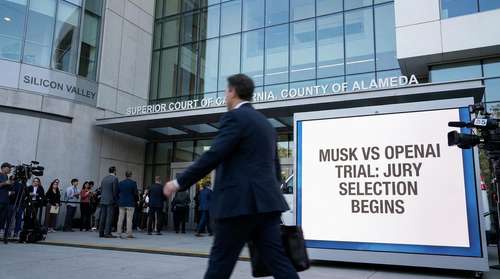
Jury selection officially commenced this week in an Oakland federal courthouse, marking the dramatic beginning of the Musk vs OpenAI lawsuit. At the heart of this high-stakes legal showdown between two of the tech industry’s most powerful figures is an ideological and financial battle over the future of artificial intelligence. As the Elon Musk Sam Altman trial unfolds, the proceedings are poised to expose deep-seated rivalries, unveil hidden corporate communications, and lay bare the inner workings of an $852 billion corporate empire.
The $150 Billion Stakes: Unpacking the Dispute
Elon Musk, who co-founded OpenAI in 2015 and contributed approximately $38 million to its early operations, accuses the company’s leadership of a massive AI non-profit mission betrayal. Musk alleges that Chief Executive Officer Sam Altman and OpenAI President Greg Brockman transformed the organization from an altruistic research lab meant to benefit humanity into a for-profit wealth machine.
To rectify this alleged breach of charitable trust, the billionaire is seeking staggering OpenAI $150 billion damages. If successful, these funds would not go into Musk's own pockets; instead, his legal team has requested the money be redirected entirely to OpenAI's non-profit charitable arm. Furthermore, Musk is demanding the removal of Altman and Brockman from their leadership positions and a court order to unwind the company's highly lucrative for-profit conversion.
Inside the Courtroom: Jury Selection and Dropped Claims
Presiding U.S. District Judge Yvonne Gonzalez Rogers began jury selection on Monday by assuring prospective jurors that the case would not require deep technical expertise. "This is just a case about promises and breaches of promises," she explained to the courtroom. While Musk voluntarily dropped his outright fraud claims late last week to sharpen his legal strategy, the remaining allegations of unjust enrichment and breach of charitable trust promise a grueling two-to-three-week evidentiary phase.
Betrayal or Sour Grapes? The Diary Entry That Could Change Everything
The courtroom drama is already hinging on thousands of pages of newly unsealed internal documents. Among the most explosive pieces of evidence is a 2017 personal diary entry written by Greg Brockman. In the excerpt, Brockman wrote, "This is the only chance we have to get out from Elon," before questioning if Musk was the "glorious leader" he would choose to follow. Legal analysts view this as a pivotal piece of evidence regarding the founders' early intentions to bypass their non-profit commitments.
Conversely, OpenAI’s legal defense sharply disputes Musk's narrative. They argue the lawsuit is fundamentally a case of "sour grapes" from a former partner attempting to sabotage their rapid growth. According to their filings, Musk abandoned the project in 2018 after his attempts to merge the startup with Tesla and assume total operational control were rejected. Now, they claim, he is merely weaponizing the legal system to benefit his own competing venture, xAI.
The Microsoft OpenAI Partnership Lawsuit Angle
You cannot fully grasp this Silicon Valley tech trial 2026 without examining the massive corporate shadow looming over the proceedings. Microsoft’s sprawling $13 billion investment is heavily scrutinized, effectively turning this into a Microsoft OpenAI partnership lawsuit as well.
Musk argues that the tech giant knowingly aided and abetted OpenAI’s shift away from its founding principles. Internal communications revealed in pretrial filings show Microsoft executives, including Chief Technology Officer Kevin Scott, expressing quiet reservations about the partnership's broader implications before moving forward. Microsoft CEO Satya Nadella is expected to testify in person, where he will undoubtedly face intense cross-examination regarding how much influence his company wielded over OpenAI's board during the critical for-profit transition.
- Key Witnesses Expected: Sam Altman, Elon Musk, Satya Nadella, Kevin Scott, and former OpenAI CTO Mira Murati.
- Core Legal Claims: Unjust enrichment and breach of charitable trust.
- Potential Outcomes: Up to $150 billion redistributed to the non-profit arm, alongside a reversal of the for-profit corporate structure.
What This Means for Generative AI Ethics and Law
Beyond the personal vendettas and astronomical financial figures, this trial serves as a definitive flashpoint for generative AI ethics and law. The verdict, which will be decided by a nine-person jury, could fundamentally sway the balance of power across the entire artificial intelligence landscape.
The stakes extend far beyond the courtroom walls. OpenAI is currently laying the groundwork for a highly anticipated initial public offering, reportedly eyeing a valuation near $1 trillion by 2026 or 2027. However, a steady stream of unflattering disclosures from the witness stand could shake investor confidence, complicate the IPO process, and invite harsher regulatory scrutiny from federal lawmakers.
The central question being debated in Oakland—whether the world's leading artificial intelligence developer breached its legal and ethical obligations to humanity in pursuit of profit—will set a massive precedent. For emerging startups, this case could redefine how non-profit charters are enforced when revolutionary technology is commercialized. As the trial progresses, the tech industry watches closely, knowing the outcome will dictate not just the financial future of ChatGPT's creator, but the foundational rules governing the most transformative technology of our generation.