
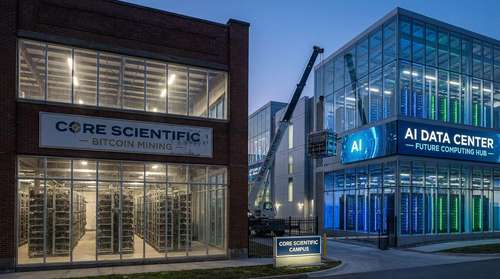
On April 20, 2026, the digital infrastructure landscape experienced a seismic transformation as one of North America's largest crypto miners officially changed course. The highly anticipated Core Scientific AI shift was unveiled, detailing a massive $10 billion strategic plan to transition its flagship blockchain mining facilities into specialized data hubs for artificial intelligence. By capitalizing on its massive power contracts and advanced cooling systems, the company is effectively rewriting the playbook for industrial-scale computing and leaving its cryptocurrency roots behind.
Inside the Core Scientific $10 Billion Pivot
The transition from mining digital assets to hosting generative artificial intelligence represents a monumental reallocation of resources. Driven by a pipeline of long-term contracts—most notably expanded agreements with AI hyperscaler CoreWeave—the Core Scientific $10 billion pivot guarantees that by the end of 2028, every megawatt of the company's operational portfolio will be dedicated to colocation services. This aggressive move directly addresses the unprecedented electricity demands of the global AI industry, which continues to vastly outpace available utility grid capacity across the United States.
Following a challenging post-halving environment in 2024 and throughout 2025, the economics of securing the blockchain forced industry giants to reconsider their core business models. In early 2026, Core Scientific signaled its permanent pivot by liquidating its remaining treasury of approximately 2,537 Bitcoin, valued at roughly $170 million at the time. Furthermore, the company secured a $500 million loan facility from Morgan Stanley, explicitly earmarked for AI expansion. The proceeds from the cryptocurrency sale and institutional financing were immediately injected into infrastructure upgrades, purchasing the necessary electrical switchgear and liquid-cooling hardware required to run enterprise-grade GPUs.
Financial Realities Driving the Change
The financial writing has been on the wall for several quarters. In its late 2025 financial disclosures, the company revealed that while traditional mining revenues were shrinking, revenue from leasing computing infrastructure had more than tripled year-over-year to $31.3 million. Chief Executive Officer Adam Sullivan emphasized that the company was actively expanding its colocation platform into a 1.5 gigawatt pipeline ready for lease, presenting a far more stable and lucrative path forward than the volatile margins of proprietary digital asset extraction.
From ASIC Arrays to High-Performance Computing Data Centers
Transforming a standard mining operation into an AI-ready environment requires intense engineering. Fortunately, Bitcoin mining AI infrastructure is uniquely suited for this baseline upgrade. Crypto mining facilities are strategically positioned near robust power sources and high-voltage substations. Core Scientific is actively converting these existing structural advantages into tier-III high-performance computing data centers. Instead of running single-purpose hashing machines on open racks, the retrofitted sites will house tens of thousands of densely packed Nvidia GPUs. These cutting-edge computing clusters are supported by sophisticated closed-loop liquid cooling systems, designed to manage the immense thermal output generated by training large language models.
The Rise of AI Compute Landlords
This bold maneuver solidifies a rapidly accelerating trend in the technology sector: the emergence of AI compute landlords. As software hyperscalers like Amazon Web Services, Microsoft, and Meta scramble for available power to train their next-generation models, former Bitcoin miners hold the literal keys to the grid. Securing gigawatt-level power agreements from scratch can take traditional data center developers five to ten years due to severe regulatory bottlenecks and utility interconnection delays. Core Scientific already possesses these energized assets and zoning approvals.
By leasing their power capacity and specialized structural environments to AI developers, these infrastructure providers secure long-term, dollar-denominated revenue streams. This starkly contrasts with the unpredictable nature of global hash rates and cryptocurrency price swings. The blockchain and AI convergence 2026 narrative has decisively shifted from a theoretical technological synergy to highly lucrative commercial real estate transactions, where energized data capacity is the most valuable commodity on the market.
Impact on the Future of Crypto Mining Hardware
With major publicly traded players abandoning the hash rate race, the future of crypto mining hardware faces a major inflection point. Core Scientific's departure from proprietary mining removes one of the largest institutional buyers from the ASIC (Application-Specific Integrated Circuit) market. Manufacturers of mining rigs will likely need to adapt their business strategies as their largest traditional clients increasingly favor adaptable GPU clusters over specialized, single-use hashing equipment.
For the broader decentralized ecosystem, this permanent infrastructure pivot means the global hash rate will increasingly consolidate among leaner, private mining outfits operating in regions with exceptionally cheap, stranded renewable energy. Meanwhile, legacy industrial miners in North America are realizing their true competitive advantage was never in hashing algorithms, but rather in their legal rights to draw massive, uninterrupted loads of electricity from the regional grid.
The total transformation of Core Scientific serves as the ultimate bellwether for the digital infrastructure industry. As the boundary between blockchain facilities and artificial intelligence compute centers dissolves, the race to power the next digital revolution has officially found its bedrock in the remnants of the crypto mining boom.