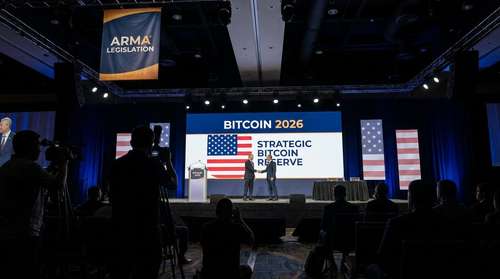
The atmosphere at the Bitcoin 2026 conference Las Vegas has been nothing short of electric, driven by an unprecedented convergence of U.S. regulatory and legislative support. Speaking directly to industry leaders, officials from the White House, the Securities and Exchange Commission (SEC), and Congress laid out a cohesive vision for the future of digital assets in America. At the center of the discussion is the highly anticipated Strategic Bitcoin Reserve, a policy shift that could permanently redefine global finance. Coupled with regulatory waivers for on-chain assets and a push to pass comprehensive market structure legislation, the United States is rapidly positioning itself as the undisputed leader in cryptocurrency innovation.
White House Nears Historic Reserve Announcement
During the Las Vegas summit, Patrick Witt, Executive Director of the President's Council of Advisors for Digital Assets, electrified the crowd by confirming that the administration is preparing a major announcement regarding its national crypto strategy. According to Witt, the White House has spent the months following last year's executive order finalizing the complex "machinations and legal interpretations" required to consolidate and protect government-held digital assets.
The administration is expected to detail the operational framework for the Strategic Bitcoin Reserve within the next few weeks. This initiative marks a definitive pivot from simply auctioning off seized assets to actively managing a US national crypto reserve. The impending announcement has already injected massive optimism into the financial markets, with Bitcoin actively testing new highs as institutional players brace for a potential sovereign accumulation phase.
Begich Rebrands Legislation to the American Reserves Modernization Act ARMA
While the executive branch readies its framework, lawmakers are moving aggressively to codify the reserve into permanent law. Representative Nick Begich announced a strategic pivot at the conference, renaming the previously stalled BITCOIN Act to the American Reserves Modernization Act ARMA.
The rebranding aims to broaden support within the House Financial Services Committee by framing Bitcoin not merely as a digital novelty, but as a legitimate geopolitical reserve asset akin to gold. ARMA proposes a bold, budget-neutral strategy to acquire one million Bitcoin over five years, equating to roughly 200,000 BTC annually.
Protecting Financial Sovereignty
Beyond asset acquisition, Begich emphasized that the legislation includes stringent protections for self-custody. He stressed that individuals must retain full control over their private keys, recognizing self-custody as a fundamental tenet of financial sovereignty. By putting these principles into statute, Begich and his co-sponsors hope to safeguard the reserve and individual rights from the shifting priorities of future political administrations.
Paul Atkins Signals SEC Innovation Exemptions Tokenization
The regulatory pivot extends far beyond federal reserve accumulation. SEC Chair Paul Atkins and CFTC Chairman Mike Selig used the event to broadcast a dramatically softer, more cooperative tone. Shifting away from the era of regulation-by-enforcement, Atkins revealed that the agency is finalizing a new framework to encourage development rather than stifle it.
The highly anticipated SEC innovation exemptions tokenization rollout will allow traditional financial institutions and crypto-native developers to experiment with on-chain securities in a controlled environment. The exemptions are expected to temporarily ease restrictions, permitting tokenized assets to trade on public automated market makers (AMMs) using specialist transfer agents. SEC Commissioner Hester Peirce noted that the agency is adopting a modest, incremental approach to ensure traditional finance can safely interact with decentralized liquidity mechanisms.
By introducing volume caps and whitelists rather than outright bans, the updated Paul Atkins SEC Bitcoin policy signals a profound recognition that blockchain technology is necessary for modernizing capital markets. The framework empowers builders to launch products efficiently without the constant threat of retroactive enforcement.
Racing Toward the CLARITY Act Crypto Deadline
To cement this new era of cooperation, lawmakers are racing against the legislative clock to pass the Digital Asset Market Clarity (CLARITY) Act. Senator Cynthia Lummis emphasized the urgency of pushing the bill through the Senate Banking Committee review process before the August recess.
The legislation, which already passed the House with strong bipartisan support, remains the most comprehensive effort to divide regulatory jurisdiction between the SEC and the CFTC clearly. It formally recognizes certain digital assets as commodities, handing secondary market oversight to the CFTC while preserving the SEC's authority over true investment contracts.
While Senate negotiations previously stalled over stablecoin yield provisions, the unified momentum generated at the conference could provide the final push needed to resolve the deadlock. As the CLARITY Act crypto deadline approaches, the industry is watching closely. If lawmakers meet the target, the U.S. will finally establish a predictable statutory framework, officially ending years of legal uncertainty and unlocking trillions in sidelined institutional capital.