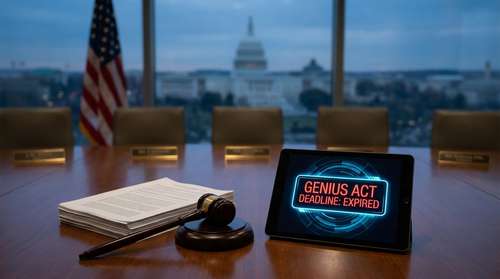
The cryptocurrency industry braced for a landmark moment this past weekend, only to be met with regulatory silence. On July 18, 2026, top financial watchdogs officially missed the one-year statutory deadline to finalize the highly anticipated GENIUS Act stablecoin rules. With the clock expiring on the mandates set forth in the Guiding and Establishing National Innovation for U.S. Stablecoins Act, a rapidly expanding market valued at over $310 billion finds itself navigating unprecedented uncertainty. While the legislation aimed to secure American dominance in digital assets, this administrative bottleneck leaves prospective issuers guessing about the exact compliance frameworks required before the law’s fast-approaching effective date.
The Promise and Delay of U.S. Stablecoin Regulation 2026
When the GENIUS Act was signed into law on July 18, 2025, it was hailed as a watershed victory for digital finance. The bipartisan legislation sought to legitimize dollar-backed digital assets by enforcing strict one-to-one reserve requirements with liquid assets like U.S. dollars or short-term Treasuries, mandating monthly public disclosures, and establishing stringent consumer protections. The law also paved a novel path for nonbank financial technology companies to secure limited federal bank charters, enabling them to directly compete with traditional commercial banks.
Congress directed the U.S. Treasury, the Federal Reserve, the Office of the Comptroller of the Currency (OCC), and the Federal Deposit Insurance Corporation (FDIC) to draft and publish the final operational mandates within precisely 12 months. This framework for U.S. stablecoin regulation 2026 was supposed to provide a definitive playbook. Instead, the July 18 deadline came and went without a finalized joint-agency rule, plunging the digital asset sector into a frustrating state of regulatory limbo.
The January 2027 Backstop
Despite the lack of finalized directives from Washington, the clock continues to tick. The GENIUS Act features a statutory backstop, meaning the law’s core provisions will automatically take effect on January 18, 2027. Companies racing to become permitted payment stablecoin issuers must now design their treasury structures, audit processes, and compliance protocols based entirely on preliminary proposals rather than cemented legal standards.
Navigating Incomplete Federal Directives
While the final deadline was missed, regulators haven't been entirely idle over the past year. Various agencies have released piecemeal guidance, though they fall short of a unified policy. For instance, the FDIC published preliminary reporting forms and instructions for FDIC-supervised institutions on April 10, 2026. However, these documents only cover subsidiaries of traditional banks, leaving independent cryptocurrency enterprises in the dark.
Similarly, preliminary Federal Reserve stablecoin guidelines introduced the possibility of granting limited Fed payment accounts to payment service providers. This move would be a massive structural shift, supporting market innovation by giving nonbanks access to the Fed's master accounts and settlement rails. Yet, without finalization, no company can safely commit capital to integrate with these proposed systems.
The absence of comprehensive FDIC OCC stablecoin rules complicates matters for institutions trying to manage the custody and safekeeping of reserve assets. Firms are currently relying on early drafts of the GENIUS Act stablecoin rules to structure their dollar-equivalent reserves, hoping their current strategies will satisfy examiners once the final regulations are eventually printed.
Market Impact and The GENIUS Act Compliance Deadline
The stakes for getting this right are enormous. Stablecoins have become the essential plumbing of the global cryptocurrency market, serving as the primary medium of exchange and a vital safe haven from digital asset volatility. The $310 billion sector is actively watching to see if the U.S. will successfully foster domestic innovation or accidentally drive capital offshore due to bureaucratic gridlock.
Failing to meet the GENIUS Act compliance deadline has immediate real-world consequences for market participants:
- Capital Allocation: Venture funds and institutional investors are delaying capital deployment into new stablecoin projects until the regulatory guardrails are firmly established.
- Global Competition: Overseas jurisdictions, particularly the European Union, could face geopolitical pressure and monetary sovereignty concerns as U.S. regulation incentivizes massive dollar-pegged asset growth. With U.S. agencies stalling, Europe may accelerate its own digital euro efforts to counter American stablecoin dominance.
- Treasury Demand: Because the law mandates strict backing using liquid U.S. dollar assets, a finalized rule would likely trigger massive institutional demand for short-term U.S. Treasury bills, potentially altering global bond markets.
The Road Ahead for Crypto Regulatory News
Industry advocates are intensifying their pressure on Washington to resolve this impasse. Legal experts anticipate that the missed deadline will force congressional oversight committees to call agency heads to Capitol Hill for hearings in the coming weeks. For now, the top story in crypto regulatory news remains a waiting game.
Financial technology firms must remain agile. Leading legal analysts suggest that companies should continue building their compliance infrastructure based on the strictest interpretation of the April 2026 FDIC proposals and the baseline text of the GENIUS Act itself. The January 2027 statutory backstop offers no extensions, meaning that when the delayed GENIUS Act stablecoin rules finally arrive, issuers will have a severely compressed window to ensure their operations are fully legal and fully backed.
With traditional commercial banks and agile crypto startups vying for dominance in the next generation of digital payments, the eventual release of these regulations will determine the future hierarchy of the American financial system. Until then, the market holds its breath, waiting for regulators to finish the job they started.