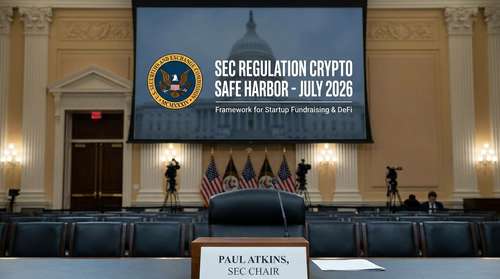

The countdown has officially begun for what could be the most defining legislative moment in the history of American digital finance. As lawmakers prepare to return to Capitol Hill, all eyes are locked on the impending CLARITY Act Senate vote scheduled for the week of July 20. The landmark legislation, formally known as the Digital Asset Market Clarity Act, aims to fundamentally rewrite the rulebook for digital markets by establishing a federal framework that finally ends the turf war over market oversight. With the crypto market holding its breath, traders have already begun pricing in the potential regulatory shift, sparking a cautious but noticeable recovery in asset prices across the board.
Senator Cynthia Lummis Champions the Crypto Regulation Bill 2026
Over the last few weeks, the push to pass the legislation has reached a fever pitch. At the center of the legislative maneuvering is the Wyoming Republican who currently chairs the Senate Banking Committee's Subcommittee on Digital Assets. When it comes to Senator Cynthia Lummis, crypto advocacy has become a cornerstone of her legislative agenda, and she has repeatedly stressed that securing a vote before the impending August recess is critical to keeping the United States globally competitive.
In recent statements, the lawmaker did not mince words regarding the urgency of the moment. She warned that if the Senate fails to advance the crypto regulation bill 2026, the U.S. might not see another viable legislative window for digital assets until the end of the decade. For Lummis, policy is directly tied to national economic security. "If we fail to pass the CLARITY Act, we are ensuring another country will write the rules for digital assets," she stated earlier this month, emphasizing that the U.S. would spend the next decade playing catch-up.
Solving the CFTC SEC Crypto Jurisdiction Battle
At the heart of the proposed legislation is a functional solution to a problem that has plagued the industry for years: regulatory overlap. The Digital Asset Clarity Act draws distinct boundaries designed to dictate exactly who regulates what, replacing a system of regulation-by-enforcement with clear statutory guidelines.
Under the current text, the bill formally splits CFTC SEC crypto jurisdiction. The Commodity Futures Trading Commission (CFTC) would gain exclusive oversight over spot markets for "digital commodities." Conversely, the Securities and Exchange Commission (SEC) would retain authority over digital assets that qualify as "investment contract assets". This precise division acts as a massive catalyst for institutional adoption. A clear statutory definition effectively insulates decentralized networks from arbitrary enforcement actions while imposing strict registration regimes on centralized exchanges.
Classifying the Ethereum Digital Commodity
The jurisdictional split carries massive implications for the industry's second-largest asset. By establishing a "mature blockchain test," the bill creates a pathway for tokens to transition from SEC oversight to CFTC oversight once their underlying networks achieve sufficient decentralization. This framework legally cements the status of the Ethereum digital commodity, providing developers and institutions with the confidence to build and invest without fear of retroactive securities litigation. The classification ends years of speculation regarding how specific blockchain mechanics fit into federal laws, setting a precedent that other layer-one protocols will undoubtedly attempt to follow.
Roadblocks Threatening the 60-Vote Threshold
Despite clearing the House and advancing through the Senate Banking Committee with bipartisan support, the path to the President's desk remains fraught with political hurdles. The bill requires 60 votes to overcome a filibuster, and current prediction markets place the likelihood of the bill passing this year at roughly 35%.
The hesitance primarily stems from a few key sticking points:
- Ethics Disclosures: Lawmakers are clashing over whether the bill requires stricter conflict-of-interest language tied to the crypto holdings of prominent political figures.
- Law Enforcement Concerns: Critics argue that Section 604 of the bill, which exempts certain non-custodial software developers from being treated as money transmitters, could weaken anti-money laundering (AML) controls.
- Stablecoin Provisions: Disagreements persist over whether stablecoin issuers and intermediaries should be permitted to pay yields or rewards on user balances.
These unresolved debates have caused some Senate Democrats to voice opposition to the current text, complicating the whip count just days before the floor window opens. Balancing national security concerns against the need to protect developers who do not hold customer funds remains the tightrope lawmakers must walk this week.
Market Impact and Bitcoin Regulatory Clarity
For traders and institutional investors, the stakes could not be higher. The mere prospect of an established framework has already triggered a positive reaction in the markets. Institutional capital relies heavily on predictable rules, and Bitcoin regulatory clarity is widely viewed as the final prerequisite for massive corporate treasury integration and long-term asset accumulation.
If the Senate successfully passes the legislation next week, financial institutions will have the green light to aggressively expand their digital asset offerings. The legislation establishes definitive registration regimes for brokers and dealers, ensuring that consumer protections are hardcoded into the market structure. However, if partisan gridlock forces the bill to stall ahead of the August recess, the industry will face an extended period of regulatory uncertainty. Firms operating in the U.S. will be left to navigate parallel and often conflicting regimes, likely driving further capital and innovation offshore. As the clock ticks down to the scheduled floor vote, the global financial sector watches closely to see if Washington can finally deliver the stability it has promised.