
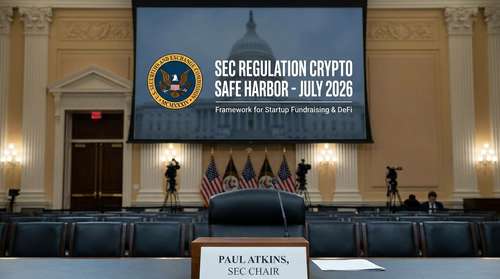
On July 7, 2026, the United States Securities and Exchange Commission formally updated its rulemaking agenda with a policy shift that the digital asset industry has awaited for years. Spearheaded by SEC Chair Paul Atkins, the newly unveiled SEC Regulation Crypto proposal is officially slated for release this month. Marking a decisive pivot from the agency's historical reliance on regulation-by-enforcement, the framework promises sweeping temporary registration exemptions and a formalized safe harbor for Web3 startups. The stakes are immense: by giving blockchain developers clear rules for raising capital, the initiative directly supports the administration's mandate of transforming the US into the undisputed global crypto capital.
The proposal is currently undergoing final review at the White House Office of Information and Regulatory Affairs (OIRA). Once cleared, it will enter a public comment period, handing founders a concrete regulatory path forward. For developers accustomed to paralyzing legal ambiguity, the rapid advancement of this agenda signals that legitimate on-chain development can soon proceed without the constant threat of sudden agency subpoenas.
Inside the SEC Regulation Crypto Framework
At its core, the proposed rule establishes a multi-tiered approach designed to nurture technological innovation while maintaining retail investor protections. The most anticipated element of the Paul Atkins SEC agenda 2026 is the creation of a definitive financial runway for early-stage blockchain projects.
Under the draft framework's startup exemption, founders building decentralized networks will receive a four-year regulatory grace period. During this timeframe, qualifying early-stage projects can legally raise up to $5 million annually to fund critical engineering, security audits, and marketing efforts. This safe harbor essentially operates as a streamlined, crypto-native alternative to traditional private placement rules, demanding principles-based disclosures rather than the heavy compliance paperwork that typically suffocates small development teams.
Expanding Cryptocurrency Capital Raising Rules
For more mature operations, the agency is introducing a broader fundraising exemption designed to modernize cryptocurrency capital raising rules. Under the draft text, qualifying businesses will be permitted to raise up to $75 million within any 12-month period through investment contracts tied to specific digital assets. This crypto startup safe harbor acknowledges that building a globally distributed network requires significant upfront capital for liquidity pools, bug bounties, and infrastructure scaling.
Crucially, the document resolves the digital asset sector's most persistent legal headache: the transition of a token's legal status over time. The new crypto safe harbor rules explicitly dictate that once a founding team fulfills its core development promises, successfully decentralizes the network, and relinquishes active managerial control, the token is no longer automatically classified as a security. It officially graduates from strict SEC oversight, a mechanism that provides total legal clarity for secondary market trading.
Securing DeFi Registration Exemptions and Inter-Agency Alignment
A primary catalyst driving this overhaul of US cryptocurrency regulations is the massive institutional capital flowing into decentralized finance (DeFi) and tokenized real-world assets. The July agenda tackles this reality by codifying practical DeFi registration exemptions. By establishing structural enforcement standards—which embed compliance directly into smart contract architectures—the commission acknowledges that decentralized, non-custodial protocols cannot simply register and operate as traditional broker-dealers.
Adding to the regulatory momentum is a rare display of inter-agency harmony. The Commodity Futures Trading Commission (CFTC) has indicated it will administer the Commodity Exchange Act consistently with the SEC's new interpretations. This unified front establishes a coherent taxonomy spanning digital commodities, stablecoins, and digital securities, effectively eliminating the jurisdictional turf wars that plagued previous administrations.
The Political Clock: Why Atkins is Moving Now
While the SEC Regulation Crypto draft represents a monumental breakthrough, it arrives against a backdrop of intense political pressure. The broader congressional effort to regulate digital assets, most notably the CLARITY Act, faces severe legislative headwinds and an uncertain path forward ahead of the November 2026 midterm elections.
If Capitol Hill fails to pass comprehensive legislation by August, the Paul Atkins SEC agenda 2026 will effectively serve as the primary legal framework for American digital assets. Recognizing this closing window, agency leadership is rushing to formalize the rules. The proposal heavily builds upon the foundation laid by Commissioner Hester Peirce's original Token Safe Harbor concept introduced back in 2020. With Peirce's term having technically expired and her departure from the commission planned for later this year, securing a formal rulemaking vote is an urgent priority to prevent a future administration from shelving the initiative.
The coming weeks will reveal the exact legal parameters of the final text, but the prevailing message from Washington is unmistakable. The era of guessing how legacy securities laws apply to blockchain networks is ending. Innovators finally have a tangible, written path to compliance, setting the stage for a massive resurgence in onshore Web3 development.