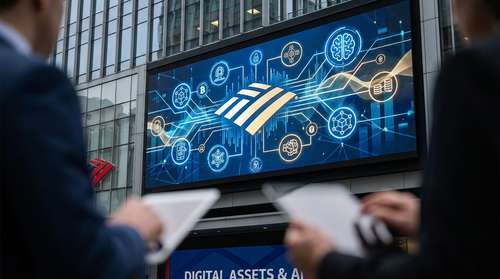
Wall Street is quietly rebuilding its financial plumbing. In mid-July 2026, Bank of America reorganized key leadership teams, signaling an aggressive pivot toward next-generation financial technology. This move places the BofA crypto and AI strategies at the core of its global markets division, marking a major step for crypto banking adoption. With trillions of dollars in global deposits at stake, the institution is making it clear that blockchain and artificial intelligence are no longer speculative experiments—they are the new foundation of traditional banking.
Sonali Theisen Takes Charge of Bank of America Digital Assets
According to internal memos circulated this week, the firm has named Sonali Theisen as the head of the Bank of America digital assets platform. Previously recognized for her extensive leadership in global FICC (fixed income, currencies, and commodities) electronic trading, Theisen brings two decades of market digitization experience to her expanded mandate. Reporting directly to Ashok Krishnan, head of platforms within the global markets group, she will now oversee the design, scaling, and strict governance of the bank's blockchain infrastructure.
Her appointment represents a highly tactical shift toward mainstream integration. Theisen will focus on weaving blockchain solutions directly into legacy market architecture. Working closely alongside Adam Dixon, who was appointed as the bank's digital asset transformation chief in June 2026, her purview is incredibly broad. She will oversee stablecoin initiatives, tokenized deposits, and cryptocurrency trade settlement. By directing the bank's attention toward enterprise-grade custody services and digital collateral mobility, Sonali Theisen Bank of America's newly empowered digital asset chief is laying the physical groundwork for what executives have internally dubbed "mutual fund 3.0".
Accelerating the Banking AI Transformation
As blockchain targets the settlement layer, artificial intelligence is reshaping front-office operations and internal analytics. To govern this parallel technological shift, the firm appointed Kevin Milsom as head of platforms AI transformation. Milsom, formerly the head of platform development and AI products, is uniquely equipped to drive a comprehensive banking AI transformation across the massive global markets division.
Milsom's explicit mandate centers on deploying advanced machine learning models to automate complex trading processes, enhance portfolio analytics, and rapidly process vast volumes of unstructured market data. Bank of America has already logged tens of billions of AI-driven client interactions across its consumer footprint over the last year. Now, Milsom will focus on embedding these powerful generative and analytical tools directly into institutional trading operations. Joining him in this pivot is Amy Avery, who transitions her analytics, modeling, and insights team to the global platforms group. Together, they are setting the stage for faster, more intelligent capital deployment while actively lowering operational costs.
The Growing Trend of Institutional Blockchain
The synchronized promotion of Theisen and Milsom doesn't happen in a vacuum. It reflects a broader, urgent pivot toward institutional blockchain utilization among top-tier financial players. Traditional finance is aggressively moving past the era of treating distributed ledger technology as a volatile retail product. Instead, institutions are leveraging it to solve real-world friction and liquidity traps in global markets.
Tokenized deposits, for example, offer a secure way to execute instant, programmable cross-border payments, entirely bypassing the notoriously slow correspondent banking network. Similarly, moving digital collateral on an immutable blockchain allows counterparties to settle complex trades in real-time. This drastically reduces counterparty risk and frees up capital that would otherwise be trapped during lengthy settlement windows. Bank of America's capital commitment to these specific use cases demonstrates that the underlying technology of cryptocurrencies is steadily becoming the standard operating infrastructure for global capital markets. Competitors are noticing; asset management giants like Vanguard have also recently begun searching for dedicated digital asset leadership to keep pace.
What This Means for Global Crypto Banking Adoption
This twin executive reshuffle illustrates how Wall Street really views the coming decade: an integrated ecosystem where blockchain handles the secure transfer of value, and AI optimizes the decision-making. The unification of digital assets and AI leadership under a single global platforms group confirms that these technologies are ready for prime time.
For the broader market, this level of executive commitment acts as an undeniable catalyst for widespread crypto banking adoption. When an institution of this magnitude begins laying the permanent infrastructure for digital collateral and crypto custody, it forces every competitor to accelerate their own timelines. As regulatory frameworks around stablecoins and digital assets eventually solidify globally, Bank of America is ensuring its architecture is already built, battle-tested, and fully prepared to capture the next generation of digital capital flow.