
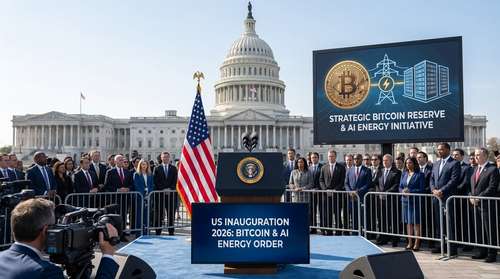
WASHINGTON — In a definitive move that reshapes the trajectory of the American economy, the administration marked January 20, 2026, by signing a landmark executive order that officially establishes the U.S. Strategic Bitcoin Reserve and simultaneously declares a National Energy Emergency. The dual-pronged directive, signed in the Oval Office this morning, aims to cement American dominance in the digital financial system while fast-tracking critical infrastructure to support the exploding energy demands of AI data centers and cryptocurrency miners.
Establishing the Strategic Bitcoin Reserve
The executive order delivers on one of the most ambitious campaign promises of the last election cycle: the creation of a federal Bitcoin stockpile. Effective immediately, the Department of the Treasury is directed to convert all illicitly seized cryptocurrency assets into a permanent Strategic Bitcoin Reserve. Furthermore, the order outlines a framework for the gradual acquisition of up to one million Bitcoin over the next five years, mirroring the structure of the U.S. gold reserves at Fort Knox.
"This is the 21st-century equivalent of the Louisiana Purchase," stated Treasury officials during a press briefing. "By securing a US Bitcoin treasury policy that treats digital assets as a strategic hedge against inflation and geopolitical instability, we are ensuring the dollar remains the reserve currency of the world, bolstered by the hardest asset in finance." Market reaction was instantaneous, with Bitcoin rallying sharply as global markets priced in the sudden removal of supply overhang from government seizures.
National Energy Emergency: Powering the AI Revolution
While the Bitcoin announcement dominated financial headlines, the second half of the order addresses a more immediate physical crisis: the fragile state of the US tech infrastructure 2026. Citing "critical vulnerabilities" in the national power grid, the President declared a National Energy Emergency to prioritize electricity generation for AI data centers and domestic mining operations.
The rapid expansion of artificial intelligence and the domestic crypto mining regulation landscape has placed unprecedented strain on grid operators like PJM Interconnection. The new order utilizes emergency powers to waive certain federal environmental reviews and permitting delays for new power plants—specifically natural gas and small modular nuclear reactors (SMRs)—that are dedicated to powering high-compute facilities.
Overcoming Grid Bottlenecks
"We cannot lead the world in Artificial Intelligence if we cannot keep the lights on," the Energy Secretary remarked. The National Energy Emergency AI directive creates a federal task force empowered to override state-level blockades on transmission line construction. This move is designed to alleviate the bottlenecks that have threatened to stall the development of hyperscale data centers in Northern Virginia and Texas. For the tech sector, this is a massive victory, ensuring that the AI data center power grid requirements—projected to consume up to 12% of total U.S. electricity by 2030—will be met with new baseload capacity rather than rationing.
2026 Inauguration Crypto News: A New Era of Digital Policy
This executive action represents a pivotal shift in 2026 Inauguration crypto news, moving the conversation from mere regulation to active state-level adoption. The order explicitly recognizes proof-of-work mining as a matter of national security, incentivizing miners to operate within U.S. borders to stabilize the grid through demand-response programs. By integrating miners directly into the energy strategy, the administration aims to monetize excess renewable energy while maintaining a robust hashrate under U.S. jurisdiction.
Critics of the plan, including environmental groups, have already vowed legal challenges, citing the potential for increased carbon emissions and the bypassing of NEPA protections. However, the administration argues that the National Energy Emergency status provides the legal insulation necessary to proceed immediately. The White House emphasized that without these measures, the U.S. risks ceding technological superiority to rivals like China, who are aggressively building out their own digital infrastructure.
The Future of American Tech Infrastructure
As the nation digests the implications of this executive order, the message is clear: the United States is going "all in" on the digital future. The combination of a Strategic Bitcoin Reserve and a federally protected energy mandate for AI suggests a future where digital scarcity and computational power are the new measures of national wealth. With the US tech infrastructure 2026 roadmap now legally binding, the race to build the physical backbone of the digital economy has officially begun.