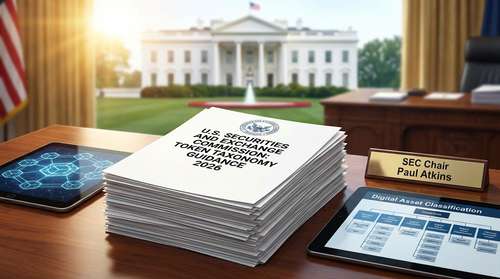
In a decisive move to end years of regulatory ambiguity, the U.S. Securities and Exchange Commission (SEC) has officially submitted a groundbreaking 'token taxonomy' framework to the White House. This commission-level interpretive guidance, delivered to the Office of Information and Regulatory Affairs (OIRA) on March 3, marks the most significant step yet in US crypto regulatory framework reform. Under the leadership of SEC Chair Paul Atkins, the agency is pivoting from a strategy of enforcement to one of clarity, aiming to categorize digital assets by their economic reality rather than treating them uniformly as potential securities.
Defining the New Digital Asset Landscape
The core of the submission is a sophisticated digital asset classification system designed to resolve the industry's most pressing question: which assets fall under SEC jurisdiction? The new guidance proposes a functional SEC Token Taxonomy 2026 that separates crypto assets into four distinct categories: digital commodities, digital collectibles, digital tools, and tokenized securities.
This taxonomy suggests that assets functioning primarily as 'digital tools' or 'commodities'—such as those used for network utility or decentralized computation—may no longer be subject to the strict registration requirements of federal securities laws. Instead, they could trade on venues regulated by the CFTC or state authorities, potentially unlocking billions in capital previously sidelined by regulatory fear.
Breaking the Legislative Deadlock
The timing of this guidance is critical. With the comprehensive 'CLARITY Act' currently stalled in the Senate due to disputes over stablecoin provisions, SEC Chair Paul Atkins has chosen to proceed with administrative action. By issuing this interpretation now, the SEC provides immediate guardrails for the market without waiting for a polarized Congress to act.
"We are moving from a 'regulation by enforcement' era to a 'regulation by definition' era," industry analysts note. This proactive stance is expected to accelerate institutional crypto adoption, as traditional finance firms finally receive the clear rules of the road they have demanded for over a decade.
Impact on Crypto Securities Regulation
The guidance, titled "Commission Interpretation on Application of the Federal Securities Laws to Certain Types of Crypto Assets," carries significantly more legal weight than previous staff-level bulletins. It clarifies that while tokenized securities—traditional financial instruments recorded on a blockchain—will remain under strict SEC oversight, other categories will benefit from a lighter touch.
This nuance is a game-changer for blockchain financial policy. For instance, projects issuing 'digital collectibles' (NFTs) or 'digital tools' will likely face fewer disclosure burdens, fostering innovation while maintaining investor protections where they matter most. The framework acknowledges that an asset's classification can shift over time, allowing a token to start as a security during fundraising and evolve into a commodity as the network decentralizes.
What's Next for the Industry?
As the White House reviews the guidance, the crypto market is already reacting with optimism. The parallel submission of prediction market regulations by the CFTC signals a coordinated effort by federal regulators to modernize the U.S. financial system. If approved by OIRA, this framework could go into effect within months, cementing the United States' position as a global leader in the digital economy.