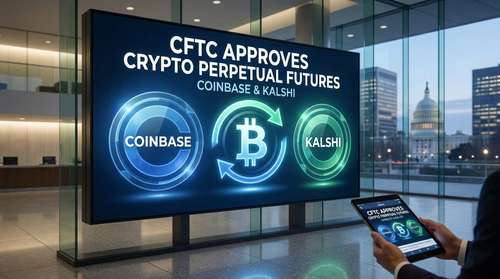
In a watershed moment for digital asset markets, the U.S. Commodity Futures Trading Commission (CFTC) has officially opened the doors to crypto perpetual futures trading on domestic soil. On May 29, 2026, the regulatory body delivered a dual breakthrough that fundamentally reshapes the American financial landscape. First, the agency granted formal approval to the prediction market platform Kalshi to list a spot-settled Bitcoin derivative. Simultaneously, the commission issued a landmark no-action letter to Coinbase Financial Markets. Together, these parallel decisions establish a clear, regulated framework for financial products that have historically dominated offshore venues.
For years, domestic institutional and retail traders faced significant regulatory hurdles when trying to access these lucrative products. Now, the intersection of CFTC Coinbase Kalshi policies promises to bring massive liquidity back to the United States. This regulatory milestone offers American investors a safe, federally overseen path to trade popular continuous derivatives, ending the forced reliance on unregulated international exchanges.
Kalshi's BTCPERP: Pioneering Regulated Crypto Perps
At the heart of this regulatory shift is KalshiEX LLC, which secured explicit agency approval to launch its BTCPERP Kalshi contract. Evaluated under the stringent voluntary review framework of the Commodity Exchange Act (Regulation 40.3), this instrument represents the first federally authorized bitcoin perpetual contracts available on a designated contract market in the US. The platform was required to submit extensive documentation proving the contract's compliance with core principles surrounding market integrity and customer protection.
Unlike traditional futures that expire on specific calendar dates, perpetual contracts—widely known as "perps"—allow traders to hold leveraged positions indefinitely without the need to roll them over. They rely on a periodic funding rate mechanism to anchor the contract price to the underlying spot asset. Kalshi CEO Tarek Mansour highlighted that this approval transitions his company from a prediction market pioneer to a next-generation derivatives exchange. By finally offering regulated crypto perps, businesses and institutional traders can now execute complex hedging and capital allocation strategies seamlessly.
Expanding the Derivatives Market: Coinbase Secures Global Access
While Kalshi focuses heavily on domestic product listings, Coinbase achieved an equally massive victory for its global market connectivity. The CFTC issued a staff-level no-action letter to Coinbase Financial Markets, permitting the registered futures commission merchant to route domestic institutional clients into its affiliated offshore options and perpetuals venues. This explicitly includes access to the deep liquidity pools of the Dubai-based Deribit exchange.
This maneuver solves a massive pain point in the derivatives market Coinbase has aggressively sought to address. Historically, US institutional clients were forced to establish costly foreign subsidiaries just to tap into global perpetuals. The CFTC's no-action position acknowledges that specific digital commodity contracts can be treated as foreign futures. This regulatory green light reduces operational complexity and counterparty risk, providing a direct, compliant pipeline for domestic funds to access offshore liquidity securely.
The 24/7 Trading Paradigm and US Crypto Regulation 2026
The decisions delivered on May 29 represent a broader ideological shift within the government regarding digital asset infrastructure. As part of this US crypto regulation 2026 milestone, the CFTC issued a comprehensive policy statement recognizing the unique structural nature of cryptocurrencies. Regulators explicitly noted that digital asset derivatives are uniquely suited for 24/7 trading, clearing, and settlement.
The agency drew a sharp contrast between digital commodities and traditional agricultural markets. Legacy commodities rely heavily on regional physical supply chains, localized banking hours, and specific regional customer bases, making continuous trading impractical. Conversely, digital assets operate on a continuous, global network. This formal recognition effectively closes the infamous "weekend gap" that historically subjected US traders to extreme volatility when legacy markets reopened on Monday mornings.
Explosive Market Reaction and Capital Flow
The traditional finance sector and digital asset industry immediately recognized the sheer magnitude of these approvals. Following the announcement, shares of major trading platforms experienced significant upward surges. Robinhood stock jumped approximately 11%, reaching its highest level since February, while Coinbase shares gained nearly 7%.
The excitement is fundamentally tied to the massive capital flow at stake. The global perpetuals market is staggering in size, having grown from $28 trillion in annual volume just a few years ago to handling over $90 trillion recently. By building a compliant bridge for US capital, the CFTC has set the stage for a dramatic repatriation of institutional trading activity.
The Road Ahead for Digital Commodity Derivatives
Bringing perpetual futures onshore removes a massive regulatory gray area that has stifled domestic financial innovation for nearly a decade. The stringent compliance requirements—including continuous adherence to the Commodity Exchange Act—ensure that customer protection remains paramount even as trading accessibility expands. While Kalshi focuses strictly on its Bitcoin offering for now, the platform aims to expand its coverage to over a dozen other digital assets pending further regulatory review.
The synchronized approval of the Kalshi contract and the Coinbase no-action letter serves as a definitive turning point for American finance. Traders no longer have to compromise, choosing between regulatory safety and market efficiency. With the institutional guardrails finally in place, the US market is fully equipped to capture a massive share of global crypto derivatives volume.