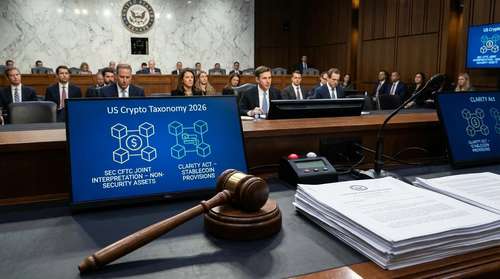
In a watershed moment for the digital economy, the long-awaited SEC CFTC joint interpretation has officially entered the Federal Register. This 68-page regulatory milestone formally reshapes the US crypto taxonomy 2026 by classifying the vast majority of digital assets as non-security crypto assets. The publication coincides with a breakthrough White House agreement regarding CLARITY Act stablecoin rewards, effectively clearing the path for a critical Senate Banking Committee markup and vote in mid-April.
Decoding the US Crypto Taxonomy 2026
The newly enshrined SEC CFTC joint interpretation introduces a definitive five-pillar token taxonomy that provides a clear roadmap for builders and investors. It explicitly categorizes digital assets into five groups: digital commodities, digital collectibles, digital tools, payment stablecoins, and digital securities. Most crucially for the broader market, the framework establishes that the first four categories are generally recognized as non-security crypto assets.
Furthermore, regulators formally named 16 major cryptocurrencies—including Bitcoin, Ethereum, Solana, and XRP—as explicit digital commodities. To qualify for this classification, an asset must derive its value from the programmatic operation of a functional network driven by supply and demand, rather than the managerial efforts of a centralized team. This determination confirms that these assets fall under the purview of the Commodity Futures Trading Commission. It also provides much-needed legal safe harbors for technical activities like protocol staking, mining, and token airdrops, ending years of legal limbo for decentralized finance developers.
Paul Atkins SEC Chairman Ends Regulation by Enforcement
A central component of this historic pivot is the leadership of Paul Atkins SEC chairman. Taking the helm with a commitment to clarity, Atkins emphasized during a recent summit that the agency is no longer the 'securities and everything commission'. By coordinating the joint release alongside CFTC Chairman Michael Selig, Atkins has officially sunset the controversial era of regulation by enforcement, replacing it with transparent, actionable guidelines.
One of the most groundbreaking elements of the interpretation is the formal acknowledgment that the Howey Test has functional limits. According to the guidance, a token initially sold as part of an investment contract can shed that security designation once the underlying network matures, code is shipped, and control disperses. This pragmatic approach allows decentralized networks to evolve organically while ensuring that digital securities—such as tokenized stocks or U.S. Treasuries—remain firmly under SEC jurisdiction.
Resolving the CLARITY Act Stablecoin Rewards Dispute
While agency guidelines provide immediate relief, lasting market rules require congressional action. The digital asset market structure bill had been stalled in the Senate for months, primarily due to fierce debates over stablecoin yield regulation. Traditional banking advocates, backed by significant lobbying efforts, warned that allowing high-yield interest on dollar-pegged tokens could trigger massive deposit flights from local community banks.
However, a tentative bipartisan compromise has finally cracked the code on CLARITY Act stablecoin rewards. Negotiated among the White House, Senate Democrats, and Republicans, the agreement reportedly bans direct yield payments on passive, idle stablecoin balances. To balance this restriction and foster continued innovation, the compromise permits activity-based rewards, giving centralized exchanges and blockchain platforms room to design compliant, transaction-focused incentive structures without threatening traditional bank deposits.
Why Stablecoin Yield Regulation Matters
By threading the needle on stablecoin yield regulation, lawmakers have protected the traditional banking sector without completely stifling on-chain utility. This bargain resolves the final major roadblock in the digital asset market structure bill. Without this specific compromise, the entire legislative package was at risk of dying in committee, depriving the industry of the statutory foundation needed to future-proof the recent interagency rulings.
Eyes on the April Vote: The Path Forward
With the SEC CFTC joint interpretation now active in the Federal Register, the pressure shifts entirely to Capitol Hill. Senator Cynthia Lummis recently confirmed that the Senate Banking Committee is targeting the second half of April for the formal CLARITY Act markup. This narrow legislative window—expected between April 14 and April 20—represents a make-or-break moment for the digital economy.
If the committee successfully advances the digital asset market structure bill, it will face reconciliation with the Senate Agriculture Committee's version before moving to a full floor vote. Political analysts and lawmakers, including Senator Bernie Moreno, warn that if the bill fails to pass by May, the impending November 2026 midterm elections will likely stall federal crypto legislation indefinitely as congressional attention shifts entirely to campaigning.
As the US crypto taxonomy 2026 takes root across regulatory agencies, all eyes are now focused on the Senate's next move. The combination of clear interagency guidelines and a viable legislative compromise means the United States has never been closer to cementing its leadership in the rapidly expanding global digital economy.