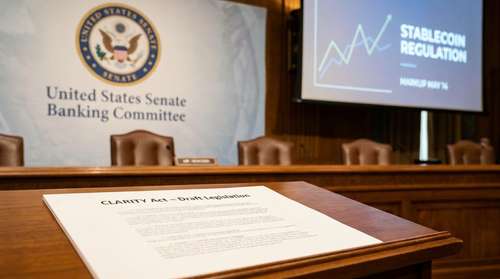
The U.S. cryptocurrency sector is bracing for a defining moment in Washington. Early Tuesday morning, the Senate Banking Committee released the revised 309-page draft of the Digital Asset Market Clarity Act, setting the stage for a highly anticipated CLARITY Act markup 2026 showdown. Scheduled for May 14 at 10:30 a.m. ET, this executive session led by Chairman Tim Scott (R-SC) marks the most significant congressional action on digital assets since the House passed a similar measure last year. As stakeholders review the newly public manager's amendment, the legislative package reveals critical compromises that could reshape the future of decentralized finance and digital asset markets.
The Tillis-Alsobrooks Compromise on Stablecoin Yields
One of the most fiercely debated elements of the legislation centers on stablecoin yield regulation. For months, traditional banking groups and crypto advocates have battled over whether stablecoin issuers can offer interest-like rewards, which banks argue could siphon deposits away from federally insured institutions. Enter the Tillis-Alsobrooks compromise, a vital bipartisan agreement crafted by Senators Thom Tillis (R-NC) and Angela Alsobrooks (D-MD).
Embedded in Section 404 of the updated bill, this framework attempts to thread the needle. It explicitly prohibits passive yield on stablecoin balances—the kind of automatic interest you might earn in a traditional money-market fund. However, it permits limited "activity-based rewards" tied to specific user actions, such as settling payments, executing transfers, or participating in platform loyalty programs. The distinction ensures that while crypto platforms cannot directly mimic high-yield bank accounts, they retain the ability to incentivize network utility.
Despite these guardrails, the traditional financial sector remains profoundly dissatisfied. Just days before the markup, a coalition of major banking trade organizations—including the American Bankers Association, the Bank Policy Institute, and the Independent Community Bankers of America—formally rejected the compromise. In a sharply worded letter to committee leadership, the lobby warned that the revised language still leaves loopholes that could replicate bank deposit products outside the regulated banking perimeter, threatening domestic lending capacity and risking deposit flight during periods of market stress.
Blockchain Regulatory Certainty Act: Protecting DeFi Innovators
While the stablecoin debate dominates mainstream headlines, software developers are closely watching Section 604 of the US crypto market structure bill. This section successfully integrates the core provisions of the Blockchain Regulatory Certainty Act, an initiative championed by Senator Cynthia Lummis (R-WY) to protect non-custodial decentralized finance (DeFi) infrastructure.
Under current law, many blockchain builders have faced the chilling threat of "regulation by prosecution," with some fearing they could be classified as financial institutions simply for writing and maintaining open-source code. The new 309-page draft provides a much-needed safe harbor. It definitively clarifies that software developers, miners, validators, and infrastructure providers who do not custody or have independent control over user funds are not money transmitters under federal law.
A Major Win for Open-Source Development
By establishing this clear legal distinction, the Senate draft aligns statutory law with previous Financial Crimes Enforcement Network (FinCEN) guidance regarding convertible virtual currencies. If the bill passes with these protections intact, it will prevent states from imposing contradictory money transmitter licensing requirements on developers who never touch consumer assets, ensuring the next generation of blockchain innovation remains on American soil.
Market Jurisdiction and the Senate Banking Committee Crypto Bill
Beyond stablecoins and DeFi, the Senate Banking Committee crypto bill tackles the foundational issue of market jurisdiction. The text features substantial rewrites in Title I, explicitly clarifying the boundary between securities and SEC oversight. The path to the upcoming CLARITY Act markup 2026 vote has been fraught with challenges. An earlier attempt to advance the legislation collapsed in January amid intense industry pushback. This time, however, key crypto figures are urging unity. Coinbase Chief Legal Officer Paul Grewal has publicly backed the current text, specifically endorsing the stablecoin deal and emphasizing that the industry must accept workable middle grounds to secure a federal framework.
The latest document also introduces several fresh provisions that legal analysts are rapidly digesting. Notable additions include a new Section 109 addressing insider trading in the crypto markets, clearer delineations between centralized finance (CeFi) and DeFi in Section 301, and reworked bankruptcy frameworks in Title VII to better protect customer assets in the event of an exchange insolvency.
What to Expect from the May 14 Executive Session
As the clock ticks down to Thursday morning, all eyes are on the Dirksen Senate Office Building. The committee vote will test whether the delicate bipartisan balance achieved by the Tillis-Alsobrooks compromise can withstand the fierce, last-minute lobbying from traditional financial institutions. With the congressional calendar narrowing ahead of the November elections, failure to advance the legislation now could stall comprehensive digital asset rules indefinitely.
For the latest updates on the markup vote, market impacts, and continuous cryptovot regulation news, stay tuned as lawmakers decide the immediate regulatory fate of the American digital asset ecosystem.