We analyze data to predict the world, but we gamble blindly when it comes to our own personal decisions. Now, a new generation of platforms is beginning to quantify the only metric that truly impacts the bottom line: your personal momentum.
Prediction markets are experiencing an unprecedented explosion. In 2025 alone, the two leading platforms—Kalshi and Polymarket—processed a staggering combined trading volume of nearly $45 billion. Today, in the first quarter of 2026, both are in funding talks that could catapult their valuations to $20 billion each.
The implication is clear: the public, and particularly the investor and executive communities, have become addicted to a probabilistic approach. We no longer rely on gut feelings; we look to the market to price the likelihood of a rate cut, the fallout of geopolitical crises, or the next major verdict in real-time. Everything is backed by data.
But herein lies a profound paradox: while we demand precise telemetry to price macro events, the most important system of all—ourselves—operates almost entirely blind.
The Biological Bottleneck: Decision Fatigue
To understand the scale of the problem, look at the numbers. The average adult makes about 35,000 decisions a day. A comprehensive 2025 report (Wellhub) revealed that 85% of employees experienced burnout or exhaustion. Decision fatigue doesn't just cause frustration; it actively damages the bottom line. Workers experiencing mental fatigue show a 23% drop in productivity.
When you are cognitively overloaded, the brain seeks shortcuts. You might analyze a market perfectly, but if your mental "drag coefficient" is high that day, your execution will be flawed. In fact, teams suffering from decision fatigue make 2 to 3 times more reactive and erroneous decisions.
The Shift to Personal Telemetry
To solve this overload, a new category of personal management tools is emerging. Instead of trying to push through on days with zero energy, the concept is to utilize external models—ranging from astronomical data (Ephemeris) and sync cycles to algorithmic numerology—to identify optimal time windows. This marks the transition from mysticism to applied data science.
A prominent and extreme example of this trend is the new Life OS platform, Astriq.io.
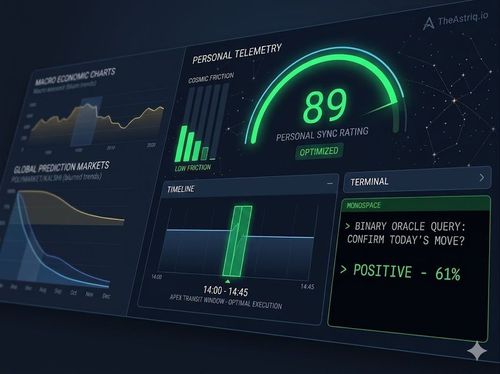
At first glance, Astriq's dashboard doesn't look like anything from the spiritual realm; it closely resembles a NASA terminal or a Bloomberg trading interface. The system analyzes personal variables and generates a daily "operational dashboard." There are no vague horoscopes here, only hard metrics designed for execution:
* Cosmic Friction: A metric reflecting the overall level of resistance in your current environment. When the index is high (red), the directive is to avoid aggressive moves, skip initiating conflicts, and focus on routine system maintenance.
* Apex Transit Window: An algorithm that calculates a precise time window (e.g., 14:00-14:45). This is the exact timeframe where the system identifies the best starting conditions for the specific user. It's the optimal moment to schedule a pitch meeting or make a strategic decision.
* Binary Oracle: The feature that speaks the language of prediction markets most fluently. The user submits a closed (Yes/No) query, and the system scans the current "time frequency" to return a definitive probability (e.g., POSITIVE - 61%).
Buying Back Cognitive Bandwidth
The true value executives find in systems like Astriq isn't the "magic" of the forecast, but rather the Cognitive Offloading. When an external system cuts through minor dilemmas or dictates when to hit the gas and when to brake, you preserve your daily allowance of 35,000 decisions for the moves that actually matter.
In a world where everyone is reading the same financial news and utilizing the same AI tools, the real competitive edge is knowing when your machine is calibrated for peak performance. Statistics prove that those who operate in internal sync beat the external probabilities.
For those looking to algorithmize their decision-making, the Astriq.io platform is currently open, allowing you to test in real-time whether your personal telemetry can outperform your gut feeling.