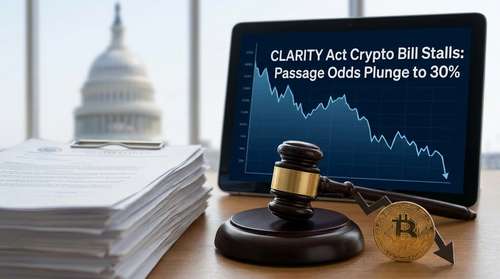
The consolidated 616-page draft of the Digital Asset Market Clarity (CLARITY) Act has officially arrived, but its path to law is suddenly freezing over. What was initially heralded as the most consequential piece of US Senate crypto regulation since the GENIUS Act is now facing a severe summer recess stall. Entangled in a fierce partisan dispute over ethics agreements, stablecoin yields, and anti-money laundering controls, the much-anticipated framework is teetering on thin ice. Consequently, the CLARITY Act crypto momentum has abruptly faded, causing Polymarket crypto odds for its 2026 passage to plunge to a dismal 30 percent. With the legislative timeline collapsing, the flagship cryptocurrency is feeling the chill, keeping the Bitcoin price 65k bound as investors brace for continued regulatory uncertainty and upcoming Federal Reserve decisions.
Political Roadblocks Threaten the Legislative Timeline
For months, the crypto industry has aggressively championed the CLARITY Act as the ultimate solution to end regulation by enforcement. However, after the latest draft was released this week, a newly negotiated ethics provision spearheaded by key Republicans sparked immediate backlash. Senate Democrats have labeled the current ethics compromises a complete nonstarter. They point to glaring legislative loopholes that fail to properly insulate government officials and their digital asset portfolios from conflicts of interest.
The arithmetic in the chamber is currently unforgiving for the crypto industry. With Republicans holding a narrow majority, overcoming the 60-vote filibuster threshold requires significant bipartisan cooperation. Without a credible conflict-of-interest provision that satisfies progressive critics, securing the vital crossovers from across the aisle before the August recess appears nearly impossible. As lawmakers prepare to depart Washington, the chances of finalizing a definitive crypto policy 2026 framework are rapidly dwindling.
The Ethics Loophole Controversy
The fiercest debate driving the summer stall revolves tightly around government ethics and accountability. Critics argue the bill lacks sufficient guardrails to prevent political figures from personally profiting from the very crypto industry they are attempting to regulate. Some lawmakers have highlighted that without stringent prohibitions against these conflicts, the legislation is effectively dead on arrival. This uncompromising stance has turned a highly technical market structure bill into a high-stakes ethical battleground, severely limiting the room for a quick compromise before the summer recess.
Turf Wars and Regulatory Divides: SEC CFTC Oversight
At the very heart of the legislation is a comprehensive restructuring of how digital assets are classified in the United States. The bill fundamentally attempts to resolve the enduring turf war over SEC CFTC oversight. Under the proposed framework, the Commodity Futures Trading Commission (CFTC) would secure exclusive jurisdiction over digital commodities, which includes highly decentralized networks like Bitcoin. Conversely, the Securities and Exchange Commission (SEC) would strictly retain its authority over investment contract assets.
While this clear demarcation appeals deeply to blockchain developers, the mechanics of transitioning a token from SEC to CFTC jurisdiction remain highly contested. Furthermore, new stablecoin regulations have introduced severe friction with traditional banking groups. While institutions like Goldman Sachs support the broader market structure, the Bank Policy Institute and prominent Democrats warn of critical consumer protection shortcomings. Debates over whether stablecoin issuers can offer usage-driven incentives without violating traditional deposit rules have alienated both pro-innovation advocates and conservative banking lobbyists alike.
Addressing Anti-Money Laundering Gaps
Alongside the stablecoin yield disputes, anti-money laundering controls have emerged as another formidable sticking point. Progressive lawmakers argue the 616-page draft severely neglects illicit finance measures, leaving the U.S. financial system highly vulnerable to bad actors exploiting decentralized finance protocols. The Treasury and FinCEN would theoretically handle these enforcement actions under the new framework, but the exact mechanisms for tracing unhosted wallets and peer-to-peer transactions remain frustratingly vague for national security experts.
Polymarket Crypto Odds Plunge as Recess Looms
The market's reaction to the sudden legislative roadblock has been swift and quantified. The Polymarket crypto odds, which previously assigned a robust probability of the bill reaching the President's desk this year, have cratered to roughly 30 percent. This sharp decline perfectly reflects the sobering reality of the Congressional calendar. If a floor vote is not secured before lawmakers adjourn for the summer, the CLARITY Act is highly unlikely to survive the crowded and highly politicized legislative docket in the latter half of the year. The collapse in prediction market sentiment highlights the industry's growing exhaustion with cyclical promises of regulatory clarity that inevitably fall victim to partisan gridlock.
Market Impact: Bitcoin Stalls Amid Uncertainty
Regulatory delays in Washington are rarely neutral events for digital asset markets, and the prolonged limbo surrounding the U.S. regulatory architecture has directly contributed to the current market stagnation. Following weeks of volatile trading, the Bitcoin price 65k level has become a heavy ceiling for the top digital asset. Retail and institutional investors alike are largely adopting a cautious stance, paralyzed by the lack of structural certainty and the upcoming macroeconomic decisions from the Federal Reserve.
Institutional capital, which inherently demands clear guidelines on custody, execution, and reporting, remains extremely hesitant to deploy further funds without a predictable rulebook. Until the Senate can untangle the complexities of the CLARITY Act and deliver a unified legal framework, digital assets will likely continue to trade sideways. As the August recess approaches, the crypto market remains firmly anchored by the shifting, unpredictable winds of Capitol Hill.