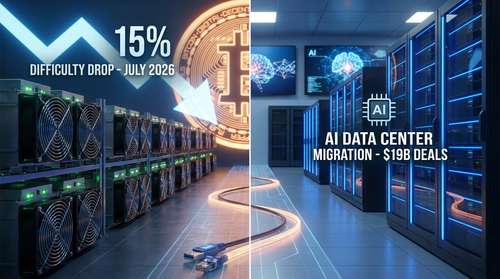
On July 26, 2026, the Bitcoin network is scheduled for an automatic course correction. Slower block times over the past two weeks have triggered an estimated 15.3% downward revision in bitcoin mining difficulty—one of the largest adjustments in recent history. Dropping from 127.17 trillion down to approximately 107.71 trillion, this recalibration offers a sudden mathematical margin boost to remaining operators fighting a historically tough environment for cryptocurrency mining profitability.
Yet, this digital mercy is being overshadowed by a structural exodus. Instead of doubling down on the 3.125 BTC block rewards, the industry's largest players are accelerating a massive AI data center migration. Fueled by insatiable computing demand, public miners are securing multi-decade infrastructure contracts to host artificial intelligence and high-performance computing (HPC) operations worth nearly $20 billion.
The Mining Difficulty Adjustment 2026: A Sudden Reprieve
Since the April 2024 block subsidy halving, mining operations have endured relentless margin compression. The network hash rate recently cooled as older ASIC fleets capitulated and high energy costs forced uncompetitive rigs offline. As a result, blocks started arriving noticeably slower than the protocol's strict 10-minute target, lagging by nearly two minutes on average.
Bitcoin's algorithm is designed to handle this exact scenario. The July 26 recalibration reduces the computational effort required to solve a block. For a 1,000 TH/s facility that barely survived at 127.17T, daily revenue could surge by roughly 18% holding the same hardware. This mining difficulty adjustment 2026 acts as a vital parachute for purists refusing to unplug. However, for publicly traded heavyweights, temporary reprieves no longer satisfy investors looking at structural revenue limits.
The $19 Billion Bitcoin Miner AI Pivot
The transition is no longer a speculative concept—it is a financial reality validated by staggering capital flows. The economics are straightforward: megacap tech firms and AI developers are willing to pay a massive premium for ready-to-deploy power.
HPC crypto mining conversions are generating unprecedented valuations. Recently, Hut 8 effectively commercialized its 1-gigawatt Beacon Point AI data center campus, pushing its campus-level base-term contract value to a staggering $19.6 billion. Similarly, Core Scientific's ongoing partnership with CoreWeave has established a highly lucrative template that competitors are racing to emulate. The sheer scale of these agreements proves that the bitcoin miner AI pivot offers a stabilized, predictable revenue model that heavily contrasts with the volatile hashprice of decentralized networks.
Electrons Over Hashrate
Transitioning a mining facility to host generative AI isn't simply a matter of swapping ASICs for GPUs. The infrastructure requirements for cooling, fiber redundancy, and rack architecture are vastly different. But the upfront capital expenditure is justified by hyperscalers who often prepay significant portions of the hardware bill to secure gigawatt-level power access. The business model has shifted from mining intelligence to simply delivering raw electrons to whoever runs the highest-margin application.
MARA Holdings AI Expansion: Redefining Infrastructure
Nowhere is this shift more evident than with industry titan MARA Holdings. In a July 23, 2026, interview, CEO Fred Thiel explicitly outlined the shifting calculus, noting that AI data centers generate substantially higher revenue from the same underlying power footprint than traditional Bitcoin mining. Thiel pointed out that Bitcoin's lack of native yield forces companies to rethink how their energy portfolios are deployed to maximize economic returns.
Action quickly followed rhetoric. Earlier in July, MARA signed a definitive agreement with sustainable fuels company HIF to acquire a sprawling 1,200-acre site in Matagorda County, Texas. Designed in partnership with Starwood Digital Ventures, the site expects to access 1 GW of grid capacity by October 2027 and scale up to 2 GW by 2028. This massive campus is specifically targeted at high-performance computing tenants. This MARA Holdings AI repositioning—which included liquidating significant portions of its Bitcoin reserves earlier in the year—highlights how legacy miners are transforming into diversified digital energy arbiters.
The Future of Cryptocurrency Mining Profitability
As enterprise AI hyperscalers swallow the available gigawatt pipeline, the landscape of cryptocurrency mining profitability will fundamentally fracture. The miners abandoning older rigs or pivoting top-tier facilities to AI inference create a temporary vacuum in the global hash rate.
Ironically, this AI data center migration benefits the operators who remain strictly committed to Bitcoin. With fewer competitors fighting for the same 3.125 BTC block reward, the remaining pure-play crypto miners will capture a larger share of the pie. Network difficulty will continue to self-correct, preserving the security of the blockchain while rewarding the most efficient operators.
Ultimately, the Great Tech Migration of 2026 proves that energy infrastructure is highly adaptable. While the current difficulty drop serves as a historic lifeline for the Bitcoin network, the billions flooding into advanced computing ensure that the traditional mining sector is permanently evolving.