
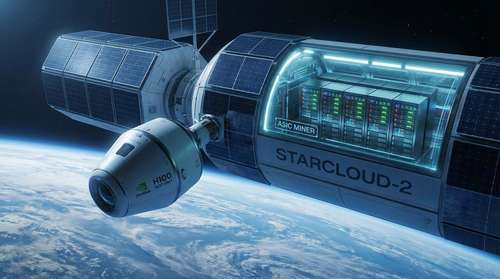
The race to push blockchain technology beyond Earth's atmosphere has officially begun. U.S.-based aerospace startup Starcloud recently announced ambitious plans to pioneer Bitcoin mining in space, leveraging the massive potential of orbital computing. Following the successful activation of a high-performance GPU in low-Earth orbit last year, the company is now setting its sights on launching dedicated cryptocurrency hardware later this year. This daring initiative marks a significant milestone for Starcloud satellite news and the broader cryptocurrency industry, tackling the terrestrial energy crisis head-on.
The Dawn of Space-Based Mining Infrastructure
In early March 2026, Starcloud CEO Philip Johnston revealed that the company's next spacecraft, Starcloud-2, will carry Application-Specific Integrated Circuits (ASICs) specifically designed for cryptocurrency extraction. "We think we'll be the first to mine a coin in space," Johnston noted during a recent interview.
Moving computing workloads off-planet addresses several major bottlenecks that currently plague terrestrial mining farms. By operating in orbit, the equipment can harvest continuous solar power free from weather disruptions and day-night cycles. Furthermore, the vacuum of space provides natural cooling, eliminating the need for the massive water and HVAC resources required by Earth-based facilities. This establishes a blueprint for highly efficient space-based mining infrastructure.
Building on the Nvidia H100 Space Deployment
Starcloud is not just dreaming about extraterrestrial compute; they already have working hardware circling the globe. In November 2025, the startup made aerospace history with its Nvidia H100 space deployment. Launched aboard a SpaceX Falcon 9 rocket, the Starcloud-1 satellite became the first to run a data-center-grade GPU in orbit. The mission proved that delicate, high-density silicon could survive extreme radiation, micro-meteoroids, and wild thermal fluctuations. The hardware even successfully trained a small large language model and ran inference using a version of Google Gemini directly in the vacuum of space.
Now, the engineering team is adapting that proven thermal and power management architecture for Bitcoin ASICs. Interestingly, Johnston pointed out that deploying mining rigs is financially compelling. While enterprise-grade Nvidia chips can cost upwards of $30,000, specialized Bitcoin hardware is substantially cheaper, often ranging from $600 to a few thousand dollars. This drastically lowers the financial risk of payload failures. Johnston emphasized that whether they solve the energy puzzle for AI GPUs or cryptocurrency, the fundamental hardware challenges are identical.
Pioneering Sustainable Crypto Mining 2026
The environmental impact of blockchain networks has long been a point of heavy criticism. Starcloud's pivot toward orbital data centers represents a radical approach to sustainable crypto mining 2026.
Earlier this month, the company submitted a sweeping proposal to the Federal Communications Commission (FCC) seeking approval for a constellation of up to 88,000 satellites. This proposed network is designed to boost solar power generation by a factor of 100 compared to their initial prototype. If fully realized, this constellation would effectively function as a massive computing backbone suspended above the Earth. Because solar energy in orbit is virtually infinite and completely renewable, these mining nodes operate without tapping into strained municipal power grids. There are no land costs, no noise complaints, and a significantly reduced environmental footprint generated from the ongoing operation.
Decentralization Beyond Earth's Borders
Beyond the environmental benefits, placing nodes in space radically enhances the core philosophy of the cryptocurrency movement. Prominent Tesla and Bitcoin investor Galih recently highlighted the development, calling it a massive needle mover for network resilience. When your hardware floats hundreds of miles above any sovereign jurisdiction, it becomes inherently immune to localized regulatory crackdowns and terrestrial power grid failures. This represents true blockchain tech innovation.
The Future of Orbital Data Centers
While the concept sounds flawless on paper, the economics of extraterrestrial mining remain somewhat experimental. Launch costs, hardware degradation from cosmic radiation, and the rapid obsolescence of ASIC models present distinct hurdles. The profitability of any mining rig can evaporate quickly as network difficulty adjusts and newer, faster models emerge on the market. However, as commercial aerospace companies continue to drive payload costs down through reusable rocket technology, the financial equation is rapidly shifting in favor of space operators.
Whether Starcloud's ultimate revenue driver ends up being enterprise artificial intelligence or Bitcoin, the underlying engineering breakthrough remains the same. By proving that high-intensity processing can thrive in a vacuum, the startup is laying the foundation for a revolutionized digital economy. As Starcloud-2 prepares for its upcoming launch later this year, the global tech community will be watching closely to see if the first truly extraterrestrial block is successfully mined.