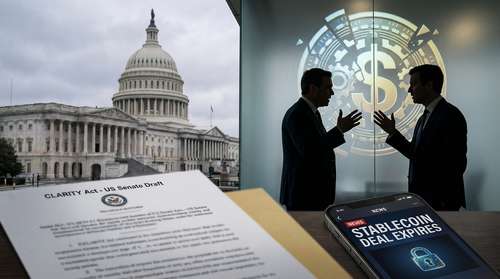
The path to comprehensive digital asset regulation in the United States hit a familiar roadblock this week. The White House’s March 1 deadline for a compromise on stablecoin rewards has expired without a deal, leaving the landmark Digital Asset Market Clarity Act (CLARITY Act) in legislative limbo. As of Tuesday morning, the Senate Banking Committee remains deadlocked, with a fierce lobbying war between Wall Street incumbents and crypto natives bringing negotiations to a standstill.
White House Ultimatum Ignored as Yield Dispute Festers
Executive Director of the White House Crypto Council, Patrick Witt, had set the first of the month as a hard target for resolving the contentious "yield versus reward" debate. The administration hoped to clear the lane for a Senate markup of H.R. 3633 before the spring recess. Instead, the deadline passed with silence, signaling that the rift between traditional banking interests and the digital asset sector is wider than previously thought.
At the heart of the stalemate is a technical but critical distinction: the difference between passive interest and activity-based rewards. While the GENIUS Act—signed into law in July 2025—explicitly banned stablecoin issuers from paying interest to prevent them from acting like unregulated banks, the CLARITY Act attempts to define what third-party platforms, such as exchanges and payment apps, can offer users.
The Core Conflict: Deposit Flight vs. User Incentives
Major banking lobbyists are digging in their heels, arguing that any form of return on a stablecoin balance—whether labeled a "reward" or "yield"—mimics a deposit account. Their primary fear is deposit flight. If a digital wallet can legally offer a 4% or 5% return on digital dollars without the overhead of a traditional bank charter, Wall Street warns that capital will flee the regulated banking system, destabilizing community lenders.
"The terminology doesn't matter to the average saver," noted one senior policy analyst familiar with the banking lobby's position. "If it looks like interest and acts like interest, it competes with insured deposits. We cannot have a shadow banking system operating under the guise of 'loyalty rewards.'"
Crypto Industry Pushes Back
Conversely, the crypto industry views these rewards as essential for network participation and customer loyalty. Summer Mersinger, CEO of the Blockchain Association, has been vocal in defending the industry's right to incentivize users. The crypto sector argues that banning all rewards would stifle innovation and hand traditional finance an unfair monopoly on value transfer.
Industry proponents emphasize that the proposed rewards in the CLARITY Act are not passive interest but are tied to specific on-chain activities, such as staking participation or transaction volume. Banning these, they argue, would be akin to prohibiting credit card points or airline miles.
Political Fallout and Market Structure Stalemate
The failure to meet the March 1 deadline puts the entire CLARITY Act at risk. The bill, which passed the House with a decisive 294-134 vote last summer, was designed to finally settle the jurisdictional turf war between the SEC and CFTC. Under the leadership of SEC Chair Paul Atkins and CFTC Chair Michael Selig, the agencies have begun to coordinate more closely, but statutory clarity from Congress remains the missing piece of the puzzle.
For the Senate Banking Committee, the inability to broker a truce raises questions about whether a market structure bill can pass in 2026. If the yield dispute isn't resolved soon, the bill risks being shelved as election season rhetoric heats up later this year.
What’s Next for Digital Asset Regulation?
Despite the setback, insiders remain cautiously optimistic that a narrow pathway to a deal exists. Sources suggest that a compromise could involve capping the percentage of rewards or strictly defining "bona fide" network participation to rule out passive holding schemes. However, until ink is put to paper, the US crypto market remains in a state of regulatory purgatory.
Investors and firms are now looking to the end of March as the new unofficial checkpoint. If the Banking Committee cannot schedule a markup by then, the CLARITY Act—and the regulatory certainty it promises—may be pushed into 2027.