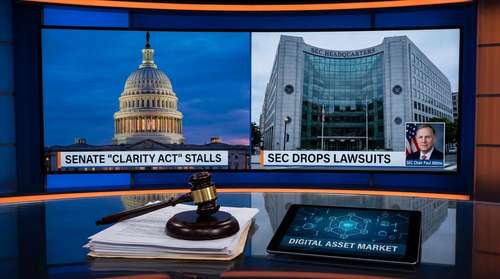
A high-stakes political showdown has paralyzed the U.S. Senate Banking Committee this week, leaving the landmark Digital Asset Market Clarity Act (the “CLARITY Act”) in legislative limbo. The deadlock on Capitol Hill comes at a volatile moment for the industry, coinciding with a controversial move by Securities and Exchange Commission (SEC) Chair Paul Atkins to formally dismiss the agency’s remaining legacy enforcement actions against major crypto exchanges. The dual developments—legislative gridlock and regulatory retreat—have ignited a fierce debate in Washington over the future of SEC crypto regulation 2026.
Senate Deadlock: The ‘Clarity’ Paradox
The Senate Banking Committee, chaired by Sen. Tim Scott (R-SC), was scheduled to mark up the much-anticipated CLARITY Act on Thursday. However, negotiations collapsed late Sunday after Coinbase, the largest U.S. crypto exchange, publicly withdrew its support for the bill. The legislation, designed to settle the long-standing CFTC vs SEC jurisdiction war, hit a wall over a last-minute provision that would ban “stablecoin rewards”—effectively prohibiting platforms from paying yield on idle digital dollar balances.
“We cannot support a bill that masquerades as clarity while quietly banning the fundamental utility of digital assets,” a Coinbase spokesperson stated on Sunday, just 48 hours before the scheduled vote. The reversal left Chairman Scott scrambling to salvage the crypto market structure bill, which had previously enjoyed tentative bipartisan support. For many industry advocates, the legislative path has become a double-edged sword: while they craved statutory legitimacy in 2025, the draconian amendments added in committee have made the status quo suddenly look more appealing.
Atkins Clears the Deck: A New Era for the SEC
While the Senate stalls, the regulatory landscape is shifting tectonically at the SEC. On Monday, Chair Paul Atkins—appointed by President Trump with a mandate to end the “war on crypto”—took the unprecedented step of filing motions to dismiss pending civil litigation against several high-profile firms, effectively ending the agency's multi-year legal crusades. This move fulfills a key promise of Atkins’ “Project Crypto” agenda, signaling a definitive pivot away from the “regulation by enforcement” strategy of his predecessor.
“The era of litigating market structure in the courtroom is over,” Atkins wrote in a memo to agency staff obtained by CryptoVOT. “We are returning the SEC to its core mission of capital formation and disclosure, not innovation suppression.” The dismissals reportedly cover the remaining charges against major exchanges that had dragged on since 2023, clearing the legal overhang that has depressed the market for years. However, this unilateral disarmament has drawn sharp rebukes from consumer protection advocates and Democratic lawmakers.
Democrats Allege ‘Regulatory Capture’
The sudden drop of lawsuits has sparked fury among Senate Democrats. In a heated press conference Tuesday morning, senior Banking Committee members accused the SEC of “regulatory capture” and jeopardizing investor safety. “Walking away from these lawsuits isn’t deregulation; it’s a capitulation to corporate interests,” argued one prominent senator. The US crypto legislation update has now become a partisan battleground, with Democrats threatening to filibuster the CLARITY Act unless strict investor protection amendments are restored—amendments that the industry has already rejected.
The Stablecoin Sticking Point
At the heart of the legislative breakdown is the stablecoin regulatory framework. Traditional banking lobbyists have aggressively pushed for language in the CLARITY Act that would treat stablecoin issuers like narrow banks, stripping non-bank entities of the ability to offer interest-bearing products. For the crypto industry, which sees yield generation as a “killer app” for decentralized finance (DeFi), this is a red line.
Analysts warn that if the CLARITY Act fails to pass before the mid-term campaigning season begins, the U.S. could remain without a federal framework until 2027. Ironically, with Atkins at the helm of the SEC, the industry may no longer feel the urgency to compromise. With the threat of enforcement removed, the incentive for crypto firms to accept a flawed Senate bill has evaporated, leaving Chairman Scott with a difficult choice: water down the bill to appease the industry, or watch his signature legislative achievement die in committee.
Outlook for 2026
As of Tuesday, the path forward remains murky. Chairman Scott has vowed to bring the bill to a vote “within weeks,” but the coalition supporting it has fractured. Meanwhile, the market has reacted positively to the SEC’s retreat, with major tokens rallying on the news of the dropped lawsuits. But for those seeking durable legal certainty, the victory is bittersweet. Without the Digital Asset Market Clarity Act, the U.S. market remains dependent on the whims of appointed regulators—a pendulum that could easily swing back in the future.