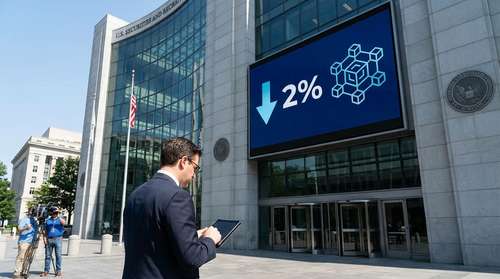
In a watershed moment for the digital asset industry, the U.S. Securities and Exchange Commission (SEC) has issued landmark guidance allowing broker-dealers to apply a mere 2% capital "haircut" to eligible payment stablecoins. Announced on February 19, 2026, and detailed in a new Division of Trading and Markets FAQ, this move effectively treats qualifying stablecoins on par with money market funds, slashing the prohibitive 100% deduction that had previously stifled institutional crypto adoption. The policy shift, spearheaded by SEC Chair Paul Atkins' SEC crypto agenda, signals the agency's decisive pivot from enforcement to modernization under the newly launched "Project Crypto" initiative.
The 2% Solution: Redefining SEC Crypto Net Capital Rules
For years, registered broker-dealers faced a stark choice: avoid stablecoins entirely or accept a crippling capital penalty. Under the old interpretation of the Net Capital Rule (Rule 15c3-1), stablecoins were deemed assets without a "ready market," forcing firms to deduct 100% of their value when calculating liquid capital reserves. This effectively made holding USDC or similar assets for settlement purposes financially toxic.
The new SEC stablecoin guidance 2026 changes the calculus overnight. By recognizing specific payment stablecoins as having a "ready market," the SEC has aligned their regulatory treatment with that of short-term U.S. Treasury securities and money market funds. "A 2% haircut changes the game entirely," noted Tonya Evans, a board member at Digital Currency Group. "It transforms stablecoins from a balance sheet liability into a viable instrument for working capital and real-time settlement."
GENIUS Act Implementation Paves the Way
This regulatory thaw is not happening in a vacuum; it is a direct precursor to the full GENIUS Act implementation. The "Guiding and Establishing National Innovation for U.S. Stablecoins" (GENIUS) Act, passed by Congress in late 2025, established a federal floor for stablecoin issuers, mandating strict reserve composition and public transparency.
The SEC's new guidance leverages these legislative standards. To qualify for the payment stablecoin capital haircut, an asset must be issued by a state-regulated trust company or national bank and backed 1:1 by cash or high-quality liquid assets. Commissioner Hester Peirce, in her concurring statement titled "Cutting by Two Would Do," emphasized that these requirements are actually "more limiting than the eligible securities requirements" for money market funds, justifying the reduced risk weighting.
Winners and Losers: Not All Stablecoins Qualify
Crucially, the guidance creates a bifurcated market. While transparent, onshore issuers like Circle (USDC) and Paxos are expected to meet the criteria immediately, offshore entities may struggle. Analysts suggest that the strict audit and reserve requirements essentially screen out opaque issuers, reinforcing the "flight to quality" that institutional investors have demanded. This regulatory filter is expected to drive massive liquidity toward compliant, U.S.-regulated tokens.
Unlocking Institutional Crypto Adoption
The practical implications for crypto broker-dealer regulation are immense. With the capital penalty removed, traditional financial giants like Goldman Sachs and Robinhood can now hold stablecoins directly to facilitate 24/7 settlement of tokenized securities. This removes a major friction point in the market structure—the need to constantly convert between fiat and crypto rails.
"Stablecoins are now working capital," explained Larry Florio, Deputy General Counsel at Ethena Labs. By allowing broker-dealers to custody and trade these assets efficiently, the SEC has effectively integrated the "backbone" of on-chain commerce into the traditional financial plumbing. This integration is a core pillar of Chair Atkins' broader strategy to onshore digital asset innovation and reverse the "regulation by enforcement" era.
What's Next for the SEC Crypto Agenda?
While the 2% haircut is a headline-grabbing victory, it is just the first step in Chair Atkins' ambitious roadmap. Sources indicate that "Project Crypto" will next address custody rules for non-security digital assets and potentially introduce an "innovation exemption" for decentralized trading platforms.
For now, the message to Wall Street is clear: The barriers to entry are falling. With the SEC stablecoin guidance 2026 providing the necessary regulatory clarity, the infrastructure for a fully modernized, tokenized capital market is finally open for business.