
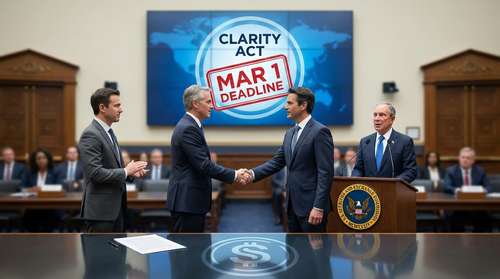
The White House has issued a strict March 1, 2026, deadline for lawmakers and industry leaders to reach a compromise on the stalled Digital Asset Market Clarity Act (CLARITY Act). The ultimatum comes as negotiations remain deadlocked over a controversial amendment that could ban third-party platforms from offering interest or yields on stablecoins. With the Senate Banking Committee poised to mark up the bill, the administration is pushing hard to resolve the standoff between the banking sector, which fears deposit flight, and crypto platforms that argue yield restrictions will cripple the U.S. digital asset economy.
The High-Stakes Battle Over Stablecoin Yields
At the heart of the impasse is a fierce debate over how stablecoins—digital assets pegged to the U.S. dollar—should be treated compared to traditional bank deposits. While the previously passed GENIUS Act already prohibits stablecoin issuers from paying interest directly to holders, the CLARITY Act debate has shifted to third-party intermediaries like exchanges and DeFi protocols.
During a tense meeting at the White House earlier this week, banking industry representatives circulated a document titled "Yield and Interest Prohibition Principles." Their proposal seeks a broad ban on any entity offering financial or non-financial rewards to stablecoin holders, arguing that such products function as unregulated, high-yield savings accounts that threaten the stability of community banks.
In response, the Digital Chamber released its own "Stablecoin Reward Principles," advocating for exemptions that would allow for transaction-based rewards and returns generated through decentralized finance (DeFi) protocols. Crypto advocates warn that a blanket ban would drive innovation offshore to jurisdictions like Hong Kong and the EU, where regulations are becoming increasingly favorable.
SEC Chairman Paul Atkins Backs Legislative Solution
Amid the legislative wrangling, SEC Chairman Paul Atkins has emerged as a vocal proponent of the CLARITY Act. Testifying before the Senate Banking Committee on February 12, Atkins emphasized that a statutory framework is essential to "future-proof" the U.S. financial system, rather than relying on piecemeal enforcement actions.
Speaking at ETHDenver just days later, Atkins signaled a shift in regulatory tone, revealing that the agency is considering an "innovation exemption" for tokenized securities. This proposed framework would allow firms to experiment with blockchain-based trading and settlement under a temporary safe harbor.
"It is not the regulator's job to worry about the daily swings of the markets," Atkins told attendees, pushing back against calls for emergency intervention during the recent market dip. His comments reinforced the agency's focus on structural rulemaking over price stabilization, a stance that has garnered cautious optimism from industry leaders.
The Coinbase Ultimatum
The stakes were raised further when Coinbase, a central figure in the negotiations, threatened to withdraw its support for the CLARITY Act if the restrictive yield amendment remains. The exchange has argued that preventing users from earning rewards on their assets would stifle the consumer benefits of digital finance.
The Senate Banking Committee indefinitely postponed its initial markup in January following this pushback. Now, with the White House's March 1 deadline looming, pressure is mounting on Patrick Witt, the President's crypto adviser, to broker a final deal that satisfies both Wall Street and the crypto faithful.
What Happens If the Deadline Is Missed?
Failure to reach a compromise by March 1 could derail the CLARITY Act entirely for the 2026 legislative session. With midterm elections approaching in November, lawmakers are eager to pass a win, but the window for complex financial legislation is closing fast.
If the bill stalls, the industry would likely remain in a regulatory gray area, relying on the conflicting interpretations of the SEC and CFTC. However, sources close to the negotiations describe recent discussions as "productive," suggesting that a middle ground—perhaps allowing yield only for active staking or specific utility-based activities—might be within reach.
As the clock ticks down, the crypto market is watching closely. The outcome of this battle will not only define the rules for stablecoins but likely set the trajectory for the entire U.S. digital asset industry for the next decade.