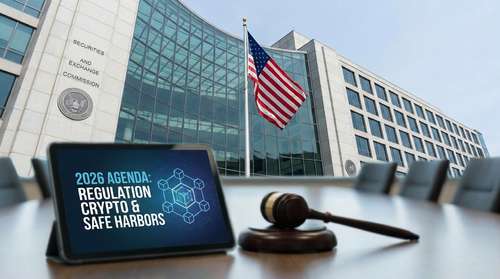

Washington, D.C. — A heated political battle has erupted on Capitol Hill this week as SEC Chair Paul Atkins faced a barrage of criticism from Congressional Democrats over his agency’s aggressive pivot toward a more industry-friendly regulatory framework. At the center of the controversy is “Project Crypto,” a newly unveiled joint initiative between the Securities and Exchange Commission (SEC) and the Commodity Futures Trading Commission (CFTC) designed to overhaul the federal approach to digital assets.
During contentious oversight hearings before the House Financial Services Committee on February 11 and 12, Atkins defended the initiative as a necessary “bridge toward legislation” aimed at ending years of regulatory ambiguity. However, Ranking Member Maxine Waters (D-CA) and other Democrats blasted the move as a capitulation to corporate interests, accusing the agency of dismantling investor protections and prioritizing “crypto billionaires” over the public interest.
“Project Crypto” and the Push for a Token Taxonomy
Officially launched in late January 2026, Project Crypto represents the most significant attempt yet to harmonize the often-conflicting jurisdictions of the SEC and CFTC. In his testimony, Chair Atkins described the initiative as a collaborative effort to establish a formal crypto token taxonomy. This classification system aims to clearly delineate which digital assets constitute securities and which are commodities, a distinction that has plagued the industry for over a decade.
“We intend to provide a bridge toward legislation,” Atkins told lawmakers, signaling that the agency is moving away from the “regulation by enforcement” strategy that characterized the previous administration. The initiative also includes exploring “innovation exemptions” that would allow market participants to conduct certain transactions on-chain without facing immediate enforcement actions, provided they comply with disclosure requirements.
The project aligns closely with the proposed Digital Asset Market Clarity Act of 2025 (the CLARITY Act), which Atkins urged Congress to pass. Until then, he argued, the joint SEC-CFTC taxonomy will serve as a critical interim measure to provide the regulatory certainty that innovators have long demanded.
Waters Leads Political Firestorm Over "Billionaire" Bias
The hearings quickly turned volatile as Representative Maxine Waters launched a blistering attack on Atkins’ leadership. Waters accused the SEC Chair of orchestrating a “Wall Street and billionaire holiday” by rolling back enforcement and softening rules. She specifically targeted the agency's recent maneuvers, including the withdrawal of 14 major proposals she claimed were vital for retail investor protection.
“This SEC is now putting Wall Street and billionaires first and America’s investors last,” Waters declared. The fiercest exchanges centered on the SEC’s decision to pause or dismiss high-profile enforcement cases, including the civil fraud case against Tron founder Justin Sun. Democrats raised alarms over potential conflicts of interest, citing Sun’s reported $75 million investment in World Liberty Financial (WLFI), a crypto project with links to the family of former President Donald Trump.
When pressed on whether political connections were influencing enforcement decisions, Atkins maintained that the agency operates on a “merit-neutral” basis. He declined to discuss specific ongoing matters in a public setting but offered to provide confidential briefings to the committee. The defense did little to quell the outrage from Democrats, who warned that the agency’s independence was being compromised.
SAB 122 and the End of "Regulation by Enforcement"
Adding fuel to the fire is the SEC's firm commitment to SAB 122 guidance, which replaced the controversial Staff Accounting Bulletin 121. While SAB 121 effectively barred highly regulated banks from holding crypto assets by requiring them to be recorded as liabilities, the new SAB 122 framework allows for off-balance-sheet treatment of safeguarded assets. This shift has been hailed by the banking sector as a game-changer that opens the door for traditional financial institutions to offer crypto custody services.
For Atkins and his supporters, SAB 122 represents a return to standard accounting principles and a rejection of punitive measures designed to choke off the industry. “We are returning the agency to its core mission,” Atkins stated, emphasizing a focus on “real fraud” — such as Ponzi schemes and theft — rather than technical registration violations by legitimate businesses.
Critics, however, argue that this relaxation invites systemic risk. During the hearing, Representative Stephen Lynch (D-MA) pointed out that enforcement actions have dropped by roughly 60% since the leadership change, a statistic he argued emboldens bad actors. Atkins countered that the agency remains vigilant but is prioritizing clear rules over endless litigation.
A New Era of SEC-CFTC Harmonization
Despite the political vitriol, the coordination between the SEC and CFTC marks a historic shift in U.S. crypto policy. CFTC Chair Mike Selig, working in lockstep with Atkins, has directed his staff to co-develop the new taxonomy, effectively ending the turf wars that left market participants caught in the crossfire.
As US crypto regulation 2026 takes shape, the industry is watching closely. If Project Crypto succeeds, it could finally unlock the institutional capital that has been sitting on the sidelines. But with Congressional Democrats vowing to fight these changes at every turn, the path to a permanent legislative solution remains a minefield of partisan politics.