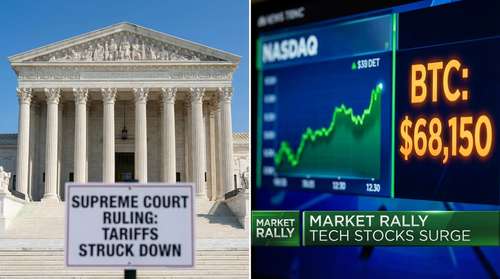
The United States Supreme Court delivered a stunning blow to President Donald Trump’s economic agenda on Friday, striking down his sweeping global tariffs in a decisive 6-3 ruling. The decision, which invalidates the controversial levies imposed under emergency powers, has triggered an immediate relief rally across global markets. Bitcoin price $68k is holding steady, demonstrating remarkable resilience, while the Nasdaq tech rally signals renewed investor appetite for risk assets. As the dust settles on this historic legal battle, Wall Street and the crypto sector are recalibrating for a trade landscape suddenly freed from the grip of indefinite executive protectionism.
Supreme Court Rulings Curbs Presidential Trade Power
In a landmark opinion authored by Chief Justice John Roberts, the Court ruled that the International Emergency Economic Powers Act (IEEPA) does not grant the President the authority to impose broad tariffs on foreign goods. The ruling specifically targets the "Liberation Day" tariffs enacted in April 2025, which had placed heavy duties on imports from dozens of nations.
The 6-3 decision saw a unique coalition of justices. Chief Justice Roberts, joined by Justices Gorsuch and Barrett, invoked the "major questions doctrine," arguing that Congress must speak clearly if it intends to delegate such vast economic power to the Executive Branch. The Court’s three liberal justices joined the majority based on the text of the statute itself. "IEEPA contains no reference to tariffs or duties," Roberts wrote, dismantling the legal foundation of the administration's trade war.
This Supreme Court tariff ruling 2026 is being hailed by legal experts as a significant reassertion of Congressional authority over trade policy. However, the political fallout was immediate. President Trump, clearly infuriated, blasted the decision as "deeply disappointing" and "shameful," vowing to continue his "America First" protectionist policies through other means.
Bitcoin Resilience: Holding the $68,000 Line
Amidst the geopolitical and legal chaos, the cryptocurrency market has shown surprising strength. Bitcoin price $68k has become a crucial psychological floor for traders. Following the ruling, the world's leading cryptocurrency rebounded from earlier weekly lows to trade near $68,150, defying fears of a broader liquidation event.
Market analysts point to strong on-chain data as a driver of this crypto market resilience. Reports indicate that "whales"—large volume investors—have accumulated approximately 200,000 BTC over the last month, absorbing selling pressure. This accumulation suggests that institutional players view the legal check on executive power as a long-term positive for decentralized assets, even as short-term volatility persists.
"The market is pricing in stability," notes a senior crypto strategist. "While the Bitcoin ETF flows February have been mixed, the underlying structure is bullish. Investors are rotating back into digital assets as a hedge against the lingering uncertainty of what the Administration might try next."
Nasdaq and Tech Stocks Surge on Relief
Traditional equities, particularly in the technology sector, greeted the ruling with enthusiasm. The Nasdaq tech rally gained momentum on Friday, closing up nearly 0.8% as fears of a protracted global trade war subsided. heavyweights like Nvidia, Meta, and Alphabet saw gains, driving the index higher.
The removal of the IEEPA tariffs is seen as a massive boon for tech companies, many of which rely on complex global supply chains that were threatened by the levies. The global trade policy impact of the ruling effectively lowers costs for hardware manufacturers and reduces the risk of retaliatory measures from key trading partners in Europe and Asia.
Despite sticky inflation data—with Core PCE rising 3.0%—investors are betting that the removal of inflationary tariffs will give the Federal Reserve more breathing room later in 2026. This sentiment fueled a "risk-on" rotation, lifting the tech-heavy Nasdaq and providing a tailwind for the broader S&P 500.
Trump Strikes Back: New 150-Day Tariff Threat
While the markets celebrated, the White House wasted no time in firing a return volley. Hours after the ruling, Trump tariff news today shifted from defeat to defiance. The President announced he would implement a new 10% global tariff using Section 122 of the Trade Act of 1974. Unlike the indefinite IEEPA tariffs, these new levies are capped by law to a maximum of 150 days unless extended by Congress.
"We have powerful alternatives," Trump declared, attempting to reassure his base. However, market analysts remain skeptical that a temporary, time-bound tariff carries the same economic weight as the previous indefinite regime. The move is largely seen as a political stopgap rather than a structural shift in trade policy.
Looking Ahead: Volatility or Stabilization?
As traders digest the Supreme Court tariff ruling 2026, the focus now shifts to the Federal Reserve and corporate earnings. The immediate threat of a runaway trade war has been neutralized, but the tug-of-war between the Executive Branch and the Judiciary is likely far from over.
For now, the resilience of Bitcoin at $68,000 and the surge in tech stocks suggest that the market believes the worst of the tariff drama is in the rearview mirror. Investors are cautiously optimistic, betting that the checks and balances of the U.S. government will continue to provide a guardrail for the global economy.