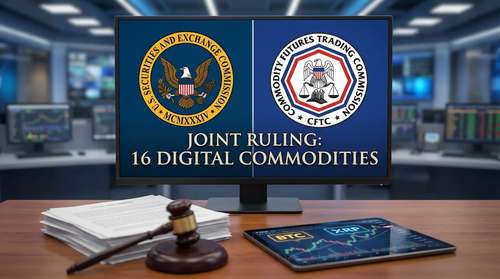
In a watershed moment for the financial technology sector, the era of regulation by enforcement has officially ended. On March 17, 2026, federal regulators issued an unprecedented SEC CFTC crypto ruling that definitively classifies 16 major cryptocurrencies—including Bitcoin, Ethereum, and XRP—as digital commodities. This 68-page binding joint interpretive document provides the exact crypto legal framework the industry has spent over a decade fighting for, establishing clear market rules for developers, digital exchanges, and Wall Street participants. By aligning both major U.S. financial regulators, this historic action eliminates the jurisdictional turf wars that have historically stifled domestic innovation and pushed blockchain companies overseas.
The Five-Tier Taxonomy and Digital Commodity Classification
Signed simultaneously at the DC Blockchain Summit by regulators representing the Paul Atkins SEC and CFTC Chairman Michael Selig, the directive entirely reshapes the landscape of US crypto regulation 2026. Rather than treating all tokens as a monolithic asset class, the agencies established a rigorous five-category taxonomy: digital commodities, digital collectibles, digital tools, stablecoins, and digital securities. Only digital securities will remain strictly under SEC purview.
The most consequential aspect of the release is its explicit digital commodity classification for 16 specific assets. The confirmed list spans the entire digital ecosystem. It includes foundational infrastructure networks like Bitcoin (BTC), Ethereum (ETH), and Solana (SOL), alongside highly utilized chains such as Cardano (ADA), Avalanche (AVAX), Chainlink (LINK), Polkadot (DOT), Hedera (HBAR), and Aptos (APT). Regulators also extended this definitive digital commodity classification to payment and community-driven assets, explicitly naming Litecoin (LTC), Bitcoin Cash (BCH), Stellar (XLM), Tezos (XTZ), Dogecoin (DOGE), and Shiba Inu (SHIB).
Beyond asset labels, the agencies clarified that vital network activities—namely protocol mining, staking, non-security token wrapping, and most standard airdrops—do not constitute securities transactions. This critical distinction shields network validators, node operators, and liquid staking providers from future enforcement actions, paving the way for advanced decentralized finance applications to operate safely within the United States.
XRP Commodity Status: Closing a Contentious Legal Chapter
For veteran market participants, perhaps the most highly anticipated revelation in the new SEC CFTC crypto ruling was the definitive XRP commodity status. Ripple spent more than four years and hundreds of millions of dollars litigating against the Securities and Exchange Commission over whether the XRP token was an unregistered security. That prolonged legal battle cost the XRP ecosystem billions in missed market development opportunities and forced widespread exchange delistings.
Tuesday’s final interpretive rule officially closes that contentious chapter. By naming XRP alongside Bitcoin and Ethereum as a digital commodity under CFTC jurisdiction, the government has eliminated the single biggest regulatory overhang suppressing the asset's utility. The confirmation of XRP commodity status means every trading platform that previously halted transactions out of caution can now operate with full federal backing. This pivot acknowledges a crucial reality that industry advocates have heavily stressed: a token's regulatory status should depend on its ongoing programmatic function and network decentralization, rather than the initial fundraising circumstances of its early launch.
Unlocking Massive Institutional Crypto Investment
The collaborative and pragmatic tone of the Paul Atkins SEC marks a dramatic departure from the combative posture of prior administrations. Chairman Atkins explicitly noted during the summit that his agency is no longer functioning as the "securities and everything commission," signaling a return to capital formation principles. By formally transferring spot market oversight for these 16 massive assets to the Commodity Futures Trading Commission, this latest SEC CFTC crypto ruling has dismantled the primary psychological and legal barrier blocking widespread institutional crypto investment.
Top-tier asset managers, sovereign wealth funds, and traditional banking institutions mandate absolute regulatory certainty before deploying client capital. The new crypto legal framework finally provides that guaranteed security. Wall Street institutions can now confidently build custody solutions, offer direct spot exposure to their clients, and structure complex, yield-bearing financial products around these network tokens. Because of this clarity, there is no longer a looming threat of retroactive enforcement actions disrupting multi-million dollar trading operations. As a result, analysts project a massive influx of institutional crypto investment over the coming quarters.
What Comes Next for US Crypto Regulation 2026?
While global markets are rightfully celebrating this monumental milestone, legal experts caution that an interpretive release—even a binding joint one backed by both agency chairs—is fundamentally different from a permanent statute enacted by Congress. The ultimate, long-term permanence of this regulatory shift relies on the swift passage of the CLARITY Act.
This comprehensive digital asset market structure legislation is specifically designed to enshrine the SEC and CFTC's new token taxonomy into bulletproof federal law. Having successfully passed the House of Representatives in July 2025 and subsequently clearing the Senate Agriculture Committee earlier this January, the bill remains pending before the full Senate. Market lobbyists are highly optimistic that this joint regulatory endorsement will provide the necessary bipartisan momentum to push the legislation over the finish line and solidify the current US crypto regulation 2026 framework.
Until the CLARITY Act officially lands on the President's desk for signature, this joint interpretation serves as the supreme operational baseline for the modern digital asset economy. It represents the most significant regulatory victory for blockchain innovators in history, fundamentally derisking the sector and setting the stage for the next massive wave of institutional and retail adoption.