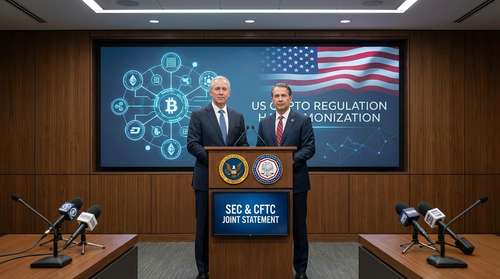
In a watershed moment for the U.S. digital asset industry, Securities and Exchange Commission (SEC) Chairman Paul Atkins and Commodity Futures Trading Commission (CFTC) Chairman Michael Selig have announced a historic joint initiative to harmonize federal oversight of the cryptocurrency markets. The announcement comes as the Senate Agriculture Committee prepares for a high-stakes markup of the Digital Commodities Intermediary Act this Thursday, aiming to codify the regulatory truce into law.
The joint effort, described by insiders as the "final piece of the puzzle" for President Trump's vision to crown the United States as the "crypto capital of the world," marks a decisive end to the era of regulation by enforcement. With SEC CFTC harmonization 2026 becoming the central theme of the new administration's financial policy, the two agencies are moving rapidly to dismantle the jurisdictional silos that have stifled American innovation for a decade.
Historic Handshake: Atkins and Selig's Shared Vision
The coordinated push was originally set to be unveiled Tuesday morning but has been rescheduled for a joint appearance at CFTC headquarters on Thursday, January 29. The timing is intentional, aligning the regulators' public show of unity with the Senate's legislative schedule. Chairman Atkins, whose "Project Crypto" initiative has already seen a 60% drop in enforcement actions against digital asset firms since 2025, emphasized that the days of ambiguity are over.
"For too long, market participants have been forced to navigate regulatory boundaries that are unclear in application and misaligned in design," Atkins said in a preliminary statement. "We are building a framework where innovation takes root on American soil, under American law."
CFTC Chairman Michael Selig, a former partner at Willkie Farr & Gallagher and previous counsel to the SEC's Crypto Task Force, is the ideal counterpart for this harmonization. Having taken the helm at the CFTC just last month, Selig has moved quickly to position his agency as the primary watchdog for the digital spot markets. His "principles-based" approach contrasts sharply with previous administrations, focusing on fraud prevention rather than technical prescriptive rules.
The Legislative Lynchpin: Digital Commodities Intermediary Act
While the regulators shake hands, the real battleground remains on Capitol Hill. The Senate Agriculture Committee is set to mark up the Digital Commodities Intermediary Act on Thursday. This critical piece of crypto market structure legislation seeks to grant the CFTC exclusive jurisdiction over "digital commodities," a category Atkins has agreed includes the vast majority of cryptocurrencies, including Bitcoin and Ethereum.
The bill establishes a clear registration regime for crypto exchanges and stablecoin issuers, treating them akin to traditional commodities brokers. However, the path to passage is fraught with last-minute hurdles. A competing, more comprehensive bill from the Senate Banking Committee—the "Digital Asset Market Clarity Act"—has stalled after losing support from key industry players like Coinbase due to restrictive provisions on decentralized finance (DeFi).
The 'Poison Pill' Threat
Industry optimism is currently tempered by a controversial amendment filed by Senators Roger Marshall (R-Kan.) and Dick Durbin (D-Ill.). In a move that has baffled crypto lobbyists, the senators are attempting to attach the Credit Card Competition Act—a completely unrelated measure regarding credit card routing mandates—to the crypto bill.
"This is a classic poison pill," notes regulatory analyst Sarah Jenkins. "By attaching controversial credit card legislation to a bipartisan crypto bill, they risk sinking the entire US crypto regulation update right at the finish line. If the Marshall amendment passes during markup, we could see the industry pull its support entirely."
End of the 'Turf War'?
Despite the legislative drama, the executive branch's alignment is unprecedented. Under the Paul Atkins SEC crypto policy, the agency has already begun issuing "no-action" letters to firms that demonstrate compliance with the proposed CFTC disclosure standards, effectively treating the unpassed legislation as the de facto rule of law.
This harmonization effort aims to resolve the "security vs. commodity" debate that defined the Gensler era. By conceding that assets on sufficiently decentralized networks are commodities, Atkins is effectively ceding territory to Selig’s CFTC in exchange for stricter disclosure requirements around initial token distributions—a compromise that industry leaders have welcomed.
As Thursday approaches, all eyes are on the Senate Agriculture Committee. If the Digital Commodities Intermediary Act survives the markup without the credit card amendment, and if Atkins and Selig deliver a convincing roadmap for joint oversight, 2026 could indeed be the year the U.S. finally cements its status as the global leader in digital finance.