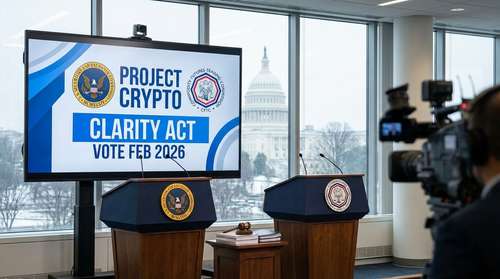
In a historic move that signals the end of a decade-long regulatory tug-of-war, the Securities and Exchange Commission (SEC) and Commodity Futures Trading Commission (CFTC) have officially operationalized Project Crypto. This joint initiative, formalized during a landmark inter-agency summit in Washington D.C. this week, aims to harmonize the fractured U.S. digital asset market structure just as the Senate Banking Committee schedules a decisive vote on the CLARITY Act for late February 2026.
'Project Crypto' Ends the Turf War
For years, the U.S. crypto industry has navigated a minefield of conflicting guidance, with the SEC and CFTC often asserting overlapping jurisdiction. That era appears to be over. Speaking from a shared podium, SEC Chair Paul Atkins and CFTC Chair Michael Selig unveiled the operational framework of Project Crypto, a bi-agency task force designed to execute a "minimum effective dose" regulatory strategy.
"Modern markets do not divide neatly along the lines drawn in the 1930s," Chair Atkins stated, marking a sharp pivot from the enforcement-heavy approach of his predecessor. "Project Crypto is our commitment to a unified taxonomy. If an asset functions as a commodity, it will be treated as one, without the fear of a surprise subpoena from a sister agency."
The initiative introduces a Joint Digital Asset Taxonomy Council (JDATC), which will issue binding classifications for the top 100 digital assets by market cap within 90 days. This mechanism directly addresses the "regulation by enforcement" criticism that has long plagued the sector, promising clear lanes for issuers and exchanges to operate within the United States.
Senate Moves to Pass CLARITY Act by Feb 28
While regulators align their enforcement playbooks, the legislative gears are finally turning. Senate leadership has fast-tracked the Digital Asset Market Clarity Act (CLARITY Act) for a floor vote before the end of February. Widely viewed as the spiritual successor to the historic FIT21 bill passed by the House, the CLARITY Act provides the statutory bedrock for Project Crypto's administrative reforms.
The bill's momentum follows an intense week of negotiations involving the White House, which has renewed its pledge to cement the U.S. as the "crypto capital of the planet." However, the path to passage remains tight. The legislation faced a near-fatal stall in late January when industry heavyweights, including Coinbase, raised alarms over a provision effectively banning third-party yield on stablecoins.
The Stablecoin Yield Controversy
One of the most contentious aspects of the current draft is the treatment of stablecoin yield legislation. The original text barred platforms from passing yield generated by reserve assets to end-users—a revenue model critical for many exchanges. Sources close to the Senate Banking Committee suggest a last-minute compromise is being drafted to allow "qualified yield-bearing stablecoins" under strict disclosure regimes, a move intended to bring major industry players back to the table.
A New Digital Asset Market Structure for 2026
If passed, the CLARITY Act will radically reshape the digital asset market structure in 2026. Key provisions include:
- Provisional Registration: Exchanges can register jointly with the SEC and CFTC through a single portal, a core deliverable of Project Crypto.
- Safe Harbors: A 24-month grace period for decentralized networks to achieve "sufficient decentralization" before facing full compliance requirements.
- Tokenization Greenlight: Explicit legal frameworks for banks to custody and trade tokenized real-world assets (RWAs).
"We are witnessing the maturing of an asset class," said legal analyst Mara Goodman. "The coordination between Atkins and Selig is unprecedented. They aren't just tolerating crypto; they are building the infrastructure to onshore it."
Industry Reacts to Policy Shift
The market has reacted cautiously but optimistically to the news. With Paul Atkins' SEC crypto policy prioritizing clarity over litigation, institutional capital is reportedly preparing for re-entry. However, the final language regarding stablecoins remains the wild card. As the February deadline looms, all eyes are on the Senate floor. A successful vote would not only codify the Project Crypto framework but also serve as the most significant update to U.S. financial laws in nearly a century.